Better Enforcement of Grievous Offenses by unNaturalized Emigrants Act or the BE GONE Act This bill expands, for immigration purposes, the definition of aggravated felony to include sexual abuse, sexual assault, and aggravated sexual violence. (Under current law, a conviction for an aggravated felony is grounds for deportation and may bar an individual from other immigration-related benefits.)
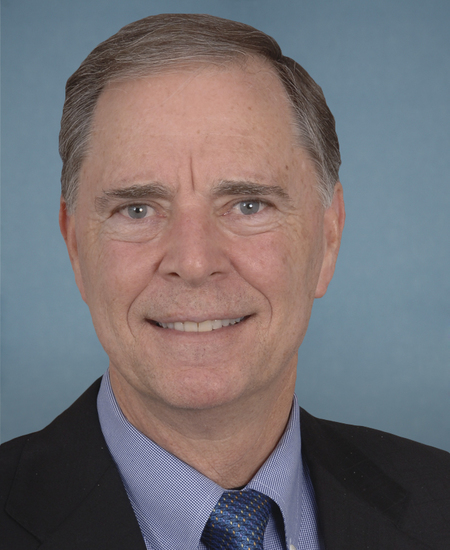
Rep. Bill Posey
Sponsored bills
Fentanyl Penalties Parity Act This bill modifies the drug quantity thresholds that trigger a mandatory minimum prison term for a defendant who manufactures, distributes, imports, exports, or possesses with intent to distribute fentanyl. Specifically, the bill reduces from 400 to 20 grams the fentanyl quantity and from 100 to 5 grams the fentanyl analogue quantity that trigger a mandatory minimum prison term for high-level first-time or repeat offenders. It also reduces from 40 to 2 grams the fentanyl quantity and from 10 to 0.5 grams the fentanyl analogue quantity that trigger a mandatory minimum prison term for low-level first-time or repeat offenders.
Safeguards Ensuring Criminal and Unvetted Refugees don't Enter America Act or the SECURE America Act This bill imposes restrictions on the admission of aliens, including refugees, and addresses related issues. Specifically, no refugees may be admitted until Congress enacts a joint resolution setting the maximum number of refugees allowed to be admitted in a particular fiscal year. Currently, that number is set each fiscal year by the President. The Department of Homeland Security (DHS) must notify Congress at least 30 days before determining that an alien or class of aliens is eligible for refugee status. Congress may nullify the determination by enacting a joint resolution of disapproval. Further, an alien shall be inadmissible for holding certain beliefs, such as (1) believing that a system of religious law should be implemented in the United States, (2) believing that the alien does not need to learn English if the alien is not already fluent, or (3) any belief that the Department of State determines is incompatible with the principles of the United States. DHS may not parole into the United States an alien who does not have status under immigration law. Currently, DHS may provide parole in certain instances, including for urgent humanitarian reasons. Federal agencies must notify a state at least 30 days before resettling a refugee in that state. The refugee may not be resettled in that state if the state expresses disapproval. An alien who has committed a crime of violence (generally one involving the use or threat of physical violence against person or property) may not be eligible for refugee status and must be removed.
Defending Students' Civil Rights Act of 2021 This bill prohibits the use of critical race theory or critical race pedagogy in any federally funded program or activity. Specifically, the bill includes the use of critical race theory or critical race pedagogy as a violation of Title VI of the Civil Rights Act of 1964, which prohibits discrimination based on race, color, or national origin in federally funded programs or activities. The bill defines critical race pedagogy as the separation of students or teachers, or the assignment of characteristics or assumptions, based on race, color, or national origin. The bill defines critical race theory as a curriculum that establishes specified principles relating to race or sex, including that (1) one race or sex is inherently superior to another, (2) the United States is fundamentally racist or sexist, and (3) an individual bears responsibility for the past actions of others of the same race or sex.
No Frivolous Application for Short-Barreled Shotguns Act or the NFA SBS Act This bill removes certain short-barreled shotguns from the definition of firearms for purposes of the National Firearms Act. It also eliminates the prohibition on the sale or transportation of such shotguns in interstate commerce and treats persons who acquire or possess a short-barreled shotgun as meeting the registration or licensing requirements for such shotguns where such requirements are determined by reference to the National Firearms Act. The bill preempts state or local laws that impose a tax or recordkeeping requirements on short-barreled shotguns. The Department of Justice must destroy records relating to the registration of shotguns described by this bill within one year after the enactment of this bill.
No Taxpayer Funding for the Central American Minors Program Act This bill prohibits using federal funds to carry out the Central American Minors program, a Department of Homeland Security and Department of State program that reunites qualified children from El Salvador, Guatemala, and Honduras with their parent who is lawfully present in the United States.
Transparency of Migration Act This bill requires the Department of Homeland Security and the Department of Health and Human Services (HHS) to make publicly available online certain information about individuals unlawfully present in the United States who are (1) apprehended by U.S. Customs and Border Protection and sent to a federal detention center or released into the United States, or (2) processed through an HHS facility. This information must be updated weekly and must include daily numbers, the country of origin of such individuals, and other details.
Nuclear Family Priority Act This bill imposes limits on various types of family-sponsored immigration visas. The alien parents of U.S. citizens shall not qualify for visas for immediate relatives , which are not subject to any direct numerical limits. Currently, the spouses, unmarried children under 21, and parents of citizens are considered immediate relatives. The bill also creates a nonimmigrant visa for such parents of citizens. Such aliens shall not be eligible for employment or any public benefits. The bill also reduces the baseline annual cap for family-sponsored visas from 480,000 to 88,000, and revises the methods for calculating the cap. Currently, the 480,000 cap may be adjusted depending on various factors but shall not be less than 226,000. Preference allocations (visa categories subject to various annual caps) for various family-sponsored visas shall be eliminated, including those for the siblings and married children of citizens. The bill provides for a preference allocation for the unmarried children under 21 and spouses of permanent residents, subject to the 88,000 annual cap.
No Vaccine Passports for Americans Act This bill restricts collection and disclosure of an individual's vaccination status, including for COVID-19 vaccinations. It also makes it unlawful to discriminate based on COVID-19 vaccination status and to mandate vaccination in certain circumstances. Specifically, the bill prohibits the use of federal funds to establish or collaborate with federal, state, private, or international systems that track or monitor an individual's COVID-19 vaccination status. Additionally, federal agencies must destroy existing records that contain information about an individual's COVID-19 vaccination status within 30 days. Furthermore, agencies may not issue vaccine passports or similar standardized documentation of COVID-19 vaccination status. The bill also prohibits discrimination based on COVID-19 vaccination status or willingness to provide documentation of vaccination status in employment, public accommodations, and certain public programs and services. Remedies and enforcement mechanisms available under federal civil rights laws apply to violations under this bill. In addition, federal privacy standards for health information must prohibit the disclosure of non-anonymized information about the status of any vaccination without a patient's express consent. Moreover, the bill makes anyone who requests an individual's vaccination status subject to these standards. The bill temporarily bans (1) mandates for vaccines authorized for use under emergency procedures, and (2) administration of those vaccines to minors or individuals who lack capacity to consent to vaccinations without the consent of their parent or guardian. It also prohibits public disclosure of an individual's COVID-19 vaccination status without express, written consent. Violations of these prohibitions are subject to criminal and civil penalties.

Firearm Due Process Protection Act This bill expands the grounds for pursuing judicial remedies related to certain firearm transfers. Additionally, the bill establishes procedural rules applicable to actions for judicial remedies. Current law authorizes judicial remedies for an individual who is erroneously denied a firearm (e.g., an individual is denied a firearm but the individual is eligible to receive or possess a firearm). This bill authorizes remedies for an individual who experiences an extended delay (i.e., a delay of more than 60 days) on a firearm transfer. Additionally, the bill requires an expedited hearing on an action for judicial remedies and places the burden of proof on the respondent to show by clear and convincing evidence that the individual was ineligible to receive or possess a firearm.