

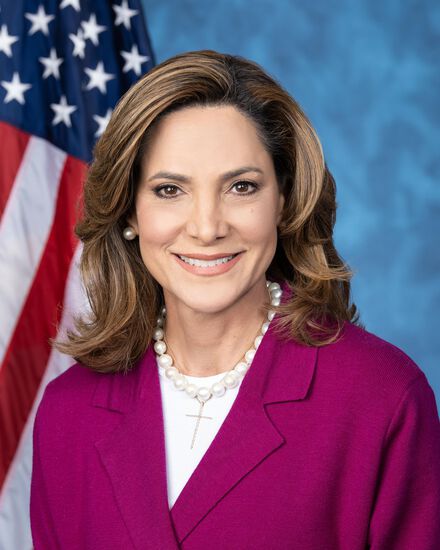
Photo of Maria Elvira Salazar
R United States House · District 27 · Florida On the 2026 ballot

Rep. Maria Elvira Salazar

Compare
Total votes
2,831
all sessions
Attendance
92%
221 missed
Lower than 95% of chamber peers
With party
90%
of cast votes
Near the chamber average
Bipartisan score
5%
crosses aisle rarely
Near the chamber average
Sponsored
1,434
bills & resolutions
Near the chamber average
Committees
7
assignments
1,434 bills and resolutions

Sponsored bills

Total
1,434
Primary
73
Co-sponsor
1,361
This page
1,434
matching current filters
Co-sponsor HR 4700
In committee · United States House · Co-sponsor
PRIME Act

Maddy summaryThe PRIME Act exempts custom slaughter facilities from federal meat inspection requirements when they follow state laws and sell meat exclusively within the same state. It specifically allows facilities to slaughter animals and prepare meat without federal oversight if the products go only to household consumers or local businesses (like restaurants, hotels, or grocery stores) serving consumers directly in that state. The bill clarifies that this exemption does not override stricter state regulations governing custom slaughter or meat sales. This primarily affects small-scale slaughter operations and local food businesses operating within a single state's borders.

In committee Jul 23, 2025 1 co-sponsor
Co-sponsor HR 4698
In committee · United States House · Co-sponsor
PAAW Act

Maddy summaryHR 4698, the PAAW Act, prohibits the National Institutes of Health (NIH) from conducting or funding research that causes significant pain or distress to dogs or cats. This directly affects NIH-funded studies involving these animals, specifically banning research assigned to USDA-defined severe pain categories (D or E). The law takes effect 90 days after enactment and relies on existing USDA pain classification standards under the Animal Welfare Act. It creates a clear policy change limiting NIH research involving dogs and cats when severe pain is anticipated.

In committee Jul 23, 2025 1 co-sponsor
Co-sponsor HR 4335
In committee · United States House · Co-sponsor
Abraham Accords Defense Against Terror Act

Maddy summaryHR 4335, the Abraham Accords Defense Against Terror Act, streamlines U.S. defense exports to countries that have normalized relations with Israel (via the Abraham Accords) and cooperate with the U.S. on countering Iran and Iran-aligned threats in the Middle East and North Africa. The bill authorizes the Secretary of State to identify qualifying countries and fast-tracks approval for military sales, leases, or transfers to them, requiring a 15-day congressional notification with specific safeguards. Key safeguards include ensuring sensitive U.S. technology isn’t shared with China or Russia and mandating regular strategy reports to Congress on implementation, threat assessments, and pending defense deals over $25 million. This directly affects participating Middle Eastern nations and U.S. defense export processes, aiming to accelerate security cooperation without altering Israel’s military edge. The bill focuses on procedural changes to expedite defense cooperation, not on new funding or policy outcomes.

In committee Jul 22, 2025 1 co-sponsor
Co-sponsor HR 1144
In committee · United States House · Co-sponsor
Frederick Douglass Trafficking Victims Prevention and Protection Reauthorization Act of 2025

Frederick Douglass Trafficking Victims Prevention and Protection Reauthorization Act of 2025   This bill reauthorizes programs and activities that combat international trafficking; establishes a new program to help victims of trafficking; and updates various elements of the federal framework to combat international trafficking. Specifically, this bill reauthorizes through FY2029 programs and activities at various federal departments and agencies to combat international trafficking and reduce the prevalence of modern slavery. The bill also reauthorizes International Megan’s Law through FY2029. Among its provisions, the law requires sex offenders to provide certain information about their intended travel outside of the United States. Additionally, the bill authorizes the Department of Health and Human Services to carry out a new program to help victims of trafficking integrate or reintegrate into society. The bill requires the Department of State's Trafficking in Persons Report to include information about trafficking in persons for the purposes of organ removal.  With respect to country rankings for anti-trafficking efforts, the bill narrows the types of countries that are listed on the Tier 2 Watch List and increases the length of time a country may remain on the Tier 2 Watch List after being downgraded to the lowest ranking and then reinstated to the watch list. (The Tier 2 Watch List refers to countries that are making efforts to meet international standards for combatting human trafficking but still have a significant number of severe trafficking cases.)   Finally, the bill requires counter-trafficking strategies, activities, and efforts to be further incorporated into U.S. foreign assistance.

In committee Jul 22, 2025 1 co-sponsor
Co-sponsor HR 4577
In committee · United States House · Co-sponsor
Defending American Property Abroad Act of 2025

Maddy summaryThe Defending American Property Abroad Act of 2025 protects U.S. property interests in Western Hemisphere countries with U.S. free trade agreements. It requires the Secretary of Homeland Security to identify and list ports, harbors, or marine terminals where a foreign government has nationalized, expropriated, or seized U.S.-owned land (since January 2024) through actions like contract repudiation or forced control. Once listed, the President must prohibit vessels using these sites from importing goods, docking passenger vessels, or conducting maintenance in the United States. This directly affects U.S. persons (citizens or businesses) with property in designated locations.

In committee Jul 21, 2025 1 co-sponsor
Co-sponsor HR 4568
In committee · United States House · Co-sponsor
Supporting Upgraded Property Projects and Lending for Yards (SUPPLY) Act

Maddy summaryThe SUPPLY Act establishes a federal program to insure second loans (additional financing) for building accessory dwelling units (ADUs) on single-family properties. This insurance, administered by the Department of Housing and Urban Development, covers up to 30% of a standard one-unit home loan amount or 100% of the property value after construction (with potential increases based on 50% of projected rental income). Homeowners seeking to add ADUs - such as backyard cottages, converted basements, or detached units - can use this insurance to secure financing, with a government premium of up to 1% annually. The bill also requires Fannie Mae and Freddie Mac to purchase and securitize these insured loans, potentially expanding access to ADU financing.

In committee Jul 21, 2025 1 co-sponsor
Co-sponsor HR 4558
In committee · United States House · Co-sponsor
To designate the area between the intersections of 16th Street Northwest and Fuller Street Northwest and 16th Street Northwest and Euclid Street Northwest in Washington, District of Columbia, as "Oswaldo Payá Way".

Maddy summaryThis bill (HR 4558) renames a specific street segment in Washington, D.C., between 16th Street Northwest and Fuller Street Northwest, and between 16th Street Northwest and Euclid Street Northwest, to "Oswaldo Payá Way." It also redesignates the address 2630 16th Street Northwest as 2630 Oswaldo Payá Way. The bill requires the District of Columbia to install two new street signs matching the city's standard Metro station sign design at the intersections. This is a purely ceremonial designation with no policy changes or new requirements for citizens or government agencies.

In committee Jul 21, 2025 1 co-sponsor
Co-sponsor HR 4531
In committee · United States House · Co-sponsor
BANNED in Latin America Act

Maddy summaryHR 4531, the BANNED in Latin America Act, requires the U.S. Secretary of State to create a strategy within 180 days to counter Iranian and Hezbollah influence operations in Latin America. The strategy must include specific actions like limiting Iranian cultural centers promoting Iranian ideology, restricting travel of Iranian agents through visa denials or sanctions, strengthening U.S. intelligence monitoring of these networks, disrupting Iranian media platforms (HispanTV) and Hezbollah media (Al Mayadeen Espanol), and addressing Al Mustafa International University's radicalization role. The bill directly affects Iranian and Hezbollah entities operating in Latin America through diplomatic, financial, and travel restrictions. It mandates this strategy be submitted to Congress, with specific provisions targeting their propaganda, cultural, and media activities. The bill focuses on concrete policy mechanisms to counter these groups' influence, not on direct sanctions or military action.

In committee Jul 17, 2025 1 co-sponsor
Co-sponsor HR 4486
In committee · United States House · Co-sponsor
Microplastics Safety Act

Maddy summaryHR 4486, the Microplastics Safety Act, requires the FDA (within the Department of Health and Human Services) to study the health impacts of microplastics in food and water. The study must identify major exposure pathways and examine effects on children's health, the endocrine system, cancer, chronic illness, and reproductive health. The FDA must submit a report to Congress within one year of the bill's enactment, detailing the study's findings and recommending potential legislative or administrative actions. This bill does not impose new regulations or bans but mandates a federal study to inform future policy decisions.

In committee Jul 17, 2025 1 co-sponsor
Co-sponsor HR 1919
Passed · United States House · Co-sponsor
Anti-CBDC Surveillance State Act

Maddy summaryHR 1919, the "Anti-CBDC Surveillance State Act," prohibits the Federal Reserve from developing, testing, or issuing any central bank digital currency (CBDC) or similar digital assets. It specifically bans the Fed from offering direct financial products to individuals, maintaining individual accounts, or issuing CBDCs directly or indirectly through intermediaries like banks. The bill also blocks the Fed from using any digital asset for monetary policy and clarifies that physical currency's privacy protections remain intact. This policy directly affects the Federal Reserve System's ability to create or manage digital monetary tools.

Passed Jul 17, 2025 1 co-sponsor
Showing 221 to 230 of 1,434 bills
Previous 1 … 22 23 24 … 144 Next