

Maddy summaryThe America's College Promise Act of 2023 would make community college tuition free for eligible students by creating a Federal-State partnership where the federal government covers most of the cost. For the 2024-2025 academic year, the federal government would pay 100% of tuition costs for eligible students at community colleges, decreasing to 80% by 2028-2029. States would provide the remaining share, starting at 0% for 2024-2025 and increasing to 20% by 2028-2029. The bill requires states to implement reforms to improve student outcomes, including transfer pathways between community colleges and four-year institutions, as well as support services for underrepresented students. Tribal colleges and universities would receive different funding rules, with the federal government potentially covering 100% of costs.
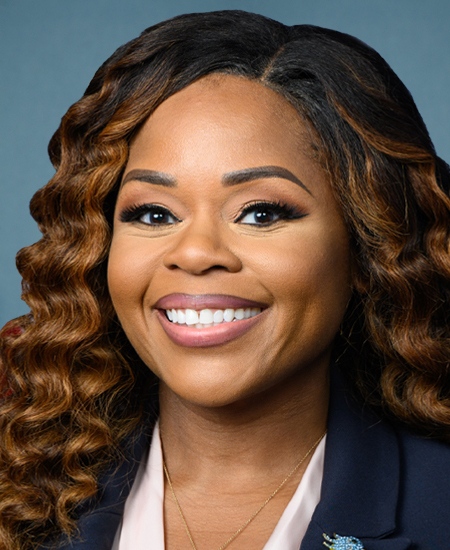
Rep. Sheila Cherfilus-McCormick
Sponsored bills
Keeping Drugs Out of Schools Act of 2023 This bill allows the Office of National Drug Control Policy to award grants for eligible entities to implement school-community partnerships for preventing and reducing substance use and misuse among youth. Eligible entity refers to a coalition that (1) is a Drug-Free Communities funded coalition on or before the date on which the coalition submits a grant application, and (2) has a memorandum of understanding in effect with not less than one local school to establish a school-community partnership.
Maddy summaryThis bill authorizes the presentation of a Congressional Gold Medal to the United Negro College Fund (UNCF) and its member Historically Black Colleges and Universities (HBCUs) to recognize the UNCF's 80-year service. It directs the U.S. Treasury to strike the medal and sell bronze duplicates to cover costs, with proceeds going to the U.S. Mint. The medal commemorates the UNCF's role in supporting HBCUs and African-American students through scholarships and fundraising, as detailed in the bill's findings. The measure is purely ceremonial and does not create new policy or funding.
Maddy summaryHR 5895 amends the Higher Education Act to allow historically Black colleges and universities (HBCUs) to use existing grant funds for specific arts-related activities. The bill adds new provisions enabling HBCUs to provide financial assistance to arts students, establish arts outreach programs, offer wraparound student services (like mentorship and career advising), maintain Black art collections, and create paid arts internships through partnerships. This directly affects HBCUs by expanding how they can allocate current funding to strengthen their arts programs and support Black artists. The key mechanism is modifying Section 323 of the Higher Education Act to include these new uses, with optional partnerships with the National Endowment for the Arts.
Maddy summaryHCONRES 68 is a symbolic resolution expressing the House of Representatives' support for recognizing September 26, 2023, as "World Contraception Day." It states the House's "sense" that Congress and the Administration should work to improve universal, affordable access to contraception for all people who may become pregnant, both domestically and globally. The resolution calls for evidence-based policies to address disparities in access, expand comprehensive sex education, and support programs like Title X family planning services, without creating new laws or funding. It directly affects all individuals seeking reproductive health care, particularly those facing barriers due to race, income, location, or gender identity. The resolution does not mandate action but outlines policy priorities for future consideration.
Maddy summaryThe Youth, Peace, and Security Act of 2023 requires the U.S. government to increase meaningful youth engagement in peacebuilding and conflict prevention efforts globally. The bill mandates the development of a U.S. Foreign Assistance Youth, Peace, and Security Action Plan within one year, focusing on inclusive participation of diverse youth aged 10-29, particularly marginalized groups including girls, LGBTQI+ youth, and youth with disabilities. It authorizes $5.5 million for grants to youth-led organizations working on peacebuilding, conflict resolution, community violence intervention, and post-conflict recovery. The legislation also establishes a USAID Youth Coordinator role to oversee implementation and requires U.S. foreign assistance programs to integrate youth participation in decision-making processes. The Act aims to address barriers to youth involvement in peace processes while ensuring safety, security, and equitable access to resources for young people in conflict-affected areas.
Reducing Obesity in Youth Act of 2023 This bill requires the Centers for Disease Control and Prevention, in coordination with the Administration for Children and Families, to award grants to nonprofits, institutions of higher education, or consortia of these entities to promote healthy eating and physical activity and address food insecurity among children in early care and education settings.
Maddy summaryThis bill directs the CDC to launch public education campaigns about blood clot risks, symptoms, and prevention, with special focus on high-risk groups including Black Americans, cancer patients, seniors, and hospitalized individuals. It creates a new 18-month advisory committee to study DVT/PE data collection, develop prevention guidelines, and recommend improved care standards for at-risk patients. The bill also mandates a federal study on electronic health record systems for better DVT/PE surveillance and authorizes $20 million annually for these efforts through fiscal year 2029. These provisions aim to reduce preventable deaths and improve early diagnosis, directly affecting millions at risk of blood clots nationwide.
Maddy summaryThis bill adds a new student loan deferment option for individuals who experienced sex-based harassment. It allows eligible students to pause loan payments for up to 3 years (in periods of 3-12 months) if they reduced their course load due to harassment and submitted documentation to a covered individual (like a Title IX coordinator or healthcare provider). It also waives requirements for students to return federal grants or loans if they withdrew due to harassment and are using the new deferment. The policy directly affects students enrolled in institutions covered under the Higher Education Act who report harassment under defined terms, including sexual harassment, dating violence, domestic violence, stalking, or sexual assault.
Maddy summaryThis bill replaces "Columbus Day" with "Indigenous Peoples’ Day" as the official federal holiday observed on the second Monday in October. It directly affects federal government operations and all federal documents, rules, or laws that previously referenced "Columbus Day" by automatically updating those references to "Indigenous Peoples’ Day" upon enactment. The key mechanism is a simple amendment to federal law (5 U.S.C. § 6103(a)) to change the holiday name and a provision ensuring all existing federal references to Columbus Day are legally treated as referring to Indigenous Peoples’ Day instead. This is a procedural change to federal holidays and references, not a new policy or program.