

Extreme Risk Protection Order Act of 2021 This bill establishes grants to support the implementation of extreme risk protection order laws at the state and local levels, extends federal firearms restrictions to individuals who are subject to extreme risk protection orders, and expands related data collection. Extreme risk protection order laws, or red flag laws, generally allow certain individuals (e.g., law enforcement officers or family members) to petition a court for a temporary order that prohibits an at-risk individual from purchasing and possessing firearms. Among its provisions, the bill directs the Office of Community Oriented Policing Services within the Department of Justice to establish a grant program to help states, local governments, Indian tribes, and other entities implement extreme risk protection order laws; extends federal restrictions on the receipt, possession, shipment, and transportation of firearms and ammunition to individuals who are subject to extreme risk protection orders; and requires the Federal Bureau of Investigation to compile (and later destroy) records from federal, tribal, and state courts and other agencies that identify individuals who are subject to extreme risk protection orders.
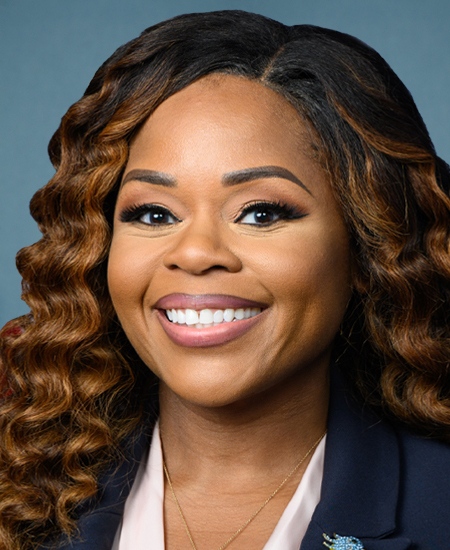
Rep. Sheila Cherfilus-McCormick
Sponsored bills
Original National Domestic Violence Awareness Month Resolution of 2022 This resolution supports the goals and ideals of National Domestic Violence Awareness Month. Further, it expresses the sense of the House of Representatives that Congress should continue to raise awareness of and support programs to end domestic violence.
Major Richard Star Act This bill provides that combat-disabled uniformed services retirees with fewer than 20 years of creditable service may concurrently receive, without reduction, veterans' disability compensation and retired pay or combat-related special compensation.
Manufacturing Jobs for Veterans Act of 2022 This bill requires the Department of Labor, as part of the Veteran's Workforce Investment Program, to implement the Veterans Manufacturing Employment Program to award competitive grants to three states for the establishment and administration of a State Manufacturing Employment Program. Such program must provide grants to manufacturing employers and joint-labor management organizations that provide eligible veterans with training, on-the-job training, apprenticeships, and training that leads to a recognized postsecondary credential. Eligible veterans are those who are employed by a manufacturing employer and enrolled or participating in a specified training, on-the-job training, apprenticeship, or certification class.
Reviewing the Effects of Programs, Orders, and Rules with Thorough Study Act or the REPORTS Act This bill requires federal agencies, when publishing notice of a proposed major rule, to include an analysis of the rule's potential impact on low-income individuals and racial inequity. The Government Accountability Office must annually report on the impact of certain programs on low-income individuals and racial inequity.
This concurrent resolution commemorates the 50th anniversary of the enactment of the Federal Water Pollution Control Act Amendments of 1972, commonly known as the Clean Water Act.
This resolution recognizes the accomplishments of Roberto Clemente, the first Puerto Rican to be elected to the National Baseball Hall of Fame, and urges Major League Baseball to retire the number 21 in honor of his life and legacy.
Global Food Security Reauthorization Act of 2022 This bill reauthorizes through FY2028 activities to implement the Global Food Security Strategy, a whole-of-government strategy to promote global food security, resilience, and nutrition. The bill also modifies aspects of the strategy, such as requiring the strategy to seek to improve the efficiency and resilience of agricultural production. The bill also reauthorizes through FY2028 activities related to the Emergency Food Security Program, an international market-based assistance program.
Mental Health Matters Act This bill requires certain federal actions to increase access to mental and behavioral health care. Among other provisions, the bill creates various grants to increase the number of school-based mental health services providers, establishes requirements for institutions of higher education concerning students with disabilities, prohibits arbitration and discretionary clauses in employer-sponsored benefit plans under the Employee Retirement Income Security Act of 1974, and establishes an occupational research program on mental health.
This bill designates the facility of the United States Postal Service located at 3900 Crown Road Southwest in Atlanta, Georgia, as the John R. Lewis Post Office Building.