Fresh Start Act of 2022 This bill establishes a federal statutory process to expunge records related to certain nonviolent criminal offenses. The bill defines the nonviolent offenses eligible for expungement; it establishes qualifications for an eligible offender; and it sets forth procedures for filing an expungement petition.
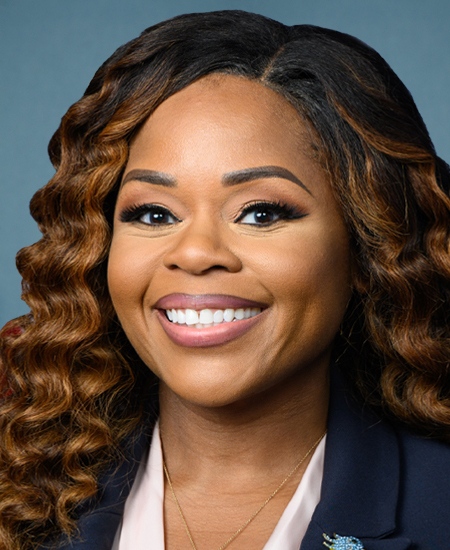
Rep. Sheila Cherfilus-McCormick
Sponsored bills
Protect Black Women and Girls Act of 2021 This bill establishes an Interagency Task Force to examine the conditions and experiences of Black women and girls to identify and assess the efficacy of policies and programs of federal, state, and local governments designed to improve outcomes for such individuals and to make recommendations to improve such policies and programs. The task force shall (1) cover issues involving Black women and girls in education, economic development, health care, justice and civil rights, and housing; and (2) submit recommendations at specified intervals to Congress, the President, and each state or local government on policies, practices, programs, and incentives that may be adopted to improve outcomes. The U.S. Commission on Civil Rights shall conduct a comprehensive study and collect data with respect to the effects on Black women and girls of a wide range of specified economic, health, criminal justice, and social services factors.
Repeal Existing Policies that Encourage and Allow Legal HIV Discrimination Act of 2022 or the REPEAL HIV Discrimination Act of 2022 This bill addresses federal and state laws, policies, and regulations that may burden people living with HIV/AIDS. Specifically, the bill directs the Department of Justice (DOJ), the Department of Health and Human Services (HHS), the Department of Defense (DOD), and the White House Office of National AIDS Policy to initiate a national review of federal (including military) and state laws, policies, regulations, and judicial precedents and decisions regarding criminal and related civil commitment cases involving people living with HIV/AIDS. DOJ must transmit to Congress and make publicly available the results of such review with related recommendations. The White House Office of National AIDS Policy must also develop and publicly release guidance to assist states with handling relevant cases. The office, DOJ, HHS, and DOD must transmit to the President and Congress any proposals necessary to implement adjustments to federal laws, policies, or regulations. This bill shall not be construed to discourage the prosecution of individuals who act with the intent to do harm to another individual by intentionally transmitting HIV.

Commission on Americans Living Abroad Act of 2021 This bill establishes the Commission on Americans Living Abroad, which must report on how federal laws and policies affect U.S. citizens living abroad, including civilians and members of the Armed Forces. Each federal agency affected by a recommendation in the report shall submit a response to the President, Congress, and the commission.
Witness Security and Protection Grant Program Act of 2021 This bill directs the Department of Justice to award competitive matching grants to state, local, and tribal governments to establish or maintain witness protection programs in cases involving (1) a homicide, serious violent felony, or serious drug offense; or (2) gangs or organized crime.
Lifting Immigrant Families Through Benefits Access Restoration Act of 2021 or the LIFT the BAR Act of 2021 This bill repeals certain limits on the eligibility of noncitizens who lawfully reside in the United States for federal means-tested programs, including Medicaid, the Children's Health Insurance Program (CHIP), programs funded through Temporary Assistance for Needy Families (TANF) grants, Supplemental Security Income (SSI), and certain nutrition and housing programs.
Supreme Court Ethics Act This bill establishes a new statutory requirement for the Judicial Conference of the United States to issue a judicial code of conduct for judges and justices of U.S. courts, including Justices of the Supreme Court. Currently, the Judicial Conference issues a code of conduct for judges of U.S. courts (but not for Justices of the Supreme Court).
Gun Theft Prevention Act This bill makes various changes to federal firearms laws related to detecting and deterring the theft of firearms from federally licensed gun dealers. Among the changes, the bill establishes security requirements for gun dealers; background check requirements for employees of gun dealers; inspection requirements for the Bureau of Alcohol, Tobacco, Firearms and Explosives; and reporting requirements for individual gun owners.
Veterans Visa and Protection Act of 2021 This bill provides permanent resident status and citizenship eligibility to certain noncitizen veterans and addresses related issues. The Department of Homeland Security (DHS) must establish a program that allows (1) eligible noncitizen veterans outside of the United States to be admitted as permanent residents, and (2) eligible noncitizen veterans in the United States to obtain permanent resident status. Generally, an eligible noncitizen veteran under this bill is one who was not removed from the United States for certain crimes related to violence or national security. DHS may waive these eligibility requirements for humanitarian, family unity, public interest, or exceptional military service reasons. A noncitizen veteran who obtains permanent resident status under this bill shall be eligible for (1) naturalization through service in the Armed Forces, and (2) military and veterans benefits as if they had not been removed (or ordered removed) from the United States. For a noncitizen veteran in removal proceedings or subject to a final removal order, the Department of Justice (DOJ) must determine whether the veteran is eligible for permanent resident status under this bill. If the veteran is eligible, DOJ must adjust the veteran's status. The bill also protects noncitizen veterans or service members from being removed from the United States unless the veteran has been convicted of a crime of violence.
Counseling Not Criminalization in Schools Act This bill prohibits the use of federal funds for law enforcement officers in schools. It also establishes a grant program to replace law enforcement officers in schools with personnel and services that support mental health and trauma-informed services. Specifically, the bill prohibits the use of federal funds to hire, maintain, or train law enforcement officers in elementary or secondary schools. Further, it prohibits the use of public safety and community policing grants for law enforcement officers in schools. Additionally, the bill directs the Department of Education to award grants to local educational agencies to (1) replace law enforcement officers in elementary and secondary schools with personnel and services that support mental health and trauma-informed services, and (2) reform school safety and disciplinary policies to reflect evidence-based practices that do not rely on the criminal justice system. A recipient must use grants funds to hire or train specified staff. The bill prohibits the use of grant funds for (1) establishing or enforcing zero-tolerance school discipline policies, (2) purchasing or installing surveillance equipment (e.g., metal detectors), or (3) arming teachers or other school personnel.