This resolution condemns the acts of gun violence that led to the tragic loss of eight lives in Georgia on March 16, 2021.
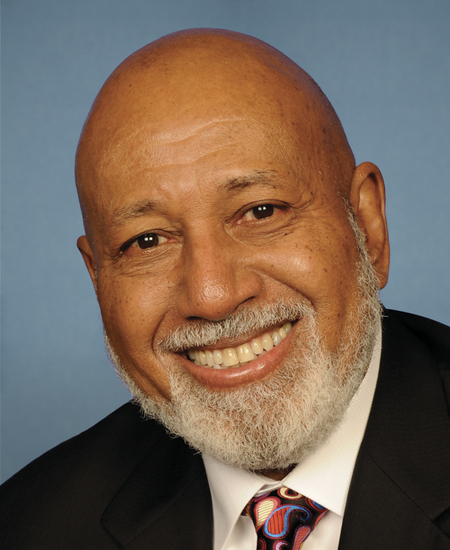
Rep. Alcee L. Hastings
Sponsored bills
Leadership Institute for Transatlantic Engagement Act or the LITE Act This bill establishes the Leadership Institute for Transatlantic Engagement to develop a diverse community of transatlantic leaders who are committed to democratic institutions. The institute shall award grants and develop programs, activities, and services that it considers appropriate for entities and individuals in the United States and abroad to (1) provide training and professional development opportunities for diverse leaders on democratic governance and international affairs, (2) enable international exchanges between leaders to increase understanding and knowledge of democratic models of governance, and (3) increase awareness of the importance of international public service careers in diverse communities.
Represent America Abroad Act of 2021 This bill requires the Department of State to establish the Represent America Mid-Career Foreign Service Entry Program to increase diversity in the Foreign Service by recruiting mid-career professionals who are from minority groups. As part of the program, the State Department shall (1) establish and publish eligibility criteria for participation; (2) carry out recruitment efforts to attract highly qualified, mid-career professionals from minority groups; and (3) include appropriate mentorship and other career development opportunities for program participants. The State Department must submit an annual report on the status of the program.
Ghost Army Congressional Gold Medal Act This bill directs the Speaker of the House of Representatives and the President pro tempore of the Senate to award a Congressional Gold Medal to the 23rd Headquarters Special Troops and the 3133d Signal Service Company, known as the Ghost Army , collectively, in recognition of its service during World War II.
Homeless Veterans with Children Reintegration Act This bill directs the Department of Labor to give homeless veterans with dependents service priority under homeless veterans reintegration programs.
This resolution expresses the sense of the House of Representatives that the federal government should begin a large-scale effort to reduce incarceration rates and reshape the American legal system by consulting with communities and individuals directly impacted by the justice system; decriminalizing certain behaviors, increasing diversion opportunities, revising sentencing laws, and reducing practices that contribute to recidivism; ending practices that advantage the wealthy and prohibiting private companies from profiting from the criminal justice system; and ending militarized policing practices, investing in other safety services, and implementing policies that address the needs of communities most affected by high rates of incarceration.
This resolution recognizes the forthcoming centennial of the Tulsa Race Massacre of 1921. The resolution acknowledges the historical significance of this event as one of the largest single instances of state-sanctioned violence against Black people in American history; honors the lives and legacies of the estimated 300 Black individuals who were killed during the massacre and the nearly 9,000 who were left homeless and penniless; condemns efforts to cover up the truth and shield the white community, especially government officials, from accountability; condemns the continued legacy of racism and white supremacy against Black people in the United States, particularly in the form of police brutality; encourages education about the massacre, the history of white supremacy that fueled the massacre, and subsequent attempts to deny or cover up the massacre, in all elementary and secondary education settings and in institutions of higher education; and recognizes the commitment of Congress to acknowledge and learn from the history of racism and racial violence to reverse the legacy of white supremacy and fight for racial justice.
This resolution expresses the sense of the House of Representatives that it is the duty of the federal government to expand and strengthen the care economy. The care economy consists of child care, home health, and similar sectors where caregiving is a predominant feature of the work.
Medicare for All Act of 2021 This bill establishes a national health insurance program that is administered by the Department of Health and Human Services (HHS). Among other requirements, the program must (1) cover all U.S. residents; (2) provide for automatic enrollment of individuals upon birth or residency in the United States; and (3) cover items and services that are medically necessary or appropriate to maintain health or to diagnose, treat, or rehabilitate a health condition, including hospital services, prescription drugs, mental health and substance abuse treatment, dental and vision services, and long-term care. The bill prohibits cost-sharing (e.g., deductibles, coinsurance, and copayments) and other charges for covered services. Additionally, private health insurers and employers may only offer coverage that is supplemental to, and not duplicative of, benefits provided under the program. Health insurance exchanges and specified federal health programs terminate upon program implementation. However, the program does not affect coverage provided through the Department of Veterans Affairs or the Indian Health Service. The bill also establishes a series of implementing provisions relating to (1) health care provider participation; (2) HHS administration; and (3) payments and costs, including the requirement that HHS negotiate prices for prescription drugs. Individuals who are age 18 or younger, age 55 or older, or already enrolled in Medicare may enroll in the program starting one year after enactment of this bill; other individuals may buy into the program at this time. The program must be fully implemented two years after enactment.

Hate Crimes Commission Act of 2021 This bill establishes the United States Commission on Hate Crimes. The commission must investigate and report on whether hate crimes have increased; factors that contributed to an increase in hate crimes, if one is determined to exist; policies or actions by law enforcement agencies to reduce the commission of hate crimes; the impact of underreporting on hate crimes statistics and prevention; and successful community bias prevention responses.