

Methane Waste Prevention Act of 2021 This bill establishes requirements to reduce methane emissions from the oil and natural gas sector. Methane is emitted during the production and transport of coal, natural gas, and oil. Specifically, the Environmental Protection Agency (EPA) must issue regulations that require the sector to reduce methane emissions over time. By 2025, methane emissions must be at least 65% below 2012 emissions. By 2030, the emissions must be at least 90% below 2012 emissions. The Department of the Interior must also establish regulations to reduce and prevent the waste of natural gas on federal land and Indian lands, including waste from venting, flaring, and fugitive releases. The regulations must include consistent enforcement mechanisms for any oil or gas operations that are not in compliance.
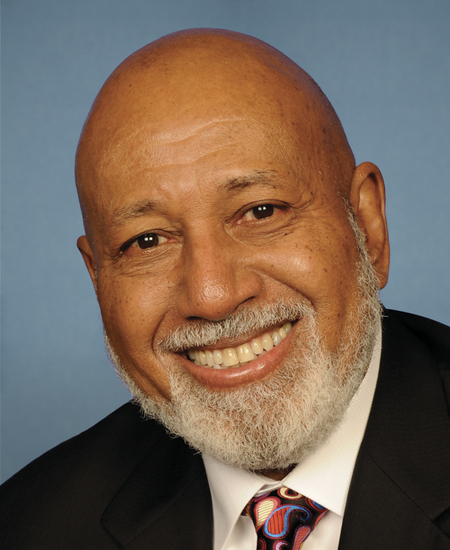
Rep. Alcee L. Hastings
Sponsored bills
Big Cat Public Safety Act This act revises requirements governing the trade of big cats (i.e., species of lion, tiger, leopard, cheetah, jaguar, or cougar or any hybrid of such species) under the Lacey Act to limit the possession, breeding, and exhibition of big cats. The Lacey Act prohibits any person from importing, exporting, buying, selling, transporting, receiving, or acquiring big cats across state lines or the U.S. border. However, some exemptions are provided for certain entities, such as universities and wildlife sanctuaries. (Sec. 3) The act expands the Lacey Act prohibitions to include a prohibition on possessing or breeding big cats. Breeding means facilitating propagation or reproduction (whether intentionally or negligently), or failing to prevent propagation or reproduction. Owners of big cats that were born before this act's enactment may keep their big cats, but the owners must register them with the U.S. Fish and Wildlife Service. The act modifies the list of entities that are exempt from prohibitions to export, buy, sell, transport, receive, acquire, possess, or breed big cats. The modified list includes exemptions for entities or facilities exhibiting animals to the public if they (1) hold a Class C license in good standing under the Animal Welfare Act, and (2) do not allow individuals to come into direct physical contact with big cats. However, direct contact is allowed if the individual is a trained professional, a veterinarian, or directly supporting conservation programs that do not involve commercial activities and meet other specified restrictions. (Sec. 4) A person who knowingly violates the act must be fined not more than $20,000, or imprisoned for no more than five years, or both. The act considers each violation to be a separate offense. The offense must be deemed to have been committed not only in the district where the violation first occurred, but also in any district in which the defendant may have taken or been in possession of the prohibited wildlife species. (Sec. 5) The act extends forfeiture provisions to fish, wildlife, or plants that are bred or possessed; thus, big cats bred or possessed in violation of the act are subject to forfeiture. (Sec. 6) The Department of the Interior must issue regulations to implement this act.
Rebuild America's Schools Act of 2022 This bill provides support for long-term improvements to public elementary and secondary school facilities. First, the bill sets forth allocations to states and establishes a need-based grant program for local educational agencies (LEAs) to improve school facilities. Further, the bill specifies allowable uses of grant funds, including carrying out major repairs, improving indoor air quality, and making facilities accessible to disabled individuals. Additionally, the bill requires LEAs that receive funds for new construction, modernization, or renovation projects to comply with hazard-resistance building codes and performance criteria under the WaterSense program of the Environmental Protection Agency. Further, the bill requires such LEAs to adopt certain green practices (environmental standards) and requires the use of iron, steel, and manufactured products that are made in the United States (Buy America). The bill restores school infrastructure tax credit bonds. The bill also sets forth reporting requirements, including annual reports on grant program projects and a report by the Government Accountability Office that requires a study of the geographic distribution of projects, the impact of selected projects on student and staff health and safety, and the accessibility of projects to high-poverty schools. The bill also establishes the Office of School Infrastructure and Sustainability within the Department of Education. Next, the bill extends through FY2027 the Impact Aid Construction program. Finally, the bill establishes a grant program to assist LEAs with repairing or replacing concrete foundations affected by pyrrhotite (an iron sulfide material linked to crumbling foundations).
VA Employee Fairness Act of 2021 This bill repeals provisions excluding any matter or question concerning professional conduct or competence; peer review; or the establishment, determination, or adjustment of employee compensation from the applicability of collective bargaining rights for Veterans Health Administration employees.
Sunshine Protection Act of 2021 This bill makes daylight savings time the new, permanent standard time. States with areas exempt from daylight savings time may choose the standard time for those areas.
Transparency in Energy Production Act of 2021 This bill requires certain disclosures by entities seeking a lease or holding a lease to develop renewable energy operations or fossil fuel operations on public lands or Indian lands or any operation using any right-of-way or special use permit that would cross public lands, Indian lands, or national forests that would facilitate fossil fuel development. The disclosures are those described in the Sustainability Accounting Standard for the Renewable Resources and Alternative Energy Sector or the Extractives and Mineral Processing Sector. Every two years, the Department of the Interior and the Department of Agriculture must report to Congress on such operations, including greenhouse gas emissions, air quality, water management, biodiversity impacts, production, and the number of sites. For renewable energy operations on public lands or Indian lands, the report must include greenhouse gas emissions that would result from the production of the same amount of energy using fossil fuels.
Bonding Reform and Taxpayer Protection Act of 2021 This bill revises bonding requirements for oil and gas development on public land leased from the federal government. Such bonds are required to ensure oil and gas developers have adequate financial resources for implementing reclamation plans to restore public land after oil and gas development (e.g., drilling operations) ceases. Specifically, the bill increases the bond amounts that oil and gas developers must provide prior to conducting surface-disturbing activities and requires such amounts to adjust at least once every three years for inflation. In addition, the bill sets fees to cover the cost for inspection and enforcement with respect to such leases. The bill also requires the Bureau of Land Management (BLM) and the U.S. Forest Service (USFS) to establish uniform standards for all interim and final reclamation plans. BLM and USFS may not release any bond amounts until the standards have been met by oil and gas developers and the inspection fees have been paid. Finally, the bill gives the U.S. Fish and Wildlife Service the authority to obtain and retain adequate financial assurances (e.g., bonds) from nonfederal entities to repair potential damages to resources of the National Wildlife Refuge System prior to the commencement of activities related to mineral development, such as oil and gas operations.
Brown v. Board of Education National Historical Park Expansion and Redesignation Act This bill redesignates the Brown v. Board of Education National Historic Site currently located in Topeka, Kansas, as the Brown v. Board of Education National Historical Park. Further, the bill expands the park to include additional sites in Clarendon County, South Carolina, and establishes as affiliated areas specified sites in Farmville, Virginia; Wilmington, Claymont, and Hockessin, Delaware; and the District of Columbia.
Restoring Resilient Reefs Act of 2021 This bill addresses the conservation and sustainability of coral reef ecosystems. Among other things, the bill reauthorizes through FY2024 and revises the Coral Reef Conservation Program; directs the National Oceanic and Atmospheric Administration (NOAA) to provide block grants to states to support state coral reef management and restoration; requires NOAA to establish standards for the formation of partnerships among government and community members for the stewardship of coral reefs; provides statutory authority for the U.S. Coral Reef Task Force to lead, coordinate, and strengthen federal government actions to preserve, conserve, and restore coral reef ecosystems; requires the Department of the Interior to provide grants upon the declaration of a coral reef emergency to implement emergency plans; authorizes Interior to provide scientific expertise, technical assistance, and financial assistance for the conservation and restoration of coral reefs; and establishes a National Coral Reef Management Fellowship Program.
Save Oak Flat Act This bill repeals the requirement for the Department of Agriculture to convey the 2,422 acres of Forest System land located in Tonto National Forest in Pinal County, Arizona, known as Oak Flat, to Resolution Copper Mining, LLC, in exchange for various parcels of land owned by Resolution Copper. Oak Flat is withdrawn from (1) entry, appropriation, or disposal under the public land laws; (2) location, entry, and patent under the mining laws; and (3) disposition under all laws pertaining to mineral and geothermal leasing or mineral materials.