

Reunite Every Unaccompanied Newborn Infant, Toddler and other children Expeditiously Act or the REUNITE Act This bill directs the Department of Homeland Security (DHS) and the Department of Health and Human Services (HHS) to reunite children and their parents or legal guardians who were apprehended for illegal entry into the United States. DHS and HHS shall develop procedures and programs, including procedures to (1) identify separated family members, (2) allow apprehended parents or legal guardians to have frequent no-cost contact with their separated children, and (3) coordinate with foreign consulates to locate apprehended individuals. DHS and HHS shall ensure immediate reunification of apprehended children with a parent or legal guardian, but may make exceptions for the child's safety. DHS and HHS may use DNA testing to determine family relationships, but shall first use other methods, such as official documents. DHS and HHS shall develop procedures for instances where the aliens refuse to consent to DNA testing. Collected DNA information may not be used for any purpose other than family reunification, including criminal or immigration enforcement. The bill restores the Family Case Management Program, an alternative to detention program that uses case managers to promote compliance with immigration law obligations. DHS, HHS, and the Department of Justice (DOJ) shall establish the Office for Locating and Reuniting Children with Parents. Aliens shall have access to counsel inside immigration detention facilities, and DOJ may provide counsel for immigration proceedings. DOJ shall provide counsel if necessary for children and vulnerable individuals, and children's cases shall be heard individually.
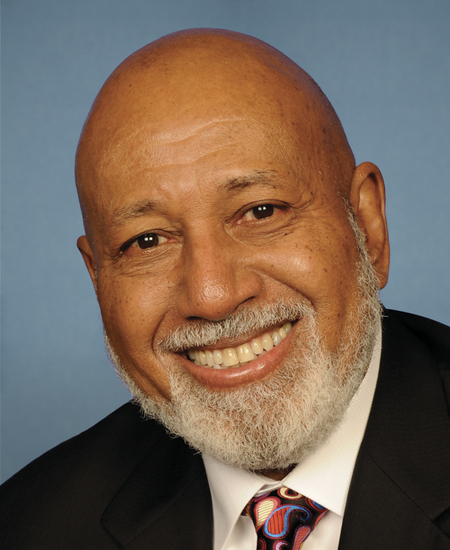
Rep. Alcee L. Hastings
Sponsored bills
Protecting Sensitive Locations Act This bill prohibits immigration enforcement actions within 1,000 feet of a sensitive location unless there are exigent circumstances and written prior approval has been obtained from certain officials. Sensitive locations include health care facilities; schools and school bus stops; places that provide assistance for people such as children, pregnant women, and abuse victims; places that provide disaster or emergency services; places of worship; courthouses and lawyers' offices; and public assistance offices. The prohibition shall apply to Department of Homeland Security officers and agents, as well as state employees pursuing immigration enforcement actions. If an enforcement action is carried out in violation of this prohibition (1) no information resulting from the action may be entered into the record in a resulting removal proceeding, and (2) the affected alien may move to immediately terminate such a proceeding. U.S. Immigration and Customs Enforcement and U.S. Customs and Border Protection shall annually report to Congress about enforcement actions taken at sensitive locations in the preceding year.
Insurrection Financing Transparency Act of 2021 This bill authorizes a law enforcement agency to require a reporting company (i.e., a corporation, limited liability company, or similar entity, subject to exceptions) to provide information about its beneficial owners if such information is required for an investigation into the attack on the U.S. Capitol on January 6, 2021. It imposes penalties for failing to report such information.
This joint resolution proposes a constitutional amendment authorizing Congress and the states to set reasonable limits on the raising and spending of money by candidates and others to influence elections. The amendment grants Congress and the states the power to implement and enforce this amendment by legislation. They are allowed to distinguish between natural persons and corporations or other artificial entities created by law, including by prohibiting such entities from spending money to influence elections.
This resolution honors Officers Brian Sicknick and Howard Liebengood of the U.S. Capitol Police, and it commends the bravery and service demonstrated by officers of the U.S. Capitol Police, the Metropolitan Police Department of the District of Columbia, and the other law enforcement agencies and protective entities that assisted in responding to the January 6, 2021, attack on the U.S. Capitol.
This resolution requires the House Committee on Ethics to investigate and report on whether (1) actions taken by Members of the 117th Congress seeking to overturn the 2020 Presidential election violated their oath of office; and (2) these Members should face sanction, including removal from the House of Representatives. It also condemns all targeted and malicious efforts to disenfranchise Black, Brown, and Indigenous voters.
This resolution censures and condemns President Donald J. Trump for asking the Georgia Secretary of State on January 2, 2021, to overturn the Georgia results of the November 2020 presidential election. It further calls on President Trump to (1) retract and disavow this behavior, and (2) acknowledge President-elect Joseph R. Biden as the victor of the November 2020 presidential election.
Federal Death Penalty Prohibition Act This bill prohibits the imposition of a death penalty sentence for a violation of federal law. A person sentenced to death before enactment of this bill must be resentenced.
Venezuela TPS Act of 2021 This bill permits nationals of Venezuela to qualify for temporary protected status, which prevents their removal from the United States and allows them to obtain employment and travel authorization. Such status shall be available to qualifying nationals of Venezuela for 18 months starting from this bill's enactment.
Preventing Future Pandemics Act of 2021 This bill establishes measures to address global public health risks posed by wildlife markets, which are commercial markets that sell or slaughter wildlife for human consumption as food or medicine in communities where alternative nutritional or protein sources are available. Specifically, the bill prohibits importing, exporting, purchasing, or selling live wild animals in the United States for human consumption as food or medicine. The Department of the Interior must hire, train, and deploy at least 50 new U.S. Fish and Wildlife Service law enforcement attachés around the world, and the U.S. Agency for International Development must increase specified activities to address the threats and causes of zoonotic (animal-to-human transmission) disease outbreaks. Additionally, the United States must work with other United Nations member states to urge a global ban on commercial wildlife markets and enforcement of laws to end wildlife trafficking. Further, the President may impose sanctions against a foreign country or foreign nationals that the Department of State has determined are taking certain actions that enable or facilitate commercial wildlife markets. Among other reports required by the bill, the National Academies of Sciences, Engineering, and Medicine must conduct a study and submit a report that includes an evaluation of (1) the impact that consumption of terrestrial wildlife as food or medicine has on the transmission of novel viral and other pathogens, (2) the role of consuming terrestrial wildlife as food or medicine in the transmission of microbes from animals to humans, and (3) the conditions at live wildlife markets that lead to this transmission.