

This bill directs the Speaker of the House and the President pro tempore of the Senate to arrange for the award of three Congressional Gold Medals to the U.S. Capitol Police (USCP) and other law enforcement agencies that protected the U.S. Capitol on January 6, 2021. Following the award of these medals, one medal shall be given to the USCP, one medal shall be given to the Metropolitan Police Department of the District of Columbia, and one medal shall be given to the Smithsonian Institution and displayed with a plaque listing all law enforcement agencies that participated in protecting the Capitol on January 6, 2021.
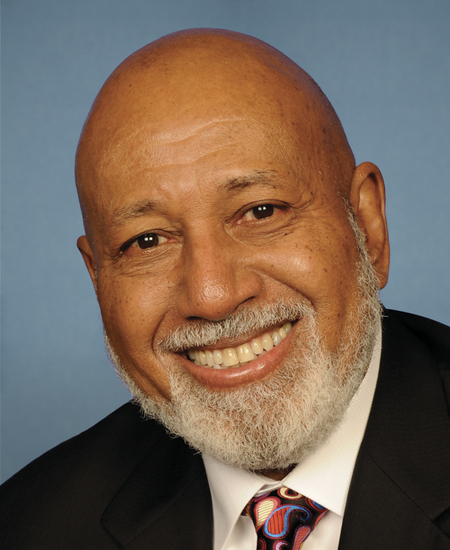
Rep. Alcee L. Hastings
Sponsored bills
Equality Act This bill prohibits discrimination based on sex, sexual orientation, and gender identity in areas including public accommodations and facilities, education, federal funding, employment, housing, credit, and the jury system. Specifically, the bill defines and includes sex, sexual orientation, and gender identity among the prohibited categories of discrimination or segregation. The bill expands the definition of public accommodations to include places or establishments that provide (1) exhibitions, recreation, exercise, amusement, gatherings, or displays; (2) goods, services, or programs; and (3) transportation services. The bill allows the Department of Justice to intervene in equal protection actions in federal court on account of sexual orientation or gender identity. The bill prohibits an individual from being denied access to a shared facility, including a restroom, a locker room, and a dressing room, that is in accordance with the individual's gender identity.
This resolution acknowledges the impact of redlining (i.e., geographic discrimination) and states that the federal government has a responsibility to ameliorate its effects, including through the creation, preservation, and maintenance of equitable economic opportunities and recovery efforts in response to the COVID-19 (i.e., coronavirus disease 2019) pandemic.
This resolution acknowledges racial disparities in the impact of colorectal cancer, particularly in the Black community, and encourages actions to address those disparities.
Children’s Health Insurance Program Permanency Act or the CHIPP Act This bill permanently extends the Children's Health Insurance Program (CHIP) and related measures, programs, and authorities. Specifically, the bill permanently funds CHIP and related programs that support the development of child health quality measures and outreach and enrollment efforts. The bill also permanently authorizes the Medicaid and CHIP express lane eligibility option, which allows states to use information from designated programs (e.g., the Supplemental Nutrition Assistance Program) to streamline eligibility determinations for children. Additionally, under the bill, states may expand eligibility to children whose family income exceeds the otherwise applicable limits.
Medicaid Report on Expansion of Access to Coverage for Health Act or the Medicaid REACH Act This bill reduces federal payment for Medicaid administrative expenses incurred by states that have not elected to participate in Medicaid expansion under the Patient Protection and Affordable Care Act (i.e., nonexpansion states) if the state does not comply with specified reporting requirements. The bill requires nonexpansion states to report, among other information, the number of uninsured individuals under the age of 65 and the estimated percentage of such individuals who would be eligible to receive coverage if the state expanded Medicaid.
Grand Canyon Protection Act This bill withdraws 1,006,545 acres of federal lands in Arizona, including any land or interest in land acquired by the United States after enactment of this bill, from entry, appropriation, and disposal under the public land laws; location, entry, and patent under the mining laws; and operation of the mineral leasing and geothermal leasing laws and mineral materials laws.
This resolution supports the designation of Eddie Bernice Johnson Black Women in Science and Technology Month.
Ensuring Kids Have Access to Medically Necessary Dental Care Act This bill modifies dental coverage under the Children's Health Insurance Program (CHIP). Specifically, the bill prohibits lifetime or annual limits on CHIP dental coverage. It also requires states to offer dental-only supplemental coverage under CHIP to children who have other health insurance but are otherwise eligible for CHIP (i.e., wraparound coverage); such coverage is currently at the option of the state.
Foster Youth Dental Act of 2021 This bill expands Medicaid coverage of current and former foster youth, particularly with respect to dental services. Specifically, the bill requires state Medicaid programs to cover early and periodic screening, diagnostic, and treatment services, including dental services, for current and former foster youth under the age of 26. States must set a special payment rate, based on rates in the private sector, for dental services provided to such individuals; the bill provides an enhanced Federal Medical Assistance Percentage (i.e., federal matching rate) for excess expenses that result from such payments. The bill's requirements take effect 80 days after the date of enactment of the bill. The bill also accelerates the application of certain provisions that require a state Medicaid program to cover former foster youth from other states until the age of 26; such provisions currently apply to former foster youth who reach the age of 18 on or after January 1, 2023. The bill instead applies these provisions to former foster youth who reach the age of 18 on or after the date of enactment of the bill.