

Commission to Study and Develop Reparation Proposals for African Americans Act This bill establishes the Commission to Study and Develop Reparation Proposals for African Americans. The commission shall examine slavery and discrimination in the colonies and the United States from 1619 to the present and recommend appropriate remedies. The commission shall identify (1) the role of the federal and state governments in supporting the institution of slavery, (2) forms of discrimination in the public and private sectors against freed slaves and their descendants, and (3) lingering negative effects of slavery on living African Americans and society.
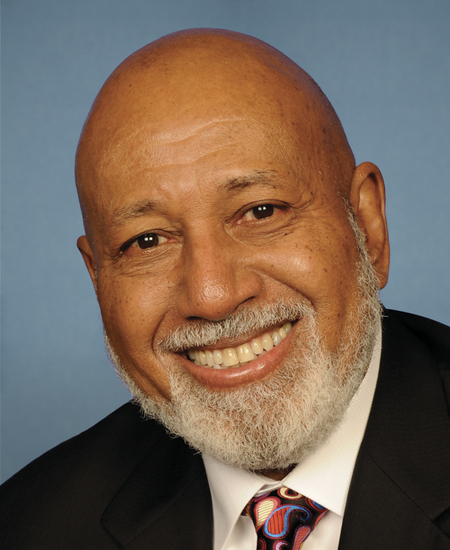
Rep. Alcee L. Hastings
Sponsored bills
Taxpayer Research and Coronavirus Knowledge Act of 2021 This bill requires the Department of Health and Human Services (HHS) to coordinate with specified federal entities to compile a public database of federal contracts, tax benefits, and other support for COVID-19 (i.e., coronavirus disease 2019) biomedical research and development. HHS must develop the database within one month and update it every two weeks.
Providing Responsible Emergency Plans for Animals at Risk of E merging Disasters Act or the PREPARED Act This bill establishes requirements governing the care of animals by entities, such as zoos, in emergencies or disasters. Specifically, the bill requires each research facility, dealer, exhibitor, intermediate handler, and carrier to develop and follow a contingency plan to provide for the humane handling, treatment, transportation, housing, and care of their animals in the event of an emergency or disaster.
Teaching Asian Pacific American History Act This bill requires entities (e.g., institutions of higher education, libraries, and museums), in order to be eligible for certain grants administered by the Department of Education (ED), to include Asian Pacific American history in their teaching of American history. It also requires Asian Pacific American history to be included in tests administered by the National Assessment of Educational Progress (NAEP). Specifically, the bill mandates the inclusion of Asian Pacific American history as a required component of American history for such entities to be eligible for American History and Civics Academies' competitive grants. These grants support the establishment of (1) Presidential Academies for Teachers of American History and Civics, which offer workshops to teachers of American history and civics to strengthen their knowledge and prepare them to teach in these subjects; and (2) Congressional Academies for Students of American History and Civics, which support high school students in developing an understanding of these subjects. (Currently, Asian Pacific American history is not a required component of American history for either academy.) In addition, ED must give priority to grant applicants that align their activities with programs and resources of the Smithsonian Institution's Asian Pacific American Center. The bill also requires the inclusion of Asian Pacific American history in tests administered by the NAEP, which measures student academic achievement in various subjects.
Water Affordability, Transparency, Equity, and Reliability Act of 2021 This bill increases funding for water infrastructure, including funding for several programs related to controlling water pollution or protecting drinking water. Specifically, it establishes a Water Affordability, Transparency, Equity, and Reliability Trust Fund. The fund may be used for specified grant programs. The bill increases the corporate income tax rate to 24.5% to provide revenues for the fund. In addition, the bill revises requirements concerning the clean water state revolving fund (SRF) and the drinking water SRF. It also creates or reauthorizes several grant programs for water infrastructure.
This resolution pays tribute to the members of Brigada de Asalto 2506 (Assault Brigade 2506) who participated in the Bay of Pigs operation, and it calls on the United States to support policies that promote respect for democratic principles, civil liberties, freedom, and justice in Cuba.
This resolution declares that respect for human rights is foundational to U.S. bilateral and international engagement with Nigeria, and it condemns the violence by Nigerian security forces against peaceful protestors. Further, the resolution supports the demands of the movement for justice, accountability, and meaningful police and security-sector reform in Nigeria, and it calls on the Nigerian government to release everyone who has been wrongfully arrested for participating in or supporting this movement.
This resolution encourages the recognition of the collective history and achievements of people of African descent and reaffirms the importance of their equal participation in all aspects of political, economic, social, and cultural life. The resolution also recognizes that many Black Europeans have experienced injustices in the public and private sector and welcomes European efforts to promote racial equality and combat discrimination. Further, the resolution urges the Department of State and the U.S. Agency for International Development to support efforts to promote equality.
Closing Loopholes for Oil and other Sources of Emissions Act or the CLOSE Act This bill repeals exemptions from the Clean Air Act under which (1) emissions from oil and gas wells and pipeline facilities are excluded from aggregation with emissions from other similar units for purposes of determining major sources, and (2) the Environmental Protection Agency (EPA) excludes oil and gas production wells from being listed as area sources. Additionally, the bill requires the EPA to issue a final rule adding hydrogen sulfide to the list of hazardous air pollutants under the Clean Air Act and revising such list to include categories and subcategories of major sources and area sources of hydrogen sulfide, including oil and gas wells.
This resolution recognizes the accomplishments and example of Cesar Estrada Chavez. The resolution also encourages the people of the United States to commemorate his legacy and to always remember his rallying cry, "Si, se puede!" (which means "Yes, we can!").