Fueling Affordable Insurance for Today's Homeowners Act of 2022 or the FAITH Act of 2022 This bill establishes the Natural Disaster Risk Reinsurance Program within the Department of the Treasury. States may voluntarily participate in the program. The program provides payments to states for damages from a natural disaster not covered by the National Flood Insurance Program for amounts in excess of trigger amounts. These trigger amounts are calculated by the National Academy of Sciences. States must present a plan that ensures the coverage of losses by insurers not exceeding the trigger amount. States must also pledge to repay the full amount provided by the program within 10 years.
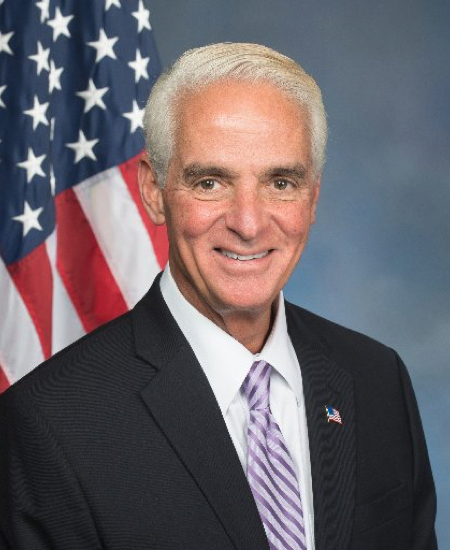
Rep. Charlie Crist
Sponsored bills
SAFER in Condos Act of 2022 or the Securing Access to Financing for Exterior Repairs in Condos Act of 2022 This bill allows an owner of a condominium (condo) unit to finance, through loans backed by the Federal Housing Administration, special assessments charged by the condo's governing body for rehabilitation, repair, replacement, or other improvement of common systems, infrastructure, facilities, features, portions, or areas.
Parents Need to Know Act of 2022 This bill requires local educational agencies to establish procedures for schools to provide (1) timely notification, including by calls and texts, to parents about certain threats, unlawful acts, or significant emergencies that occur on school grounds, during transportation for school sponsored-events, or during school-sponsored activities; (2) a plan to address, mitigate, or correct any risks to students associated with these acts or emergencies; and (3) an annual notice to students, parents, and employees describing the notification procedures required by the bill.
IHS Contract Support Cost Amendment Act This bill allows tribes to receive contract support costs for activities that would otherwise be carried out by the Department of the Interior or the Department of Health and Human Services for direct operation of a program, but for which the costs are not fully covered by the amount of funds required by the Indian Self-Determination and Education Assistance Act of 1975.
Ensuring Lasting Smiles Act This bill requires private health insurance plans to cover diagnosis and treatment of congenital anomalies and birth defects, such as reconstructive services and items. Coverage must include services and items that functionally improve, repair, or restore any body part that is medically necessary for normal bodily functions or appearance, as determined by the treating physician. Coverage limits and cost-sharing requirements for such services and items may not be more restrictive than those applicable to all medical and surgical benefits under the plan.
Marijuana Opportunity Reinvestment and Expungement Act or the MORE Act This bill decriminalizes marijuana. Specifically, it removes marijuana from the list of scheduled substances under the Controlled Substances Act and eliminates criminal penalties for an individual who manufactures, distributes, or possesses marijuana. The bill also makes other changes, including the following: replaces statutory references to marijuana and marihuana with cannabis , requires the Bureau of Labor Statistics to regularly publish demographic data on cannabis business owners and employees, establishes a trust fund to support various programs and services for individuals and businesses in communities impacted by the war on drugs, imposes an excise tax on cannabis products produced in or imported into the United States and an occupational tax on cannabis production facilities and export warehouses, makes Small Business Administration loans and services available to entities that are cannabis-related legitimate businesses or service providers, prohibits the denial of federal public benefits to a person on the basis of certain cannabis-related conduct or convictions, prohibits the denial of benefits and protections under immigration laws on the basis of a cannabis-related event (e.g., conduct or a conviction), establishes a process to expunge convictions and conduct sentencing review hearings related to federal cannabis offenses, directs the Government Accountability Office to study the societal impact of state legalization of recreational cannabis, directs the National Highway Traffic Safety Administration to study methods for determining whether a driver is impaired by marijuana, directs the National Institute for Occupational Safety and Health to study the impact of state legalization of recreational cannabis on the workplace, and directs the Department of Education to study the impact of state legalization of recreational cannabis on schools and school-aged children.

Sickle Cell Care Expansion Act of 2022 This bill establishes programs to increase treatment and other services for populations with sickle cell disease. Sickle cell disease is an inherited blood disorder that can lead to pain, anemia, infections, and stroke. Specifically, the Department of Health and Human Services must award grants to federally qualified health centers, community-based organizations, or other nonprofits that treat or otherwise support populations with sickle cell disease for education and advocacy programs concerning the disease. Additionally, the Health Resources and Services Administration must establish a program to provide scholarships or student loan repayment awards to individuals who commit to engage in clinical practice or research related to sickle cell disease for a period of obligated service as physicians.
Forced Arbitration Injustice Repeal Act of 2022 or the FAIR Act of 2022 This bill prohibits a predispute arbitration agreement from being valid or enforceable if it requires arbitration of an employment, consumer, antitrust, or civil rights dispute.
This resolution celebrates the 200th anniversary of diplomatic relations between the United States and Colombia. The resolution recognizes the vital strategic alliance between the United States and Colombia, built on a shared commitment to democracy. The resolution also celebrates the contributions made by Colombians and Colombian Americans to the United States.
Dr. Lorna Breen Health Care Provider Protection Act This bill establishes grants and requires other activities to improve mental and behavioral health among health care providers. Specifically, the Department of Health and Human Services (HHS) must award grants to hospitals, medical professional associations, and other health care entities for programs to promote mental health and resiliency among health care providers. In addition, HHS may award grants for relevant mental and behavioral health training for health care students, residents, or professionals. Additionally, HHS must conduct a campaign to (1) encourage health care providers to seek support and treatment for mental and behavioral health concerns, and (2) disseminate best practices to prevent suicide and improve mental health and resiliency among health care providers. HHS must also study and develop policy recommendations on improving mental and behavioral health among health care providers, removing barriers to accessing care and treatment, and identifying strategies to promote resiliency. Furthermore, the Government Accountability Office must report on the extent to which relevant federal grant programs address the prevalence and severity of mental health conditions and substance use disorders among health care providers.