

Relief for Restaurants and other Hard Hit Small Businesses Act of 2022 This bill addresses support for restaurants, arts and entertainment venues, and small businesses impacted by the COVID-19 pandemic. The bill provides an additional $42 billion in FY2021 for the Restaurant Revitalization Fund and gives priority to previous applicants who have not received a grant. The Small Business Administration (SBA) must provide to applicants an explanation for denied applications, establish a reconsideration process for denied applications, and institute an audit and oversight plan with respect to grant recipients. Additionally, the bill establishes the Hard Hit Industries Award Program for small businesses that suffered a pandemic-related revenue loss of 40% or more. Aggregate grant amounts are capped at $1 million. Funds may be used for expenses including mortgage, rent, and utility payments and payroll. SBA must prioritize entities that have experienced significant pandemic-related revenue loss, with first priority going to those that experienced a loss of at least 80%, and second priority going to those that experienced a loss of at least 60%. Finally, the bill extends to March 11, 2023 (or a later date as determined by the SBA), the time frame during which Shuttered Venue Operators Grant recipients may use grant funds to cover their expenses.
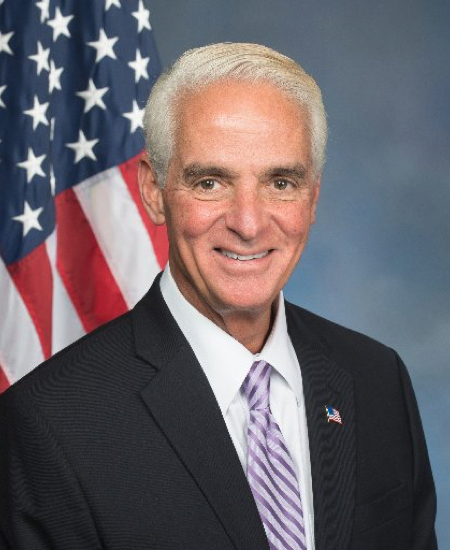
Rep. Charlie Crist
Sponsored bills
Bipartisan Background Checks Act of 2021 This bill establishes new background check requirements for firearm transfers between private parties (i.e., unlicensed individuals). Specifically, it prohibits a firearm transfer between private parties unless a licensed gun dealer, manufacturer, or importer first takes possession of the firearm to conduct a background check. The prohibition does not apply to certain firearm transfers or exchanges, such as a gift between spouses in good faith.
Health Care Providers Safety Act of 2022 This bill authorizes the Department of Health and Human Services to award grants to health care providers for security services and other expenses related to physical security and cybersecurity.
Helping Employees Navigate Rabies Regulations from over Yonder or the HENRY Act This bill directs certain actions to allow federal officers and employees to bring dogs into the United States from countries that are considered high-risk for rabies. Among other provisions, the bill directs the Centers for Disease Control and Prevention (CDC) to allow federal officers and employees who are stationed abroad, including members of the military, to bring up to three dogs into the United States per entry; the CDC may allow for more dogs through specialized waivers.
Rights for the Transportation Security Administration Workforce Act of 2022 or the Rights for the TSA Workforce Act of 2022 This bill modifies the workplace rights, protections, and benefits applicable to Transportation Security Administration (TSA) personnel. Specifically, the bill by December 31, 2022, eliminates personnel authorities of the Department of Homeland Security (DHS) and the Department of Transportation governing the conditions of employment for TSA employees, thus making TSA employees subject to the personnel management system applicable to other federal employees; sets forth transition rules that protect the pay rates, leave rights, and other rights of TSA employees; and requires DHS to consult with the exclusive representative of TSA screening employees to carry out the conversion of those positions. The bill also permits the TSA to consult with organizations representing federal air marshals to address concerns, including mental health and suicide rates; directs the TSA to ensure its employees are provided proper guidance regarding prevention and protections against COVID-19; requires the TSA to provide a one-time bonus payment of $3,000 to each TSA employee carrying out duties that require substantial contact with the public during the COVID-19 national emergency; and requires the Government Accountability Office to report on implementation of the bill, TSA recruitment efforts, and specified TSA personnel policies.
Benjamin Berell Ferencz Congressional Gold Medal Act This bill provides for the award of a Congressional Gold Medal to Benjamin Berell Ferencz in recognition of his service to the United States and the international community during the post-World War II Nuremberg trials and his lifelong advocacy for international criminal justice and the rule of law.
This resolution extends collective bargaining rights prescribed in the Congressional Accountability Act of 1995 to employees of the House of Representatives.
Improving Specialty Care for Women Veterans Act This bill authorizes the Department of Veterans Affairs (VA) to implement a program for the recruitment, retention, and training of specialty care providers for former members of the Armed Forces who are women. Individuals serving in a medical internship or residency program or nurses and physicians who are covered providers (i.e., employees of the VA or persons providing care under the Veterans Community Care Program) may participate in the program. The VA may target individuals with expertise in certain specialty care areas for recruitment. Additionally, the VA may offer targeted individuals appropriate incentives (e.g., monetary incentives). The VA must provide individuals participating in the program with training and support related to the unique needs of women veterans. Finally, the VA must (1) provide veterans enrolled in the VA health care system with information that indicates whether a provider has participated in the program, and (2) improve the timeliness of appointments scheduled with such providers.
Maddy summaryHRES 1092 is a symbolic resolution supporting National Hurricane Preparedness Week (May 1-7, 2022). It encourages federal agencies like the National Weather Service and National Hurricane Center to continue public education on hurricane safety, including developing family disaster plans and understanding evacuation procedures. The resolution urges all Americans to use this week to learn about hurricane risks, such as storm surge vulnerabilities and flood safety, based on guidance from NOAA and the National Weather Service. As a non-binding statement, it does not create new laws or requirements.
Home Modification for Accessibility Act of 2022 This bill allows distributions from a tax-exempt retirement plan, without penalty, for retirement home improvements to an individual's primary residence to improve for aging or disabled adults the accessibility, security, or safety of such residence. The bill limits the amount of such distributions to $30,000 for all taxable years. The bill also excludes the amount of such distributions from the recipient's gross income, for income tax purposes, and allows a deduction for a taxpayer's retirement home improvement expenditures.