

This resolution expresses that the House of Representatives applauds the Biden administration for reaffirming the U.S. commitment to the Paris Agreement on climate change and to our collective responsibility to globally combat climate change; encourages the Biden administration to implement measures to ensure global climate change remains a top priority for this and future administrations and to cement the United States as a global leader in the fight to mitigate its most severe consequences; voices strong commitment as legislators toward achieving the climate goals of the Paris Agreement, fulfilling the forthcoming pledges from the COP26 in Glasgow, Scotland, and advancing other international efforts to keep global warming to no more than 1.5 degrees Celsius and realize global net-zero carbon emissions by 2050 using a whole-of-government approach; and recognizes the critical responsibility of the United States and other developed nations to ensure all societies have the capabilities to transition to a clean energy economy, the resources to protect against climate-induced disasters, and the necessary assistance to endure climate-related challenges to food security, regional migration, and public health.
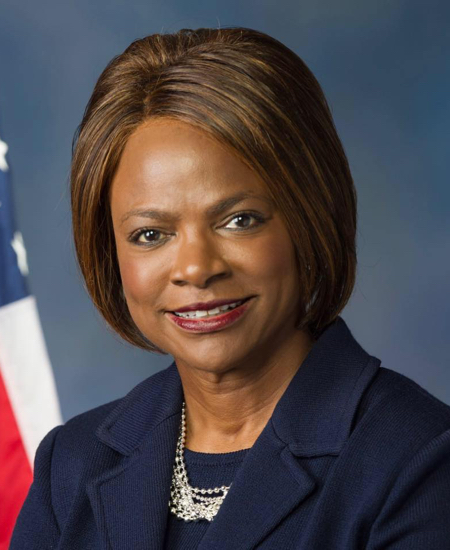
Rep. Val Butler Demings
Sponsored bills
Preserving Recreation, Oceans, Tourism, Environment, and Coastal Towns in Florida Act or the PROTECT Florida Act This bill prohibits oil and gas exploration and leasing on the Outer Continental Shelf in certain areas off the coast of the Gulf of Mexico and Florida. Specifically, the bill extends the moratorium until June 30, 2032, on oil and gas exploration, preleasing or leasing in certain areas of the Gulf of Mexico. Additionally, the bill establishes a moratorium until June 30, 2029, on oil and gas exploration, preleasing or leasing, or any related activity (including seismic testing) in the (1)Straits of Florida Planning Area, and (2) the area in the South Atlantic Planning Area that is south of the northernmost lateral seaward administrative boundary of Florida.
Social Security 2100: A Sacred Trust This bill makes changes to Social Security benefits, taxes, and other aspects of the program, including by raising the primary insurance amount, increasing the maximum taxable earnings that are subject to Social Security payroll taxes, and requiring Social Security account statements to be mailed unless the individual recipient opts for electronic delivery.
Equitable Health Care for All Act This bill prohibits discrimination in health care based on race, religion, and other characteristics. It also revises reporting requirements, adds equity-related measures to certain Medicare programs, and makes other changes to reduce health disparities. To enforce the prohibition, the Department of Health and Human Services (HHS) must establish an administrative process to resolve complaints about inequitable health care. HHS must investigate these complaints and mediate agreements to resolve issues. In the event of noncompliance with a mediated agreement, an aggrieved individual may bring a civil action. Health care providers must also report data in formats that allow disaggregation by demographic factors. HHS must issue proposed regulations to carry out this requirement within 90 days. Additionally, the Centers for Medicare & Medicaid Services (CMS) must include measures related to equitable health care in the Medicare value-based purchasing program for hospitals. This program provides incentive payments based on quality of care. The CMS may also exclude providers that furnish inequitable health care from its programs. In addition, the bill establishes the Federal Health Equity Commission to monitor implementation of the bill and establishes a grant program for hospitals to promote equitable health care.
This bill designates the the Federal Building and United States Courthouse located at 111 North Adams Street in Tallahassee, Florida, as the Joseph Woodrow Hatchett United States Courthouse and Federal Building.
Family Violence Prevention and Services Improvement Act of 20 21 This bill modifies, expands, and reauthorizes through FY2026 the Family Violence and Prevention Services program, which funds emergency shelters and supports related assistance for victims of domestic violence. Specifically, the bill requires the Department of Health and Human Services (HHS) to award grants and enter cooperative agreements with state and tribal domestic violence coalitions, and community-based organizations, to support prevention services. Depending on the type of organization, grant recipients must use funding to (1) provide technical assistance; (2) promote evidence-informed prevention strategies; (3) implement coordinated, community responses to reduce risk factors for family violence; and (4) develop prevention partnership strategies. Further, HHS must award specified grants to organizations that provide population-specific services in underserved communities and to community-based organizations that provide culturally specific domestic violence services to racial and ethnic minority groups. The bill also establishes a grants program for tribal domestic violence coalitions to support the provision of local, tribal, family domestic or dating violence services and requires HHS to award a grant for the administration of a hotline dedicated to serving Indians affected by domestic violence. In addition, the bill modifies certain program-wide definitions; changes the requirements for specified grant applications, eligibility criteria, and use of funds; and makes other technical revisions.
College Student Hunger Act of 20 21 This bill expands the eligibility of students at institutions of higher education to participate in the Supplemental Nutrition Assistance Program (SNAP). SNAP eligibility for students is expanded to include certain low-income students who (1) are employed a minimum of 10 hours per week (currently 20 hours) during the regular school year, (2) are eligible for a federal Pell Grant, (3) have an expected family contribution equal to zero, or (4) are independent. Additionally, the bill directs the Department of Education to provide notification to certain students regarding their eligibility for SNAP benefits, the Inspector General of the Department of Agriculture (USDA) to conduct an audit of the operations of the Food and Nutrition Service to examine the procedures and outreach practices used by the service to provide to states information about the eligibility of students at institutions of higher education for participation in the program, USDA to update its state outreach plan guidance, and USDA to implement projects to decrease student hunger at institutions of higher education and to reduce barriers to college students fully utilizing SNAP benefits at these institutions.
Clean Water Allotment Modernization Act of 2021 This bill revises the formula the Environmental Protection Agency (EPA) uses to determine how to distribute funds from the Clean Water State Revolving Fund (SRF) program. Under the program, the EPA allocates funding to states for water quality infrastructure projects, such as wastewater systems and stormwater management projects. In FY2022-FY2026, the EPA must provide an initial allotment to each state that is equal to the amount the state received in FY2023. The EPA must also provide an additional allotment to each state that is based on its share of the U.S. population. In FY2027 and each subsequent fiscal year, the EPA must use an updated allotment formula, which is based on the needs of states as identified in the most recently available clean watersheds needs survey. Beginning in FY2022, the formula must also provide allotments for Indian tribes and territories. In addition, the formula must provide an allotment for EPA's oversight of SRF projects to ensure they use American iron and steel.
Meeting our Seniors' Social Security Needs Act This bill requires the Social Security Administration (SSA) to ensure that each SSA office and state agency that makes disability determinations for Social Security disability benefits is fully staffed to answer phone calls during standard business hours.
This resolution recognizes that all men and women are created equal and honors the contributions of women that have led to a more equal society. The resolution also reaffirms the commitment to pursuing policies that achieve political and social equality for women, as well as supporting initiatives to put the Equal Rights Amendment in the Constitution.