

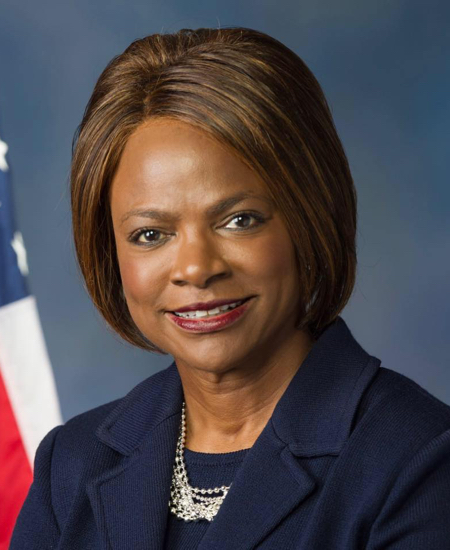
DHS Acquisition Review Board Act of 2021 This bill requires the Department of Homeland Security (DHS) to establish an Acquisition Review Board to support the Management Directorate in managing DHS acquisitions. The bill lists the board's responsibilities, which include determining whether a proposed acquisition has met the requirements of key phases of the acquisition life cycle framework and is able to proceed to the next phase. The chair of the board must ensure that all actions and decisions made pursuant to the board's responsibilities are documented in an acquisition decision memorandum that includes specified elements, such as the rationale for the decision.
Rep. Val Butler Demings
Sponsored bills
Crack Down on Dark Money Act This bill prohibits tax-exempt 501(c)(4) social welfare organizations from using more than 10% of their total expenditures on covered political expenditures (i.e., direct or indirect expenditures for an exempt function, including influencing or attempting to influence the selection, nomination, election, or appointment of any individual to any federal, state, or local public office or office in a political organization, or the election of presidential or vice-presidential electors, whether or not such individual or electors are selected, nominated, elected, or appointed). The bill also requires a social welfare organization that spends funds on political intervention to publicly disclose the name and address of any contributor donating $5,000 or more to such organization. The term political intervention includes advocacy for the election, defeat, nomination or recall of a political candidate, the making of contributions to a political campaign, communications to the electorate about political candidates, and political use of resources.
Maddy summaryHRES 386 is a symbolic resolution introduced in the U.S. House of Representatives that expresses support for recognizing "National Police Week" each year. The resolution acknowledges law enforcement officers' sacrifices, particularly during the pandemic, and encourages the public to honor their service. As a non-binding statement, this resolution does not create new law or change policy but serves as a formal expression of support for law enforcement officers across the United States.
Protecting Our Communities Act This expands the types of parts, weapons, and devices that are subject to regulation under federal firearms laws. The bill also establishes a notification requirement following a firearms-related background check that results in a denial. Specifically, the bill includes as a firearm any combination of parts designed or intended to be used to convert a device into a firearm and from which a firearm may be readily assembled; adds armor-piercing, concealable weapons to the list of firearms subject to regulation under federal firearms laws; and provides statutory authority for the regulation issued by the Bureau of Alcohol, Tobacco, Firearms and Explosives to classify bump-stock devices as machine guns for the purposes of federal firearms laws. Additionally, the bill requires the Department of Justice to notify state and local law enforcement authorities following a firearms-related background check that results in a denial.
Federal Law Enforcement Officer Service Weapon Purchase Act This bill directs the General Services Administration to establish a program under which a federal law enforcement officer may purchase a retired handgun from the agency that issued the handgun to the officer. The bill expresses the sense of Congress that amounts received from the sale of handguns should be used for evidence-based gun violence prevention or gun safety education and training programs.
Untraceable Firearms Act of 2021 This bill establishes a federal statutory framework to regulate the manufacture, sale, offer to sell, transfer, purchase, and receipt of ghost guns (i.e., guns without serial numbers). Additionally, the bill revises the federal statutory framework regulating the manufacture, possession, sale, import, shipment, delivery, receipt, and transfer of undetectable firearms. Among the revisions, the bill defines undetectable firearm as a firearm without a major component wholly made of detectable material.
Foreign National Firearms Background Check Enhancement Act This bill modifies the exceptions to a provision that generally prohibits a nonimmigrant visa holder from obtaining a firearm or ammunition. Current law provides certain exceptions to this prohibition against a nonimmigrant receiving a firearm or ammunition, such as for a nonimmigrant who has a U.S. hunting license. This bill narrows the exceptions by, among other changes, requiring a nonimmigrant with a hunting license to get a waiver from the Department of Justice (DOJ) before receiving a firearm. The person transferring the firearm to a nonimmigrant visa holder must verify the validity of the waiver with DOJ.
Protecting America's First Responders Act of 2021 This bill makes changes to the Public Safety Officers' Benefits (PSOB) program. The PSOB program provides death, disability, and education benefits to public safety officers and survivors of public safety officers who are killed in the line of duty or permanently disabled as a result of catastrophic injuries sustained in the line of duty. Among the changes, the bill expands the public safety officers eligible for coverage under the PSOB program to include firefighters whose primary duty during an emergency response is to secure the scene or manage traffic and cadets or trainees in candidate-officer training; extends coverage under the PSOB program to certain public safety officers responding outside their jurisdiction; increases the interim benefit amount payable on a claim for death benefits and requires the interim amount to be adjusted annually for inflation; increases the benefit amount payable on a death or disability claim that has been pending for more than 365 days on the date of the final determination; allows the Department of Justice (DOJ) to use investigative tools, including subpoenas, to expedite the processing of claims and obtain information or documentation from third parties (e.g., public agencies); specifies that an injury resulting from a neurocognitive disorder qualifies as a catastrophic injury for the purposes of disability benefits; requires (currently, authorizes) DOJ to provide retroactive education benefits to qualifying children and spouses; specifies that hearing officers appointed to review claims are special government employees (i.e., employees who perform temporary duties for a limited period of time) and are authorized to conduct examinations; and allows responders to the World Trade Center or their surviving family members to file claims for death or disability benefits in certain circumstances.
Ending the Monopoly of Power Over Workplace Harassment through Education and Reporting Act or the EMPOWER Act This bill makes it an unlawful labor practice for an employer to enter into, or attempt to enforce, a contract with an employee or job applicant that contains a nondisparagement or nondisclosure clause that covers workplace or sexual harassment, including retaliation for participating in a workplace harassment proceeding. The bill exempts certain settlement or separation agreements from such prohibition. The bill also requires the Securities and Exchange Commission to promulgate a regulation that requires any issuer of securities to submit a report for the most recent five-year period with respect to workplace and sexual harassment. The commission must provide for the development and dissemination of training programs and information regarding workplace and sexual harassment. The bill denies a tax deduction for amounts related to judgments and expenses in connection with litigation related to workplace or sexual harassment. It also excludes from gross income, for income tax purposes, any amount received in connection with a claim or settlement related to workplace or sexual harassment, or other unlawful discrimination.
National Flood Insurance Program Reauthorization and Reform Act of 2021 This bill generally revises the National Flood Insurance Program (NFIP) and reauthorizes the program through FY2026. The bill addresses NFIP coverage, cost, and availability, including by generally prohibiting the Federal Emergency Management Agency (FEMA) from raising certain premiums, surcharges, and fees more than 9% a year for five years; revising flood insurance coverage limits; establishing a means-tested program to provide financial assistance to low income households through policy discounts; and revising standards and certification requirements for flood insurance rate maps. The bill also revises administrative provisions of the NFIP, including by allowing for the continuous operation of the NFIP during a lapse in appropriations, and prohibiting the Department of the Treasury from charging FEMA interest for NFIP debt for five years. The bill sets forth requirements for Write Your Own companies related to reimbursements, agent commissions, and penalties for underpayment of claims. (A Write Your Own company writes and services federal standard flood insurance policies in its own name.) The bill establishes state or tribal government revolving funds for flood mitigation activities and also provides for loans, grants, and other incentives regarding mitigation.