

Maddy summaryHR 4122, the Henrietta Lacks Congressional Gold Medal Act, authorizes a posthumous Congressional Gold Medal to honor Henrietta Lacks for her contribution to medical science through the HeLa cell line. The bill directs the Treasury to strike the medal recognizing how her cells enabled major medical advances, including the polio vaccine and cancer treatments, without altering any laws or policies. The medal will be displayed at the Smithsonian Institution to commemorate her legacy in scientific research and bioethics. This is a purely commemorative measure with no direct effect on current legislation or affected individuals.
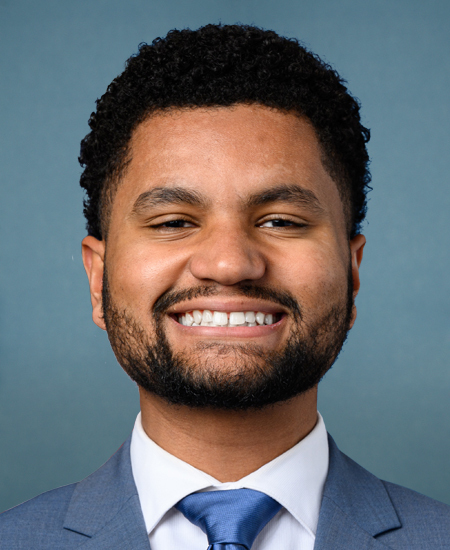
Rep. Maxwell Frost
Sponsored bills
Maddy summaryThe College for All Act of 2023 would create a federal-state partnership to eliminate tuition and required fees for eligible students at public community colleges and 4-year institutions. It would provide federal funding to cover tuition costs for students from families earning up to $125,000 annually (or $250,000 for married couples) at public institutions, with states gradually increasing their financial contribution over time. The bill also includes provisions to support historically Black colleges and universities, minority-serving institutions, and expands Pell Grant eligibility to include Dreamers. States would be required to maintain funding levels for higher education and implement specific reforms to improve student outcomes, including transfer pathways and support services.
Maddy summaryThe Bridge Corrosion Prevention and Repair Act of 2023 requires federal highway and rail bridge projects receiving federal funding to use certified contractors trained in corrosion control. It mandates a corrosion management system covering surface prep, protective coatings, materials selection, and environmental protection, and requires contractors to employ personnel certified through qualified training programs. The bill also expands federal grant funding eligibility to include corrosion control work on rail bridges and directs the Transportation Secretary to study best practices for inspecting and repairing weathering steel bridges within 18 months. These changes directly affect contractors, state transportation departments, and local governments managing federally funded bridges.
Maddy summaryHR 4086 directs the U.S. government to use its influence at the United Nations to extend the mandate of the UN Human Rights Council's independent fact-finding mission on Venezuela. The bill requires the Secretary of State to support efforts to continue this mission until Venezuela holds free elections, ends authoritarian rule, restores democracy, frees political prisoners, and allows humanitarian aid. It also directs the U.S. to urge the UN to condemn Venezuela's use of political prisoners, support humanitarian aid for vulnerable Venezuelans, and assist in releasing detained individuals. The bill mandates annual reports to Congress on these diplomatic actions. This legislation directly affects the UN mission's work and U.S. diplomatic engagement regarding Venezuela's human rights situation.
Maddy summaryHRES 500 is a non-binding House resolution commemorating the seventh anniversary of the 2016 Pulse nightclub shooting in Orlando, Florida. It honors the 49 victims killed in the attack, expresses condolences to their families, and acknowledges the community's response to the tragedy. The resolution also recognizes coordinated efforts by law enforcement and expresses ongoing support for those affected, while noting broader efforts like the Bipartisan Safer Communities Act to address gun violence. As a commemorative resolution, it does not create new laws or policies but serves as a symbolic gesture of remembrance.
Maddy summaryThis bill requires federal research agencies to develop guidelines addressing financial instability for graduate and postdoctoral researchers at institutions receiving federal funding. It mandates agencies to consider increasing stipends (adjusted for location and cost of living), improving access to healthcare, housing, transportation, and childcare, and reducing food insecurity. The bill also directs data collection on researcher financial struggles (disaggregated by demographics), funds a National Academies study on these issues, and requires a GAO report on agency implementation within three years. These provisions directly affect thousands of graduate students and postdocs conducting federally funded research across U.S. universities.
Maddy summaryThe CARE Act of 2023 strengthens protections for child farmworkers by amending the Fair Labor Standards Act. It raises minimum age requirements (restricting 14-15 year olds to family farms outside school hours, and limiting 16-17 year olds to family farm work outside school hours), repeals a waiver allowing children in hand-harvest labor, and increases penalties for violations (up to $60,115 for serious injury or death). The bill requires employers to report work-related injuries or deaths of child farmworkers under 18 and mandates annual reports to Congress on child farmworker safety data. It also prohibits children under 18 from working as pesticide handlers, directly affecting an estimated 100,000+ child farmworkers in the U.S.
Maddy summaryThis bill would allow Venezuelans already living in the U.S. since before December 31, 2021, to apply for permanent residency. Eligible individuals must have lived continuously in the U.S. for at least one year (with limited absences) and cannot have certain serious criminal convictions. It waives some immigration barriers that would normally block permanent status and provides work permits while applications are processed. Family members (spouses, children, or unmarried adult children) of eligible applicants would also qualify. The bill does not change overall visa numbers or create new immigration pathways.
Maddy summaryThis bill amends the definition of "major disaster" under the Stafford Act to explicitly include "extreme heat" before "or drought." It directly affects communities experiencing severe heatwaves by allowing such events to qualify for federal disaster assistance, which previously required disasters like floods or droughts. The key change is a technical update to eligibility criteria, enabling affected areas to access federal aid programs like FEMA assistance for extreme heat emergencies. (Procedural bill, summary limited to 2 sentences per guidelines.)
Maddy summaryThis bill requires federal agencies collecting demographic survey data to begin including questions on sexual orientation, gender identity, and variations in sex characteristics (intersex traits) within 360 days of enactment. Agencies must review existing surveys to identify gaps, develop privacy-protective methods for collecting this data (including anonymization and data destruction protocols), and incorporate it into relevant reports within three years. The law applies to all federal surveys that collect standard demographic data (like race, ethnicity, and age), such as the census or health surveys, but does not compel individuals to disclose their status. It emphasizes maintaining confidentiality, allows limited agency waivers if standards can't be met, and mandates a congressional report on implementation within two years.