Keeping Our Manufacturers from Being Unfairly taxed while Championing Health Act or KOMBUCHA This bill modifies the definition of brewer for purposes of the alcohol excise tax to exempt kombucha from such tax.
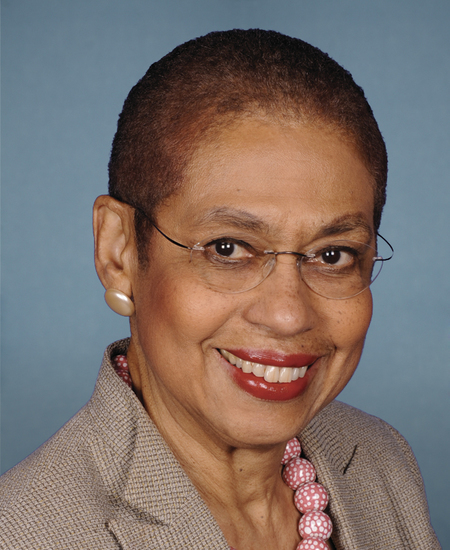
Rep. Eleanor Holmes Norton
Sponsored bills
Safe Step Act This bill requires a group health plan to establish an exception to medication step-therapy protocol in specified cases. A medication step-therapy protocol establishes a specific sequence in which prescription drugs are covered by a group health plan or a health insurance issuer. A request for such an exception to the protocol must be granted if (1) an otherwise required treatment has been ineffective, (2) such treatment is expected to be ineffective and delaying effective treatment would lead to irreversible consequences, (3) such treatment will cause or is likely to cause an adverse reaction to the individual, (4) such treatment is expected to prevent the individual from performing daily activities or occupational responsibilities, (5) the individual is stable based on the prescription drugs already selected, or (6) there are other circumstances as determined by the Employee Benefits Security Administration. The bill requires a group health plan to implement and make readily available a clear process for an individual to request an exception to the protocol, including required information and criteria for granting an exception. The bill further specifies timelines under which plans must respond to such requests.
Housing Supply and Affordability Act This bill allows the Department of Housing and Urban Development to award grants to states, local governments, Indian tribes, and Native Hawaiian organizations for the development and implementation of housing policy plans. These plans must increase the housing supply while avoiding resident displacement, increase housing affordability, and reduce barriers to housing development. The amounts provided by the bill are designated as an emergency requirement pursuant to the Statutory Pay-As-You-Go Act of 2010 (PAYGO) and the Senate PAYGO rule. (This excludes the budget effects from being counted for the purposes of enforcing the PAYGO rules.)
Improving Child Care for Working Families Act of 2021 This bill increases the limitation on the exclusion from employee gross income for employer-paid dependent care assistance from $5,000 to $10,500.
Holistic Economic Aid for Low-Income Neighborhood Growth Act of 2021 or the HEALING Act of 2021 This bill directs the Department of Housing and Urban Development (HUD) to make grants to states, local governments, Indian tribes, insular areas, and other institutions serving or owned by minorities to carry out Community Development Block Grant activities and other assistance in low- and moderate-income areas. Additionally, HUD must carry out a Civil Unrest Business Recovery Program to provide compensation to certain for-profit entities for damages from social and civil unrest during 2020 and to support business-led economic development.
Albert Pike Statue Removal Act This bill directs the National Park Service to remove the statue of Albert Pike near Judiciary Square in the District of Columbia. The Department of the Interior may donate the statue to a museum or other similar entity, as determined appropriate by Interior to ensure its preservation and interpretation in an indoor setting. The recipient of the statue may not store, display, or exhibit the statue outdoors.
Emancipation Statue Removal Act This bill directs the Department of the Interior to ensure that the Emancipation Memorial is removed from Lincoln Park in the District of Columbia. Interior shall donate the Emancipation Memorial to a museum or other similar entity. The recipient of the Emancipation Memorial may not store, display, or exhibit the memorial outside, but if the memorial is stored, displayed, or exhibited outside, ownership of the memorial will revert back to the federal government.
Working On Rewarding and Keeping Employees Resilient Act or the WORKER Act This bill addresses workforce development by advancing science, technology, engineering, and mathematics (STEM) education, revising and implementing certain worker training, retention, and advancement programs, establishing the Distressed Community Investment Agency, and renaming the Department of Commerce as the Department of Innovation and Investment. The bill requires (1) the Department of Education (ED) to award grants to eligible entities to implement certain formal and informal engineering education programs in elementary and secondary schools, and (2) the use of certain career and technical education program funds for supporting a hands-on learning approach. The bill establishes in the Department of Labor an Office of Apprenticeship, including a National Advisory Committee on Apprenticeships, to promote apprenticeship programs. Labor and ED must establish a voluntary Registered Apprenticeship-College Collaborative consisting of the sponsors carrying out registered apprenticeship programs, two- or four-year post secondary educational institutions, and organizations that represent such programs or institutions. The bill requires states to provide a Labor-approved reemployment bonus program for individuals currently receiving unemployment benefits. It also allows states to use workforce development funds for a wage insurance program for individuals age 50 and over (age 45 and over for individuals in economically distressed communities) and establishes a training voucher program to assist workers in obtaining job skills training.
Safe and Accountable Federal Energy Review for Pipelines Act of 2021 or the SAFER Pipelines Act of 2021 This bill revises the process used by the Federal Energy Regulatory Commission (FERC) to review a pipeline expansion project. Before granting a certificate for a proposed pipeline expansion project, FERC must conduct (1) a full evidentiary hearing on any contested issue of need for the expansion; or (2) a cumulative review of major energy infrastructure projects planned throughout the region of the expansion, their purported purpose and need, and their prospective impacts on state and regional energy goals. In addition, the bill outlines criteria FERC must consider before granting such a certificate. In addition to existing environmental review requirements, FERC must meet new environmental review requirements for interstate natural gas pipeline projects, including the requirement to consider the cumulative impacts of other natural gas pipeline projects as specified by this bill. Finally, FERC must monitor approved pipeline projects for five years to ensure that environmental mitigation steps have been implemented.
Farm Workforce Modernization Act of 2021 This bill contains provisions related to alien farmworkers, including provisions establishing a certified agricultural worker (CAW) status and changing the H-2A temporary worker program. The Department of Homeland Security (DHS) may grant CAW status to an applying alien who (1) performed at least 1,035 hours of agricultural labor during the two-year period prior to March 8, 2021; (2) on that date was inadmissible, deportable, or under a grant of deferred enforced departure or temporary protected status; and (3) has been continuously present in the United States from that date until receiving CAW status. The bill imposes additional crime-related inadmissibility grounds on CAW applicants and makes some other grounds inapplicable. CAW status shall be valid for 5.5 years and may be extended. DHS may grant dependent status to the spouse or children of a principal alien. An alien with a pending application may not be detained or removed by DHS and shall be authorized for employment until DHS makes a final decision on the application. A CAW alien (and dependents) may apply for lawful permanent resident status after meeting various requirements, including performing a certain amount of agricultural labor for a number of years. DHS shall create an electronic platform for (1) filing H-2A petitions, (2) facilitating the processing of H-2A cases, and (3) providing agencies a single tool for obtaining H-2A-related case information. The bill makes various changes to the H-2A program, such as (1) modifying the method for calculating and making adjustments to the H-2A worker minimum wage, (2) specifying how an employer may satisfy requirements that it attempted to recruit U.S. workers, (3) requiring H-2A employers to guarantee certain minimum work hours, (4) making the program available for agricultural work that is not temporary or seasonal, and (5) reserving a visa allocation for the dairy industry. DHS shall establish a pilot program allowing certain H-2A workers to apply for portable status, which gives the worker 60 days after leaving a position to secure new employment with a registered H-2A employer. DHS shall establish an electronic system patterned on the E-Verify Program for employers to verify an individual's identity and employment authorization. Employers hiring individuals for agricultural employment must use the system. This bill permanently establishes the Housing Preservation and Revitalization Program, which provides financing assistance for rural rental housing and off-farm labor housing and rental assistance for qualified tenants of such housing. It also authorizes the Department of Agriculture to provide various assistance, including funding for insuring loans and grants for new farmworker housing.