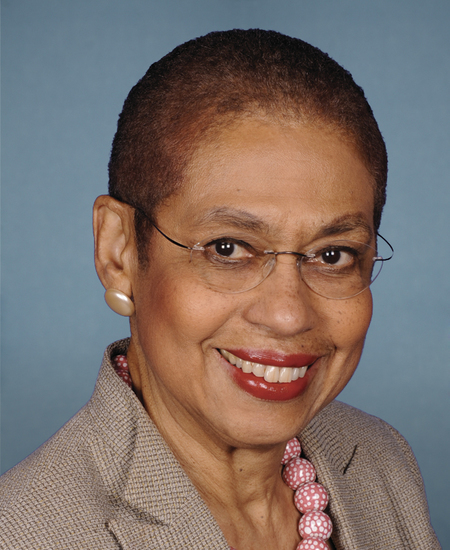
Photo of Eleanor Holmes Norton
D United States House · District At-Large · District of Columbia

Rep. Eleanor Holmes Norton

Compare
Total votes
637
all sessions
Attendance
35%
1,153 missed
Lower than 99% of chamber peers
With party
98%
of cast votes
Near the chamber average
Bipartisan score
2%
crosses aisle rarely
Near the chamber average
Sponsored
6,183
bills & resolutions
Higher than 99% of chamber peers
Committees
7
assignments
6,183 bills and resolutions

Sponsored bills

Total
6,183
Primary
374
Co-sponsor
5,809
This page
6,183
matching current filters
Co-sponsor HR 2288
In committee · United States House · Co-sponsor
Investing in Our Communities Act

Investing in Our Communities Act This bill reinstates the exclusion from gross income for interest on certain bonds issued to advance the refunding of a prior bond issue. The exclusion was repealed for bonds issued after 2017.

In committee Mar 29, 2021 1 co-sponsor
Co-sponsor HR 2292
In committee · United States House · Co-sponsor
Keep Your Home and Prevent Homelessness Act of 2021

Keep Your Home and Prevent Homelessness Act of 2021 This bill allows the Department of the Treasury to transfer Troubled Asset Relief Program funds to the Department of Housing and Urban Development's Housing Trust Fund. This fund provides grants to states to (1) increase and preserve the supply of rental housing for extremely low-income and very low-income families, including homeless families; and (2) increase homeownership for extremely low-income and very low-income families.

In committee Mar 29, 2021 1 co-sponsor
Co-sponsor HR 2201
In committee · United States House · Co-sponsor
Computer and Internet Access Equity Act

Computer and Internet Access Equity Act This bill increases broadband service support for low-income consumers, establishes a grant program to provide internet safety education or training, and provides a tax credit for certain computer and education costs. Specifically, the bill modifies the broadband service support program known as Lifeline, which assists low-income consumers with access to telecommunications and broadband services, to (1) increase the amount of the payments that a provider of Lifeline services may receive for each low-income consumer to whom the provider supplies such services, (2) allow consumers with higher incomes to qualify for participation in the program, and (3) allow a broadband service provider to receive Lifeline support for providing such service to a low-income consumer without being designated as an eligible telecommunications carrier. The bill also requires the Federal Communications Commission to establish a grant program to develop and implement internet education and training programs for low-income individuals. Further, the bill provides a refundable tax credit, not to exceed $2,000 ($4,000 in the case of a joint return) in a taxable year or $10,000 in a lifetime ($20,000 in the case of a joint return), for amounts paid or incurred for computers, printers, and other education-related technology. The Department of the Treasury must establish a program for making advance payments of such credit to eligible individuals.

In committee Mar 29, 2021 1 co-sponsor
Co-sponsor HR 2216
In committee · United States House · Co-sponsor
Jeanette Acosta Invest in Women’s Health Act of 2021

Jeanette Acosta Invest in Women's Health Act of 2021 This bill directs the Department of Health and Human Services to establish a series of programs to increase access to cancer screenings for women. These programs include demonstration projects to train certain health care providers to screen for breast and cervical cancer, and increase co-testing of human papillomavirus (HPV) and cervical cancer among populations that have disproportionate rates of cervical cancer.

In committee Mar 29, 2021 1 co-sponsor
Co-sponsor HR 2202
In committee · United States House · Co-sponsor
Fracturing Responsibility and Awareness of Chemicals Act of 2021

Fracturing Responsibility and Awareness of Chemicals Act of 2021 This bill revises drinking water requirements concerning hydraulic fracturing (fracking) operations. Hydraulic fracturing, or fracking, is a process to extract underground resources such as oil or gas from a geologic formation by injecting water, a propping agent (e.g., sand), and chemical additives into a well under enough pressure to fracture the geologic formation. The bill gives the Environmental Protection Agency (EPA) the authority to protect groundwater sources (e.g., wells) from certain pollution risks posed by fracking operations. The bill also establishes requirements for disclosing the chemicals intended for use in fracking operations as well as the chemicals actually used in the operations. If the proprietary chemical formulas of chemicals used in fracking operations are necessary for treatment in medical emergencies, then the operations must disclose the formulas or the specific chemical identities of trade secret chemicals to the state, the EPA, or the treating physicians or nurses upon request, regardless of whether written statements of need or confidentiality agreements have been provided.

In committee Mar 29, 2021 1 co-sponsor
Co-sponsor HR 2229
In committee · United States House · Co-sponsor
Baby Food Safety Act of 2021

Baby Food Safety Act of 2021 This bill imposes certain safety requirements on infant and toddler food. The bill establishes maximum levels of certain toxic elements (cadmium, and lead, mercury, and inorganic arsenic) allowable in infant and toddler food, defined as food intended to be sold for children up to 36 months old. The Food and Drug Administration (FDA) shall periodically review and, if necessary, further lower these levels. The FDA may also establish limits on other toxic elements upon review of relevant health and dietary data. Furthermore, facilities that manufacture, process, pack, or hold infant and toddler food must have certain controls and plans to ensure that their food complies with the limits on toxic elements established by this bill. Such facilities shall also make publicly available certain information, including results from tests for toxic elements in their infant and toddler foods. The bill also expands the FDA's authority to require a recall of adulterated or misbranded food to include infant and toddler food that exceeds limits on toxic elements. The Centers for Disease Control shall carry out a public awareness campaign about the risks of toxic elements in infant and toddler food. The FDA shall commission research on agricultural methods that minimize levels of toxic heavy metals in crops.


In committee Mar 29, 2021 1 co-sponsor
Co-sponsor HR 2256
In committee · United States House · Co-sponsor
Resident Physician Shortage Reduction Act of 2021

Resident Physician Shortage Reduction Act of 2021 This bill increases the number of residency positions eligible for graduate medical education payments under Medicare for qualifying hospitals, including hospitals in rural areas and health professional shortage areas. Current law provides for an increase of up to 200 positions per fiscal year beginning in FY2023, with a total increase of 1,000 positions; each hospital may receive up to 25 additional positions. The bill provides for an additional increase of 2,000 positions per fiscal year from FY2023-FY2029; during this period, each hospital may receive up to 75 additional positions in total under the bill and current law. Additionally, one-third of the positions that are made available under the bill must be allocated to hospitals that are already operating above applicable resident limits. The bill also requires the Government Accountability Office to report on strategies to increase the diversity of the health professional workforce, including with respect to representation from rural, low-income, and minority communities.

In committee Mar 29, 2021 1 co-sponsor
Co-sponsor HR 1313
In committee · United States House · Co-sponsor
Healthy Food Access for All Americans Act

Healthy Food Access for All Americans Act This bill allows tax credits and grants for activities that provide access to healthy food in food deserts, which are communities that have limited or no access to grocery stores and meet income requirements. For entities that are certified by the Department of the Treasury as special access food providers using specified criteria, the bill allows tax credits for operating a new grocery store or renovating an existing grocery store in a food desert. The bill also authorizes grants for a portion of (1) the construction costs of building a permanent food bank in a food desert, and (2) the annual operating costs of temporary access merchants (mobile markets, farmers markets, and food banks). Treasury, in coordination with the Department of Agriculture (USDA), must annually allocate the tax credits and grants to special access food providers. Grants authorized by this bill are not considered gross income for tax purposes. The bill also requires USDA to update the Food Access Research Atlas at least annually to account for food retailers that are placed in service during that year.

In committee Mar 29, 2021 1 co-sponsor
Co-sponsor HJRES 35
In committee · United States House · Co-sponsor
Providing for congressional disapproval under chapter 8 of title 5, United States Code, of the rule submitted by the Office of the Comptroller of the Currency relating to "National Banks and Federal Savings Associations as Lenders".

This joint resolution nullifies the final rule issued by the Office of the Comptroller of the Currency titled National Banks and Federal Savings Associations as Lenders and published on October 30, 2020. The rule requires that to be considered a lender, a national bank or federal saving association must, as of the date of origination of the loan (1) be named as the lender in the loan agreement, or (2) fund the loan.

In committee Mar 26, 2021 1 co-sponsor
Showing 5,791 to 5,800 of 6,183 bills