

Armed Forces Transgender Dependent Protection Act This bill expands the policy of the Office of Special Needs within the Department of Defense to address transgender dependents. Specifically, the bill codifies the definition of a medical or educational special need to include gender dysphoria. Under the bill, the policy of the office must prohibit the assignment of a military family with special needs to a permanent duty location where the law restricts medically necessary treatment for a medical or educational special need. A member who is serving at a location when such a law is established may elect to be reassigned.
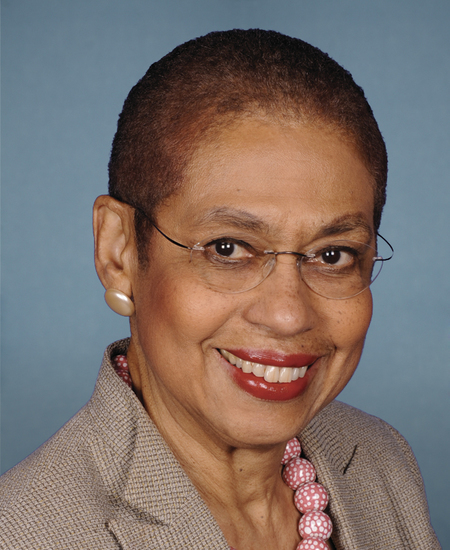
Rep. Eleanor Holmes Norton
Sponsored bills
Smarter Approaches to Nuclear Expenditures Act This bill imposes prohibitions and limitations on funding for various Department of Defense (DOD) and Department of Energy (DOE) weapons programs. Weapons subjected to prohibitions or limitations under this bill include Columbia-class submarines, intercontinental ballistic missiles, low-yield nuclear warheads, and space-based missile defense systems. The bill also requires various reports to Congress, including a joint report from DOD and DOE outlining the estimated cost savings resulting from this bill.
Clean Water Standards for PFAS Act of 2021 This bill directs the Environmental Protection Agency (EPA) to develop requirements and incentives to limit the discharge of perfluoroalkyl and polyfluoroalkyl substances (PFAS) into certain waters of the United States. PFAS are man-made and may have adverse human health effects. A variety of products contain the compounds, such as nonstick cookware or weatherproof clothing. Within two years, the EPA must publish water quality criteria for each measurable perfluoroalkyl substance, polyfluoroalkyl substance, and class of PFAS. The water quality criteria must determine how much of these substances can be present in water before it is likely to harm human health. Within four years, the EPA must publish a final rule that establishes, for each priority industry category specified in the bill, effluent limitations guidelines and standards for the discharge of each measurable perfluoroalkyl substance, polyfluoroalkyl substance, and class of PFAS. Under the Clean Water Act, effluent limitations restrict the quantities, rates, and concentrations of chemical, physical, biological, and other constituents which are discharged from point sources (e.g., a discernible source such as a pipe) into navigable waters, the ocean, or other specified waters. In addition, the EPA must award grants to owners and operators of publicly owned treatment works for implementing the effluent limitations guidelines and standards.
Stop Mental Health Stigma in Our Communities Act This bill requires the Substance Abuse and Mental Health Services Administration to develop and implement an outreach and education strategy regarding behavioral health issues among the Asian American, Native Hawaiian, and Pacific Islander populations. The strategy must be designed to promote behavioral and mental health and reduce stigma associated with mental health conditions and substance abuse among such populations.
Military Spouse Student Loan Deferment Act This bill allows certain military spouses to defer payment on their federal student loans for 90 days. Specifically, borrowers are eligible to receive this deferment if (1) their spouse is an active duty service member of the Armed Forces, (2) they have lost their employment due to a permanent change in duty station of their spouse, and (3) they provide certain documentation to the Department of Education. Loan interest shall not accrue during the deferment period.
Flexibility for Working Families Act This bill allows an employee to request from an employer a temporary or permanent change in the terms or conditions of the employee's employment if the request relates to (1) the number of hours the employee is required to work, (2) the times when the employee is required to work or be on call for work, (3) where the employee is required to work, or (4) the amount of notification the employee receives of work schedule assignments. The bill sets forth certain employer duties with respect to such requests. The bill prohibits an employer from interfering with any rights provided to an employee under this bill. An employee may file a complaint with the Department of Labor for any violations of such rights. Labor shall investigate and attempt to resolve such complaints and may issue orders making determinations and assessing civil penalties or awarding relief for alleged violations. The bill provides for judicial review of such orders, including in federal courts of appeal. Labor and certain federal agencies and offices shall provide information and technical assistance to employers, labor organizations, and the general public regarding compliance with this bill. The Wage and Hour Division of Labor must issue guidance on compliance with providing a flexible work environment through changes in employee terms and conditions of employment as provided in this bill. The requirements of this bill are applicable to certain classes of employees, including employees of the Government Accountability Office and the Library of Congress.
Homeless Youth Menstrual Product Access Act of 20 21 This bill expands the permissible uses of federal grants by local centers serving runaway and homeless youth to include the provision of menstrual hygiene products.
United States Army Rangers Veterans of World War II Congressional Gold Medal Act This bill provides for the award of a single Congressional Gold Medal to the U.S. Army Rangers Veterans of World War II in recognition of their dedicated service during World War II.
Defenders of Bataan and Corregidor Congressional Gold Medal Act This bill provides for the award of a Congressional Gold Medal to the troops from the United States and the Philippines who defended Bataan and Corregidor, in recognition of their personal sacrifice and service during World War II.
Computer Science for All Act of 2021 This bill establishes a program through which the Department of Education must award grants to states, local educational agencies, and eligible tribal schools to serve as models for national replication of computer science education expansion efforts. Grant recipients must use these funds for certain activities, including training teachers to teach computer science and expanding access to high-quality learning materials and online options.