

Eliminating a Quantifiably Unjust Application of the Law Act of 2021 or the EQUAL Act of 2021 This bill eliminates the federal sentencing disparity between drug offenses involving crack cocaine and powder cocaine. Currently, different threshold quantities of crack cocaine and powder cocaine (e.g., 28 grams of crack cocaine and 500 grams of powder cocaine) trigger the same statutory criminal penalties. This bill eliminates the lower quantity thresholds for crack cocaine offenses. Under the bill, the same threshold quantities of crack cocaine and powder cocaine trigger the same statutory criminal penalties. The change applies to future cases and cases pending on the date of enactment. With respect to past cases, the bill authorizes a sentencing court to impose a reduced sentence on a defendant who was convicted or sentenced for a specified crack cocaine offense before this bill's enactment. A defendant does not have to be present at the sentence reduction hearing. Finally, the bill prohibits the reduction of a sentence that was previously reduced.
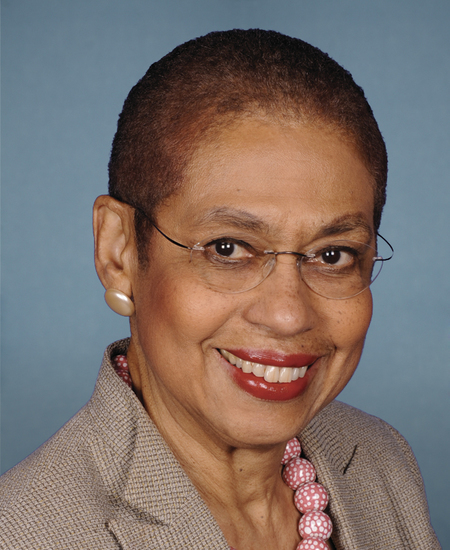
Rep. Eleanor Holmes Norton
Sponsored bills
Chai Suthammanont Remembrance Act of 2021 This bill requires federal agencies to develop and disclose safety plans that contain certain information for on-site employees and contractors during the public health emergency relating to COVID-19 (i.e., coronavirus disease 2019). Specifically, the bill requires each agency to post a safety plan on its website that includes descriptions of (1) the personal protective equipment that the agency will provide to its on-site employees and contractors; (2) protections for employees whose work requires them to travel off-site; (3) testing, contact-tracing, and vaccination protocols; and (4) protocols that ensure the continuity of operations in the event it is necessary to reverse on-site requirements. Each agency's Office of the Inspector General must report on whether the agency has published and implemented its safety plan.
This resolution supports the designation of National Voter Registration Day.
BuyAmerican.gov Act of 2021 This bill directs the President and specified federal agencies to take steps to increase transparency and limit the use of waivers of Buy American laws. Generally, Buy American requires agencies to procure domestic goods. The bill requires (1) the Department of Commerce to report periodically to Congress and the President on the implementation of, and compliance with, Buy American laws; (2) Commerce and the Office of the U.S. Trade Representative to assess the impacts of all U.S. free trade agreements and the World Trade Organization Agreement on Government Procurement on the operation of such laws; and (3) the General Services Administration (GSA) to establish a free, publicly available BuyAmerican.gov website. Public interest waivers from Buy American laws shall be construed to ensure the maximum utilization of goods, products, and materials produced in the United States. The President shall develop a mechanism to collect information on requests to waive Buy American laws and other domestic content restrictions for purposes of providing early notice to possible waivers via the website. Executive agencies shall make information concerning the intention to issue a waiver or exception in connection with a federal procurement available to the GSA at least 20 days prior to waiving a Buy American law. The Government Accountability Office shall report to Congress within two years of this bill's enactment describing the bill's implementation.
Rewarding Efforts to Decrease Unrecycled Contaminants in Ecosystems Act of 2021 or the REDUCE Act of 2021 This bill imposes an excise tax on any taxable virgin plastic resin. The bill establishes a Plastic Waste Reduction Fund to carry out reduction and recycling activities, plastic waste and marine debris reduction, detection, monitoring, and cleanup activities, and address environmental justice and pollution impacts from plastic products.
We Need Eviction Data Now Act of 2021 This bill requires the Department of Housing and Urban Development (HUD) to establish and maintain a national eviction database. The database must contain eviction data compiled annually by state courts. HUD must award grants to local governments and nonprofit organizations to collect data from landlords on illegal self-help evictions for inclusion in the database. The bill also requires HUD to establish an advisory committee on eviction research.
This resolution condemns and denounces the actions of the Customs and Border Patrol agents who confronted Haitian migrants on horseback using their reins as lashes.
ESP Family Leave Act This bill allows education support professionals to meet the hours of service requirements for family and medical leave if they have worked a number of hours equal to not less than 60% of the total monthly hours expected for their job descriptions and duties, as assigned for the previous school year. Education support professionals are employees within a public school or public institution of higher education which may include specified staff, such as paraeducators, administrative support staff, custodians, skilled trade workers, and nursing support staff. The Department of Labor may provide a method for calculating such leave for these professionals.
Military Suicide Prevention in the 21st Century Act This bill requires the Department of Defense to carry out a two-year pilot program to program suicide prevention resources onto smart devices issued to members of the Armed Forces and to provide training on these resources.
Two-State Solution Act This bill addresses U.S. policy and related activities to preserve conditions for a two-state solution to resolve territorial disputes between Israel and Palestine. The bill prohibits the United States from providing support for projects in geographic regions that came under Israeli control after June 5, 1967. It also prohibits the use of any U.S. security assistance, defense articles, or defense services provided to Israel for efforts to annex or exercise permanent control over any part of the West Bank or Gaza. Current law designates the Palestine Liberation Organization (PLO) as a terrorist organization and restricts its activities (e.g., prohibiting it from maintaining an office in the United States). The President may waive for up to six months some of these restrictions to serve U.S. national security or diplomatic interests. If the President certifies that the PLO has ceased supporting terrorist actions and met other conditions, the bill automatically terminates the terrorist organization designation. Goods produced in the West Bank or Gaza that are imported into the United States must indicate those areas as the country of origin on their labels. The bill expands the scope of certain foreign and development assistance to foster initiatives, including shared educational opportunities and youth activities, that connect Israelis and Palestinians. Additionally, the Department of State and the U.S. Agency for International Development may jointly award grants to private, nonprofit organizations to promote human rights and democracy, strengthen civil society, and otherwise address the needs of the Palestinian people.