Schools Preventing Hunger in At-Risk Kids Act or the SPARK Act This bill expands automatic eligibility for free school lunches and breakfasts to include children who have been placed in kinship care with a relative or family friend with the involvement of the state child welfare agency. To enroll in the program, a family must document the child's status to the appropriate local educational agency.
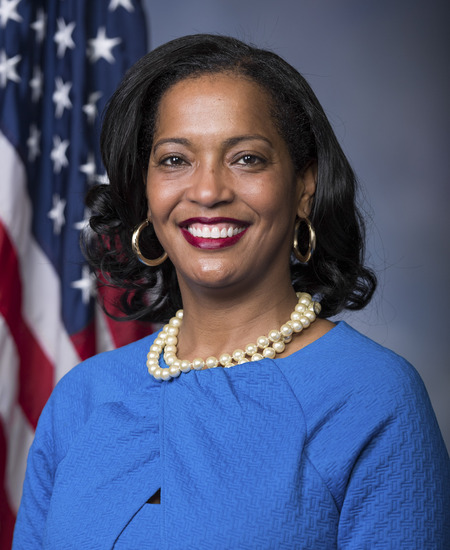
Rep. Jahana Hayes
Sponsored bills
This bill increases and extends through FY2022 emergency funding and extends through FY2022 certain flexibilities for states to administer foster care programs and services. This includes expanding eligibility for services until a youth reaches age 27, permitting a youth who left foster care to voluntarily return to foster care, and suspending certain education and training requirements.
Prohibition of Medicaid Funding for Conversion Therapy Act This bill prohibits state Medicaid programs from covering conversion therapy. The bill defines conversion therapy as any practice or treatment that seeks to change a person's sexual orientation or gender identity in exchange for monetary compensation.
This resolution expresses support for the 2021 National Recovery Month theme (Recovery is for Everyone: Every Person, Every Family, Every Community). National Recovery Month is an annual observance held in September to support the community of individuals in recovery from substance use, promote treatments and practices, and recognize service providers.
Harlem Hellfighters Congressional Gold Medal Act This bill provides for the award of a Congressional Gold Medal to the 369th Infantry Regiment, commonly known as the Harlem Hellfighters, in recognition of their bravery and outstanding service during World War I.
Quality Higher Education Act of 2021 This bill revises the accreditation standards under which an accrediting agency or association must assess an institution of higher education (IHE), and it requires the Department of Education to establish procedures for an agency or association to follow when an IHE fails to meet these standards. An accrediting agency or association must measure an IHE's success in student achievement against at least one standard each in the categories of completion, workforce participation, and progress toward meeting such completion and workforce participation standards. An agency or association must also make certain information such as student achievement standards and IHE performance benchmarks available on a publicly accessible website. Additionally, the National Advisory Committee on Institutional Quality and Integrity must evaluate the effectiveness of the revised standards and compare similar accrediting agencies or associations based on their assessments of IHEs.
First Time Homeowner Savings Plan Act This bill increases from $10,000 to $25,000 the aggregate amount a taxpayer may withdraw, without penalty, from a tax-exempt retirement plan as a first-time homebuyer distribution.
Broadband Incentives for Communities Act This bill requires the National Telecommunications and Information Administration (NTIA) to establish a grant program to assist local governments and Indian tribes with efficient review and approval of zoning or permitting applications that facilitate the deployment of broadband infrastructure. Grant recipients must use awarded funds to build application processing capacity or to purchase technology, software, and equipment to facilitate the processing of applications. The NTIA must also establish the Local Broadband Advisory Council to develop solutions to challenges faced by local governments, Indian tribes, and infrastructure providers in facilitating wireless and broadband deployment, including in unserved and underserved communities.
National Commission to Combat Workplace Sexual Harassment Act This bill establishes the National Commission to Combat Workplace Sexual Harassment to investigate and report on sexual harassment, sexual assault, and other sexual misconduct in the workplace. This includes the causes of such conduct and whether certain personal characteristics or types of employment make individuals more vulnerable to such conduct.
Helping America's Farmers Act This bill provides financial assistance to certain agricultural entities. Specifically, the bill directs the Farm Service Agency (FSA) of the Department of Agriculture (USDA) to carry out a program to provide economic disaster loans to certain agricultural entities with an adjusted gross income of less than or equal to $500,000. Under the program, such entities are eligible for zero-interest loans of up to $2 million and may seek loan forgiveness based on demonstrated economic hardship.In making loans, priority must be given to (1) entities located in states most impacted by an economic disaster; and (2) minority, veteran, and women farmers and ranchers. The FSA may also guarantee a loan to certain agricultural entities with an adjusted gross income of greater than $500,000 if such loan meets certain requirements. Entities that apply for a loan or loan guarantee may request that the FSA provide an emergency grant of at least $20,000 upon application. The bill also provides funding for USDA to carry out a program to provide FSA staff with appropriate training relating to economic injury loan processing and servicing.