

Amend the Code for Marriage Equality Act of 2021 This bill amends the Internal Revenue Code, the Social Security Act (SSAct), and other federal laws to replace (1) references to wife or husband with references to spouse , and (2) references to husband and wife or husband or wife with references to married couple or married person. For purposes of federal laws or regulations, marriage is defined as a legal union between two people as spouses. The bill eliminates a definition of spouse that refers only to a person of the opposite sex who is a husband or a wife. Requirements concerning compensation to a surviving wife after the disability or death of a person employed at a military, air, or naval base outside the United States are revised to make surviving spouses eligible for such compensation. The bill makes similar revisions to the Family and Medical Leave Act of 1993 and the Federal Mine Safety and Health Act of 1977. The bill revises title II (Old Age, Survivors and Disability Insurance) of the SSAct to consolidate separate provisions for a wife's insurance benefits and a husband's insurance benefits into a single standard for a spouse's insurance benefits. Criminal penalties that currently apply to persons who threaten to kill, kidnap, or inflict bodily harm upon a former President's wife or widow are revised to apply to threats made to a former President's spouse or surviving spouse.
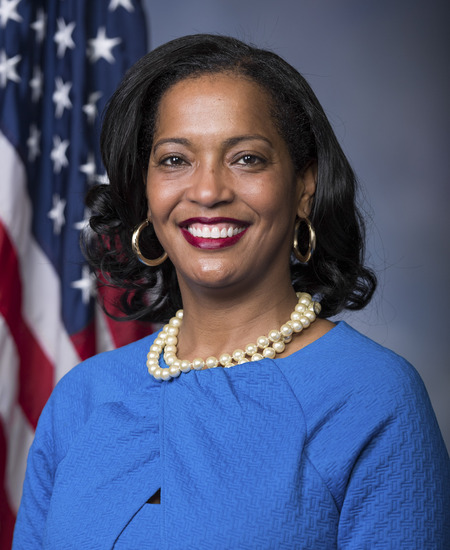
Rep. Jahana Hayes
Sponsored bills
Veterans Visa and Protection Act of 2021 This bill provides permanent resident status and citizenship eligibility to certain noncitizen veterans and addresses related issues. The Department of Homeland Security (DHS) must establish a program that allows (1) eligible noncitizen veterans outside of the United States to be admitted as permanent residents, and (2) eligible noncitizen veterans in the United States to obtain permanent resident status. Generally, an eligible noncitizen veteran under this bill is one who was not removed from the United States for certain crimes related to violence or national security. DHS may waive these eligibility requirements for humanitarian, family unity, public interest, or exceptional military service reasons. A noncitizen veteran who obtains permanent resident status under this bill shall be eligible for (1) naturalization through service in the Armed Forces, and (2) military and veterans benefits as if they had not been removed (or ordered removed) from the United States. For a noncitizen veteran in removal proceedings or subject to a final removal order, the Department of Justice (DOJ) must determine whether the veteran is eligible for permanent resident status under this bill. If the veteran is eligible, DOJ must adjust the veteran's status. The bill also protects noncitizen veterans or service members from being removed from the United States unless the veteran has been convicted of a crime of violence.
Disarm Hate Act The bill expands the categories of persons who are prohibited from receiving or possessing a firearm. Specifically, it prohibits firearm sale or transfer to and receipt, possession, shipment, or transport by a person (1) who has been convicted of a misdemeanor hate crime, or (2) who has received an enhanced hate crime misdemeanor sentence.
Greater Leadership Overseas for the Benefit of Equality Act of 2021 or the GLOBE Act of 2021 This bill contains provisions related to (1) the protection of LGBTQI individuals globally; and (2) immigration protections for vulnerable individuals. The bill establishes (1) an interagency group to respond to urgent threats to LGBTQI people in foreign countries, and (2) a permanent Special Envoy for the Human Rights of LGBTQI Peoples in the Department of State. The President shall impose visa-blocking sanctions on foreign persons responsible for violating the human rights of individuals based on sexual orientation, gender identity, or sex characteristics. The State Department shall establish the Global Equality Fund to provide assistance to nongovernmental organizations working to advance and protect human rights. The U.S. Agency for International Development shall establish the LGBTQI Global Development Partnership to work with the private sector and nongovernmental organizations to support LGBTQI rights. The bill removes prohibitions against providing foreign assistance to nongovernmental organizations that offer certain medical services (e.g., abortion-related services) using non-U.S. government funds. The bill contains several immigration-related provisions, such as those establishing that persecution based on sexual orientation or gender identity may form the basis of an asylum request, allowing certain applicants to file asylum claims more than a year after their arrival in the United States, including a permanent partnership between two partners as a marriage for immigration law purposes, providing for free counsel in certain immigration proceedings, and granting U.S. citizenship to a child born abroad through assistive reproductive technology from a U.S. citizen who is the child's nonbiological parent.
Housing is a Human Right Act of 2021 This bill establishes and expands programs to assist homeless and housing-unstable individuals and establishes new real property-related taxes to fund specified Department of Housing and Urban Development (HUD) programs. HUD must establish the Community Development Block Grant Plus Program for state and local governments to assist homeless and housing-unstable individuals as well as cost-burdened households. These funds may be used only for certain activities that assist these populations, including the construction of new affordable housing. The bill also establishes other grant programs to assist these individuals, such as by facilitating access to voting and libraries. Governmental entities may not receive assistance under the bill unless they have, or are working to implement, policies that (1) do not criminally punish homeless individuals for sleeping outside or on public property, and (2) comply with constitutional protections for these individuals' property. In addition, the bill establishes taxes on (1) the sale or exchange of real property of at least $10 million, (2) the sale or exchange of real property involving an anonymous entity, and (3) rent received by landlords that own large amounts of dwelling units. The revenue from these taxes must be credited to various HUD programs in specified percentages. The Government Accountability Office must study (1) the allocation formula for Emergency Food and Shelter grants, (2) recipient compliance with various grant program guidelines, and (3) barriers related to access to essential documents that homeless and housing-unstable individuals face.
Enhancing Oversight to End Discrimination in Policing Act This bill expands the capacity to enforce a law that prohibits patterns or practices of misconduct by state and local law enforcement agencies. Current law prohibits state and local law enforcement agencies from engaging in patterns or practices of conduct that violate constitutional or federal rights. Further, current law authorizes the Department of Justice (DOJ) to file civil cases to eliminate the pattern or practice of misconduct. Typically, DOJ's Civil Rights Division conducts pattern-or-practice investigations and resolves any misconduct through a consent decree instead of a trial. This bill provides statutory authority for state attorneys general to bring pattern-or-practice cases in federal court. The bill also authorizes grants to help states pursue pattern-or-practice investigations and cases. Additionally, the bill authorizes additional amounts for DOJ's Civil Rights Division and requires a certain portion to be used for enforcement and technical assistance related to pattern-or-practice cases. Finally, the bill requires DOJ's Civil Rights Division to modify the procedures for consent decrees and settlement agreements to ensure that the consent decrees and settlement agreements (1) foster the creation and use of alternative remedies such as mental health support or community-based restorative justice mechanisms; and (2) incorporate community oversight requirements, such as a community oversight body.
Eviction Prevention Act of 2021 This bill authorizes the Department of Justice to provide grants to state and local governments to make legal counsel available to eligible tenants undergoing eviction proceedings. An eligible tenant is an individual whose income is less than 125% of the federal poverty level. The bill also requires the Department of Housing and Urban Development to establish a national database of evictions. The Government Accountability Office must report on the national status of legal representation of tenants in eviction proceedings, including the effects of access to representation on case outcomes.
Homeland Security Improvement Act This bill establishes various bodies and policies related to border security operations. It also limits when the Department of Homeland Security (DHS) may separate a child from a parent or legal guardian. The bill establishes the independent DHS Border Oversight Commission. The commission's duties shall include recommending policies to protect civil rights and improve the safety of U.S. Customs and Border Protection (CBP) and U.S. Immigration and Customs Enforcement (ICE) officers. The bill establishes the Office of the Ombudsman for Border and Immigration Related Concerns. The office shall independently receive and resolve complaints and requests for assistance regarding border security and immigration activities. The office shall have the power to provide redress, including immigration relief and monetary damages. The bill establishes the Border Community Liaison Office. The office's duties include consulting with communities in sectors on the northern and southern borders when developing policies and programs. DHS must ensure CBP officers receive continual education and training each year on topics including interaction with vulnerable populations and professional conduct standards. The bill imposes data collection requirements on law enforcement officials conducting border and immigration-related stops and searches. A child may not be removed from a parent or legal guardian at or near a port of entry or within 100 miles of the border except in certain instances, such as when a court determines that removal of the child is in the child's best interests. The bill requires various reports, including a Government Accountability Office report on the use of force by CBP and ICE.
Neighbors Not Enemies Act of 2021 This bill repeals provisions authorizing the President to apprehend and remove from the United States the citizens of a particular nation, if the United States has declared war against that nation or that nation has threatened an invasion against the United States.
Menstrual Equity For All Act of 2021 This bill expands access to free sanitary napkins and tampons (i.e., menstrual products) in certain locations and for particular groups. It also requires Medicaid to cover menstrual products, as well as liners, cups, and similar items used by individuals with respect to menstruation. Specifically, the bill imposes requirements to make free menstrual products available in federal and state correctional facilities (including facilities that house aliens detained by the Department of Homeland Security) and restrooms in federal buildings that are open to the public. It also establishes a demonstration grant program to support the provision of free menstrual products on campuses of institutions of higher education and permits elementary and secondary schools to use certain grants to provide menstrual products to students. Furthermore, the bill requires employers with at least 100 employees to provide free menstrual products for employees. It also permits the use of certain grants for emergency food and shelter to provide menstrual products to homeless individuals.