

Respect for Marriage Act This act provides statutory authority for same-sex and interracial marriages. Specifically, the act replaces provisions that define, for purposes of federal law, marriage as between a man and a woman and spouse as a person of the opposite sex with provisions that recognize any marriage between two individuals that is valid under state law. (The Supreme Court held that the current provisions were unconstitutional in United States v. Windsor in 2013.) The act also replaces provisions that do not require states to recognize same-sex marriages from other states with provisions that prohibit the denial of full faith and credit or any right or claim relating to out-of-state marriages on the basis of sex, race, ethnicity, or national origin. (The Supreme Court held that state laws barring same-sex marriages were unconstitutional in Obergefell v. Hodges in 2015; the Court held that state laws barring interracial marriages were unconstitutional in Loving v. Virginia in 1967.) The act allows the Department of Justice to bring a civil action and establishes a private right of action for violations. The act does not (1) affect religious liberties or conscience protections that are available under the Constitution or federal law, (2) require religious organizations to provide goods or services to formally recognize or celebrate a marriage, (3) affect any benefits or rights that do not arise from a marriage, or (4) recognize under federal law any marriage between more than two individuals.
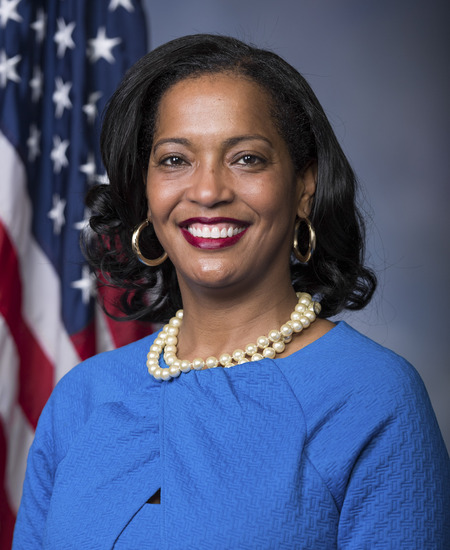
Rep. Jahana Hayes
Sponsored bills
Billy's Law or the Help Find the Missing Act This bill provides statutory authority for the Department of Justice (DOJ) to maintain the National Missing and Unidentified Persons System (NamUs) consistent with its existing purpose and structure. NamUs is a national information clearinghouse and resource center for cases involving missing persons and unidentified or unclaimed remains. NamUs is administered by the National Institute of Justice within DOJ. The bill also establishes new requirements. First, it requires a law enforcement agency that submits a missing child report to the National Crime Information Center (NCIC) to also submit the missing child report to NamUs. The NCIC is a computerized index of criminal justice data and files for reports of missing and unidentified persons. Current law requires law enforcement agencies to submit missing child reports to the NCIC database but not to the NamUs databases. Second, the bill establishes requirements to facilitate data sharing between the NCIC database and the NamUs databases with respect to missing and unidentified persons. Specifically, the bill requires DOJ to give the National Institute of Justice access to the NCIC missing person and unidentified person records for the purpose of validating cases and reconciling data with NamUs. Additionally, the bill requires DOJ to assess the NCIC and NamUs systems and governing statutes, policies, and procedures and create a plan for NCIC to automatically transmit certain records to NamUs. Third, the bill requires DOJ to report to forensic medicine service providers and law enforcement agencies on best practices for collecting, reporting, and analyzing data and information on missing persons and unidentified human remains. DOJ must also report to Congress biennially on the status of the NCIC database and the NamUs databases. The report must describe the process of information sharing between the NCIC database and NamUs databases.
International Violence Against Women Act of 2022 This bill requires a U.S. global strategy to prevent and respond to violence against women and girls. The bill establishes in the Department of State an Office of Global Women's Issues, which shall be headed by an Ambassador-at-Large for Global Women's Issues. The Ambassador-at-Large shall (1) coordinate U.S. government efforts regarding gender equality and the advancement of women and girls in foreign policy, and (2) develop or update periodically a U.S. global strategy to prevent and respond to gender-based violence. The bill establishes in the U.S. Agency for International Development the position of Senior Coordinator for Gender Equality and Women's Empowerment who shall coordinate policies, programs, and funding regarding gender equality and women's empowerment.
End Tuberculosis Now Act of 2022 This bill authorizes actions, including the provision of international assistance, to combat tuberculosis. The President may provide international assistance for the prevention, treatment, control, and elimination of tuberculosis. The President must also establish goals for U.S. efforts to detect, cure, and prevent all forms of tuberculosis globally by updating the U.S. Government Tuberculosis Strategy (2015-2019) and the National Action Plan for Combating Multidrug-Resistant Tuberculosis. The Government Accountability Office must periodically report to Congress on the impact of efforts to combat tuberculosis that are supported by U.S. bilateral assistance.
Veteran Service Recognition Act of 2022 This bill addresses immigration-related issues pertaining to noncitizen (or non-U.S. national) military veterans, including by authorizing the Department of Homeland Security (DHS) to provide lawful permanent resident status to a veteran subject to removal. If a noncitizen veteran appears to be eligible for lawful permanent resident status under this bill, that veteran must receive a reasonable opportunity to apply for such status and may not be removed until there is a final administrative decision on the veteran's eligibility. For the purposes of providing such status under this bill, DHS may waive any applicable grounds of inadmissibility, except for certain crime- or security-related grounds. The bill also extends certain deadlines relating to obtaining citizenship after serving in the Armed Forces. DHS must create a system for identifying noncitizens who are or may be veterans. Before initiating removal proceedings against a noncitizen, DHS must attempt to determine whether the noncitizen is a veteran. DHS must ensure that veteran status is considered in immigration proceedings. The bill also requires U.S. Citizenship and Immigration Services (USCIS) and the Department of Defense to take certain actions to facilitate opportunities for military recruits and veterans to obtain U.S. citizenship, such as by training Judge Advocate General Corps members to act as liaisons between the Armed Forces and USCIS on servicemember citizenship applications. The bill also establishes the Military Family Immigration Advisory Committee to provide recommendations on cases involving the removal of a servicemember, veteran, or certain family members of a servicemember or veteran. Such an individual may not be removed until the committee has provided a recommendation to DHS about the individual's case, unless the individual is inadmissible due to a conviction for an aggravated felony. The bill also waives certain grounds of inadmissibility (e.g., being unlawfully present in the United States) for certain noncitizens applying for lawful permanent resident status as an immediate relative of a U.S. citizen who has served at least two years in the Armed Forces.
READ Act Reauthorization Act of 2022 This bill reauthorizes a law that requires the implementation of a strategy to promote quality basic education in partner countries by (1) expanding access to basic education for all children, particularly marginalized children and vulnerable groups; and (2) improving the quality of basic education and learning outcomes.
Save Oak Flat Act This bill repeals the requirement for the Department of Agriculture to convey the 2,422 acres of Forest System land located in Tonto National Forest in Pinal County, Arizona, known as Oak Flat, to Resolution Copper Mining, LLC, in exchange for various parcels of land owned by Resolution Copper. Oak Flat is withdrawn from (1) entry, appropriation, or disposal under the public land laws; (2) location, entry, and patent under the mining laws; and (3) disposition under all laws pertaining to mineral and geothermal leasing or mineral materials.
One Stop Shop Community Reentry Program Act of 2022 This bill authorizes grants to support community-based reentry resources for previously incarcerated individuals who return to their communities. First, the bill authorizes the Department of Justice (DOJ) to make grants for community-based nonprofit organizations to create community reentry centers. Second, the bill authorizes DOJ to make grants for states, Indian tribes, and local governments to operate reentry services assistance hotlines.
This resolution condemns the use of starvation of civilians as a weapon of warfare. It also calls on the U.S. government to prioritize diplomatic efforts to call out and address instances where hunger and intentional deprivation of food is being utilized as a weapon of war, including efforts to ensure that security operations do not undermine livelihoods of local populations to minimize civilian harm.
Students' Access to Freedom and Educational Rights Act of 2022 This bill expands protections against discrimination and harassment in federally funded education programs or activities. Among other provisions, the bill (1) establishes statutory standards of liability for harassment and relevant remedies under specified statutes; (2) requires the Department of Education to develop a climate survey on K-12 students' experiences with domestic violence, dating violence, sexual assault, sexual harassment, and stalking; and (3) establishes training requirements and a grant program for Title IX coordinators.