This resolution condemns the actions of a White supremacist mob that drove Black residents out of Atlanta, Georgia in 1906 and supports the designation of a national day of remembrance for the victims of forced migrations of Black Americans.
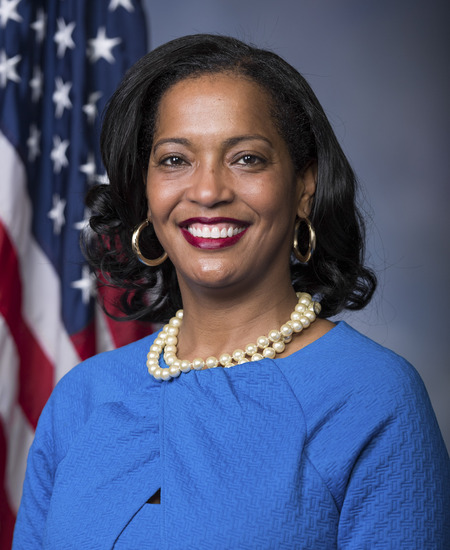
Rep. Jahana Hayes
Sponsored bills
Bus Rapid Transit Act This bill directs the Federal Transit Administration (FTA) to establish a grant program to provide grants to state, local, and tribal governments for the design and implementation of bus rapid transit systems, including for the redesign, retrofit, renovation, update, and repair of existing bus systems. As a condition of receiving a grant, eligible entities must certify that fares for riding the bus rapid transit system shall not increase solely due to improvements carried out with grant funds and for any reason for at least one year after completion of a project funded by the bill. In carrying out the program, the FTA must prioritize projects located in economically disadvantaged communities.
Expanding the Voluntary Opportunities for Translations in Elections Act or the Expanding the VOTE Act This bill expands access to voting materials for individuals with limited proficiency in the English language, including by establishing incentive grants for states and political subdivisions to provide translated voting materials. Additionally, the bill directs the Government Accountability Office to study the impact of (1) reducing the threshold requirement under Section 203 of the Voting Rights Act of 1965, and (2) expanding the definition of language minorities to include native speakers of additional languages.
Big Cat Public Safety Act This act revises requirements governing the trade of big cats (i.e., species of lion, tiger, leopard, cheetah, jaguar, or cougar or any hybrid of such species) under the Lacey Act to limit the possession, breeding, and exhibition of big cats. The Lacey Act prohibits any person from importing, exporting, buying, selling, transporting, receiving, or acquiring big cats across state lines or the U.S. border. However, some exemptions are provided for certain entities, such as universities and wildlife sanctuaries. (Sec. 3) The act expands the Lacey Act prohibitions to include a prohibition on possessing or breeding big cats. Breeding means facilitating propagation or reproduction (whether intentionally or negligently), or failing to prevent propagation or reproduction. Owners of big cats that were born before this act's enactment may keep their big cats, but the owners must register them with the U.S. Fish and Wildlife Service. The act modifies the list of entities that are exempt from prohibitions to export, buy, sell, transport, receive, acquire, possess, or breed big cats. The modified list includes exemptions for entities or facilities exhibiting animals to the public if they (1) hold a Class C license in good standing under the Animal Welfare Act, and (2) do not allow individuals to come into direct physical contact with big cats. However, direct contact is allowed if the individual is a trained professional, a veterinarian, or directly supporting conservation programs that do not involve commercial activities and meet other specified restrictions. (Sec. 4) A person who knowingly violates the act must be fined not more than $20,000, or imprisoned for no more than five years, or both. The act considers each violation to be a separate offense. The offense must be deemed to have been committed not only in the district where the violation first occurred, but also in any district in which the defendant may have taken or been in possession of the prohibited wildlife species. (Sec. 5) The act extends forfeiture provisions to fish, wildlife, or plants that are bred or possessed; thus, big cats bred or possessed in violation of the act are subject to forfeiture. (Sec. 6) The Department of the Interior must issue regulations to implement this act.

Rebuild America's Schools Act of 2022 This bill provides support for long-term improvements to public elementary and secondary school facilities. First, the bill sets forth allocations to states and establishes a need-based grant program for local educational agencies (LEAs) to improve school facilities. Further, the bill specifies allowable uses of grant funds, including carrying out major repairs, improving indoor air quality, and making facilities accessible to disabled individuals. Additionally, the bill requires LEAs that receive funds for new construction, modernization, or renovation projects to comply with hazard-resistance building codes and performance criteria under the WaterSense program of the Environmental Protection Agency. Further, the bill requires such LEAs to adopt certain green practices (environmental standards) and requires the use of iron, steel, and manufactured products that are made in the United States (Buy America). The bill restores school infrastructure tax credit bonds. The bill also sets forth reporting requirements, including annual reports on grant program projects and a report by the Government Accountability Office that requires a study of the geographic distribution of projects, the impact of selected projects on student and staff health and safety, and the accessibility of projects to high-poverty schools. The bill also establishes the Office of School Infrastructure and Sustainability within the Department of Education. Next, the bill extends through FY2027 the Impact Aid Construction program. Finally, the bill establishes a grant program to assist LEAs with repairing or replacing concrete foundations affected by pyrrhotite (an iron sulfide material linked to crumbling foundations).
VA Employee Fairness Act of 2021 This bill repeals provisions excluding any matter or question concerning professional conduct or competence; peer review; or the establishment, determination, or adjustment of employee compensation from the applicability of collective bargaining rights for Veterans Health Administration employees.
Equal Access to Green cards for Legal Employment Act of 2022 or the EAGLE Act of 2022 This bill modifies requirements related to employment-based visas and addresses related issues. The bill increases the per-country cap on family-based immigrant visas from 7% of the total number of such visas available that year to 15% and eliminates the per-country cap for employment-based immigrant visas. The bill establishes transition rules for employment-based visas such as (1) reserving a percentage of EB-2 (workers with advanced degrees or exceptional ability) and EB-3 (skilled and other workers) visas for individuals not from the two countries with the largest number of recipients of such visas, and (2) allotting a number of visas for professional nurses and physical therapists. The bill imposes additional requirements on an employer seeking an H-1B visa, such as prohibiting (1) an employer from advertising that a position is only open to H-1B applicants or that H-1B applicants are preferred, and (2) certain employers from having more than half of their employees as nonimmigrant visa workers. The Department of Labor shall create a publicly available website where an employer seeking an H-1B visa must post certain information about the open position. The bill also expands Labor's authority to review and investigate H-1B applications for fraud or misrepresentations. The bill also allows certain aliens to obtain lawful permanent resident status if the alien (1) is in the United States as a nonimmigrant, (2) has an approved immigrant visa petition, and (3) has waited at least two years for a visa.
Transparency in Energy Production Act of 2021 This bill requires certain disclosures by entities seeking a lease or holding a lease to develop renewable energy operations or fossil fuel operations on public lands or Indian lands or any operation using any right-of-way or special use permit that would cross public lands, Indian lands, or national forests that would facilitate fossil fuel development. The disclosures are those described in the Sustainability Accounting Standard for the Renewable Resources and Alternative Energy Sector or the Extractives and Mineral Processing Sector. Every two years, the Department of the Interior and the Department of Agriculture must report to Congress on such operations, including greenhouse gas emissions, air quality, water management, biodiversity impacts, production, and the number of sites. For renewable energy operations on public lands or Indian lands, the report must include greenhouse gas emissions that would result from the production of the same amount of energy using fossil fuels.
This resolution expresses that the House of Representatives is committed to building upon the 20 years of success of the George McGovern-Robert Dole International Food for Education and Child Nutrition Program, complementing humanitarian assistance efforts and development programs through the continued implementation of the McGovern-Dole Program to address global food insecurity and create conditions for peace and stability, and supporting U.S. farmers, millers, shippers, and commodity groups that provide agricultural commodities for use in the McGovern-Dole Program to help combat global malnutrition and food insecurity and advance global education.
Access to School Supplies Act of 2022 This bill directs the Department of Education to carry out a pilot program to make competitive grants for up to 10 qualified local educational agencies to purchase school supplies. School supplies refer to books, supplies, and supplementary materials used by students and instructional staff in the classroom.