Stop the Wait Act of 2022 This bill allows individuals with disabilities to begin receiving Social Security Disability Insurance (SSDI) benefits in the month they become eligible for the benefits. It also allows these individuals to immediately enroll in Medicare if they cannot afford minimum essential coverage. (Under current law, an individual must generally wait 5 months after the onset of disability to begin receiving SSDI benefits and an additional 24 months to become eligible for Medicare.)
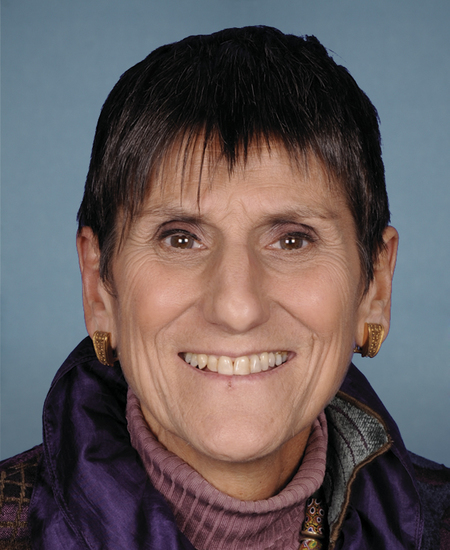
Rep. Rosa L. DeLauro
Sponsored bills
Maddy summaryThis resolution (HRES 884) symbolically recognizes January 2022 as "National Mentoring Month" to highlight the value of mentoring relationships for youth. It does not create new laws or provide funding, but instead acknowledges mentoring's role in supporting young people's education, career development, and well-being. The resolution encourages promoting mentoring programs across communities, schools, and workplaces to address the "mentoring gap" where one in three youth lacks a supportive adult outside their home. As a procedural resolution, it has no direct legal effect on individuals or programs.
This bill revises enforcement provisions under the Animal Welfare Act (AWA), including by directing inspectors to confiscate or destroy in a humane manner animals found to be suffering physical or psychological harm as a result of failure to comply with the AWA.
National Critical Capabilities Defense Act of 2021 This bill establishes the Committee on National Critical Capabilities to review certain transactions by U.S. businesses, including those transactions that could result in an unacceptable risk to national critical capabilities. Further, the bill authorizes the President to suspend or prohibit transactions that pose an unacceptable risk to national critical capabilities.
Protecting Our Democracy Act This bill addresses issues involving (1) abuses of presidential power; (2) checks and balances, accountability, and transparency; and (3) election integrity and security. Specifically, regarding abuses of presidential power, the bill requires the Department of Justice (DOJ) and the President to submit to Congress specified materials relating to certain pardons, prohibits presidential self-pardons, suspends the statute of limitations for federal offenses committed by a sitting President or Vice President, prohibits the acceptance of foreign or domestic emoluments, and sets forth provisions regarding Office of Government Ethics and Office of Special Counsel jurisdiction and enforcement authority. To address checks and balances, accountability, and transparency, the bill authorizes specified actions to enforce congressional subpoenas, imposes limits on presidential declarations of emergencies, requires DOJ to maintain a log of specified communications between it and the White House, requires cause for removal of inspectors general, increases whistleblower protections, and requires a candidate for President or Vice President to provide copies of tax returns for the 10 most recent taxable years to the Federal Election Commission. To address election integrity and security, the bill requires federal campaign reporting of foreign contacts, makes various changes to requirements concerning foreign donations to political campaigns and candidates and foreign contributions to online electioneering communications, prohibits distribution of materially deceptive audio or visual media prior to an election (i.e., deepfakes), and establishes a program to support states and localities transition to ranked choice voting systems.

Humane Cosmetics Act of 2021 This bill generally prohibits animal testing in the evaluation of cosmetic products, and it prohibits the sale or transport of cosmetics developed using animal testing, subject to civil penalties. These prohibitions begin one year after enactment. The bill specifies exceptions to these prohibitions, including if such animal testing (1) is conducted outside the United States to comply with a foreign regulatory authority; (2) is pursuant to a specified finding that there are no nonanimal alternatives to test the safety of a potentially dangerous cosmetic product or ingredient; (3) is of a product or ingredient for a drug or device subject to regulation by the Food and Drug Administration (FDA); or (4) is required for a noncosmetic purpose pursuant to a state, federal, or foreign regulatory authority. Further, no animal-testing evidence may be used to establish the safety of a cosmetic product or ingredient that is regulated by the FDA after the effective date of this bill, subject to limited exceptions.
Further Extending Government Funding Act This act provides continuing FY2022 appropriations for federal agencies, provides supplemental appropriations, and extends several expiring authorities. Specifically, the act provides continuing FY2022 appropriations to federal agencies through the earlier of February 18, 2022, or the enactment of the applicable appropriations act. It is known as a continuing resolution (CR) and prevents a government shutdown that would otherwise occur if the FY2022 appropriations bills have not been enacted when the existing CR expires on December 3, 2021. The CR funds most programs and activities at the FY2021 levels with several exceptions that provide funding flexibility and additional appropriations for various programs. In addition, the act provides supplemental appropriations to several federal agencies for activities related to the evacuees from Afghanistan. Specifically, the act provides appropriations to the Department of Defense, the Department of Homeland Security, the Department of Health and Human Services, and the Department of State. The act also extends several expiring authorities, including the authority for the Department of Health and Human Services to make certain appointments for the National Disaster Medical System, the special assessment under the Justice for Victims of Trafficking Act of 2015 on nonindigent people or entities convicted of certain criminal offenses (e.g., sexual abuse and trafficking), the temporary scheduling order issued by the Drug Enforcement Administration to place fentanyl-related substances in Schedule I of the Controlled Substances Act, the current Medicaid federal matching rate (also known as the Federal Medical Assistance Percentage or FMAP) for certain territories, and the pay freeze for certain senior officials and political appointees in the executive branch.
Maddy summaryHRES 834 is a ceremonial resolution honoring the late Congresswoman Carrie Pittman Meek (1926-2021) for her congressional service and legacy. It commends her dedication to public service, her role as a trailblazer for Black women in politics, and her advocacy for communities in Florida. The resolution specifically recognizes her work securing hurricane relief funding after Hurricane Andrew and her service in the Florida State Senate and U.S. Congress. As a commemorative resolution, it contains no policy changes or funding provisions.
Strength in Diversity Act of 2021 This bill establishes a program through which the Department of Education may award planning and implementation grants to specified educational agencies (e.g., local educational agencies) to improve diversity and reduce or eliminate racial or socioeconomic isolation in publicly funded early childhood education programs, public elementary schools, or public secondary schools.
Flu Vaccine Act This bill requires the National Institute of Allergy and Infectious Diseases, which is part of the National Institutes of Health, to conduct or support research regarding the development of a universal influenza vaccine.