

America's Call To Improve Opportunities Now for National Service Act or the ACTION for National Service Act This bill (1) converts the Corporation for National and Community Service into the AmeriCorps Administration and revises its membership, leadership, and authority; (2) reauthorizes programs carried out by the administration; (3) establishes a National Service Foundation to accept and administer gifts on behalf of the administration; (4) modifies the calculation of national service educational awards; and (5) otherwise modifies provisions related to national and volunteer service programs. Additionally, the bill creates an interagency Civilian Climate Corps, operated by the administration, to conduct service projects addressing climate change.
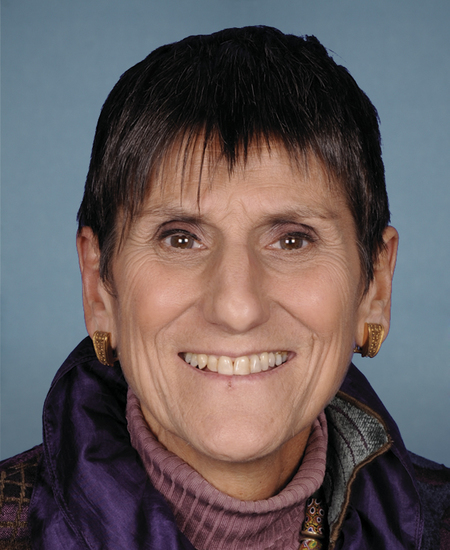
Rep. Rosa L. DeLauro
Sponsored bills
Bipartisan Ban on Congressional Stock Ownership Act of 2022 This bill prohibits Members of Congress and their spouses from owning or trading stocks, bonds, commodities, futures, or any other form of security. Each current Member must divest within 180 days after the bill is enacted and each new Member must divest within 180 days after becoming a Member. However, Members and their spouses have 5 years to divest from specified complex investment vehicles. The bill does not apply to certain investments, such as investments in widely held investment funds that are diversified and do not present a conflict of interest and investments held in government employee retirement plans. A Member or spouse who violates the bill may be subject to a fine of up to $50,000 for each violation. The bill permits a Member or spouse who is required to divest property under the bill to avoid recognizing gain for income tax purposes from the sale of that property to the extent that the Member or spouse purchases permitted bonds or diversified investment funds within 60 days of the divestiture.
Maddy summaryHRES 939 is a symbolic House resolution expressing support for designating February 21-25, 2022, as "Public Schools Week." It does not create new policies, allocate funding, or impose requirements on schools or students. The resolution uses supportive language to acknowledge public education's role in democracy but has no legal effect. It was introduced by multiple representatives as a non-binding gesture of appreciation for public schools.
Congressional Tribute to Constance Baker Motley Act of 2022 This bill provides for the award of a Congressional Gold Medal posthumously to Constance Baker Motley in recognition of her contributions and service to the United States in advancing civil rights as an attorney, elected official, and judge.
Further Additional Extending Government Funding Act This bill provides continuing FY2022 appropriations for federal agencies and extends several expiring authorities. Specifically, the bill provides continuing FY2022 appropriations to federal agencies through the earlier of March 11, 2022, or the enactment of the applicable appropriations act. It is known as a continuing resolution (CR) and prevents a government shutdown that would otherwise occur if the FY2022 appropriations bills have not been enacted when the existing CR expires on February 18, 2022. The CR funds most programs and activities at the FY2021 levels with several exceptions that provide funding flexibility or additional appropriations for various programs. For example, the CR includes provisions that address the President's authority to draw down defense articles and services to respond to unforeseen emergencies, procurement of the Columbia-class submarine, the Department of Defense's response to the contamination of drinking water near the Red Hill Bulk Fuel Storage Facility in Hawaii, and the Department of the Interior's implementation of enterprise cybersecurity safeguards. In addition, the bill extends several expiring authorities, including the authority for the Department of Health and Human Services to make certain appointments for the National Disaster Medical System, the special assessment under the Justice for Victims of Trafficking Act of 2015 on nonindigent people or entities convicted of certain criminal offenses (e.g., sexual abuse and trafficking), the temporary scheduling order issued by the Drug Enforcement Administration to place fentanyl-related substances in Schedule I of the Controlled Substances Act, and the current Medicaid federal matching rate (also known as the Federal Medical Assistance Percentage or FMAP) for certain territories. The bill also exempts the budgetary effects of these extensions from (1) the Statutory Pay-As-You-Go Act of 2010 (PAYGO), (2) the Senate PAYGO rule, and (3) certain budget scorekeeping rules.
Stop Unfair Medicaid Recoveries Act of 2022 This bill prohibits state Medicaid programs from using estate recovery to recoup the costs of benefits. States must withdraw property liens within 90 days of the bill's enactment.
This resolution extends collective bargaining rights prescribed in the Congressional Accountability Act of 1995 to employees of the House of Representatives.
Housing Emergencies Lifeline Program Act of 2022 or the HELP Act of 2022 This bill requires the Department of Housing and Urban Development (HUD) to establish a database of information regarding evictions from federally assisted dwellings, limits the inclusion of information relating to landlord-tenant actions in consumer reports, and otherwise provides eviction-related assistance and services. Specifically, the bill requires states and local entities receiving federal housing assistance to submit to HUD, for inclusion in the database, certain information regarding evictions from assisted dwelling units in the past year. Such information must include, among other things, the reason for eviction and whether the household was represented by legal counsel in the proceedings. Additionally, the bill prohibits a consumer reporting agency from making a consumer report containing an eviction or item related to an eviction from a rental dwelling or any adverse information related to rent or utility arrears. Further, the bill authorizes additional Emergency Solutions Grants to provide legal counsel and pay court fees for tenants subject to or at risk of eviction. Finally, HUD must require owners of federally assisted rental units to (1) annually provide information to each tenant regarding the rights and responsibilities of the owner with respect to eviction and local organizations and resources that can provide assistance in eviction-related matters; and (2) upon provision of an eviction notice, information stating the reason for the eviction. HUD must also establish an eviction hotline to provide assistance to tenants of these units.
Part-Time Worker Bill of Rights Act This bill modifies various employment, leave, and pension rules with respect to part-time workers. Specifically, the bill removes the requirement that employees work a minimum number of hours during the preceding 12-month period before becoming eligible for family and medical leave. The bill also sets the maximum length of service on which employers may condition the eligibility of part-time employees for a qualified pension plan (e.g., 401(k) retirement plan). Except as required by an applicable collective bargaining agreement, such service requirement may be no longer than two consecutive 12-month periods of at least 500 hours of service for part-time employees who have reached the age of 21 by the end of such periods. The bill further prohibits employers of more than 15 employees from setting disparate terms of employment or working conditions for part-time employees, including with respect to compensation, notice of work hours, and promotion opportunities, among others. Additionally, the bill requires such employers to offer available, qualified part-time employees additional work hours before hiring new employees for such hours. Among other enforcement methods, employers must maintain three years of records for offers of additional hours and employee responses to such offers. The bill also provides a private right of action for employees to enforce the nondiscrimination requirements of this bill.
Keeping School Meals Flexible Act This bill extends authority through June 30, 2023, for the Department of Agriculture (USDA) to waive certain requirements for the school meal programs to address COVID-19. The bill extends the authority for USDA to issue a single waiver of child nutrition program requirements to all states under the National School Lunch Program for purposes of providing meals and snacks with appropriate safety measures with respect to COVID-19; grant waivers of requirements to allow non-congregate feeding in the Child and Adult Care Food Program for purposes of providing meals and snacks with appropriate safety measures with respect to COVID-19; and grant waivers related to the nutritional content of meals served in child nutrition programs if it determines the waiver is necessary to provide meals and snacks, and there is a food supply chain disruption due to COVID-19.