Passport Backlog Elimination Act This bill requires the Department of State to submit and implement a plan containing specified actionable strategies to eliminate the backlog of passport applications that is due to the COVID-19 pandemic.
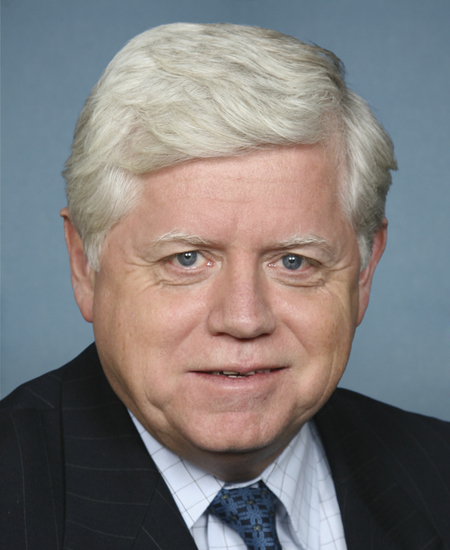
Rep. John B. Larson
Sponsored bills
This concurrent resolution recognizes the disparity in wages paid to Black women and its impact on women, families, and the nation, and reaffirms Congress' support for ensuring equal pay and closing the gender wage gap.
Equal Pay for Equal Work Act This bill establishes the National Equal Pay Enforcement Task Force to improve enforcement of equal pay laws.
Medical Device Nonvisual Accessibility Act of 2021 This bill requires certain medical devices with a digital interface to meet nonvisual accessibility standards established by the Food and Drug Administration (FDA). Specifically, the FDA must establish regulations to require a Class II or Class III medical device with a digital interface to provide a blind or low-vision user access to the same services and information, and generally the same ease of use, as provided to a user who is not low-vision or blind. (The FDA classifies medical devices in three classes. Class I devices are low-risk, Class II devices are moderate-risk, and Class III devices are high-risk.) A Class II or Class III medical device that does not meet the nonvisual accessibility standards established under this bill may not be sold.
Domestic Workers Bill of Rights Act This bill provides rights and protections for domestic workers (e.g., housekeepers, nannies, caretakers, personal assistants, and chauffeurs), including pay and leave rights, and health and safety protections. Specifically, the bill repeals the exemption of domestic live-in employees from certain minimum wage and maximum hour requirements. Employers must provide written notice of termination and provide at least 30 days of lodging and two weeks of severance pay to terminated live-in employees. Live-in employees also must be provided with reasonable access to telephone and internet service during their employment. The bill requires employers to provide domestic workers with a written agreement covering wages, sick leave, benefits, and other matters. Further, domestic workers may request and be granted changes to work schedules due to personal events. The bill also provides domestic workers with certain privacy rights, extends to domestic workers protections against discrimination in employment, and increases the federal medical assistance percentage (FMAP) for certain Medicaid-funded medical services provided by domestic workers. The Department of Labor must (1) award grants for a domestic worker national hotline for reporting emergencies, training on hazards facing domestic workers, and workforce investment activities for domestic workers; and (2) establish a Domestic Worker Wage and Standards Board to investigate standards in the domestic workers industry. Labor must publish online a document that describes the rights and protections for domestic workers under this bill.

Protecting Renters from Evictions Act of 2021 This bill extends through December 31, 2021, the order issued by the Centers for Disease Control and Prevention titled Temporary Halt in Residential Evictions To Prevent the Further Spread of COVID–19 and published on September 4, 2020.
Revitalizing Downtowns Act This bill expands the investment tax credit to add a qualified office conversion credit. The amount of such credit is 20% of the qualified conversion expenditures with respect to a qualified converted building. The bill defines qualified converted building as any building if (1) prior to conversion, the building was nonresidential real property which was leased, or available for lease, to office tenants; (2) the building has been substantially converted from an office use to a residential, retail, or other commercial use; (3) the building was initially placed in service at least 25 years prior to the beginning of the conversion, and (4) straight line depreciation is allowable with respect to the building.
Rebuilding Economies and Creating Opportunities for More People Everywhere To Excel Act or the RECOMPETE Act This bill establishes a grant program to assist economically distressed local communities and labor markets that meet specified economic criteria, including employment criteria. The Economic Development Administration (EDA) must award 10-year grants to a local government, tribal government, economic development district, or consortium of local government units located in such areas. Each grant recipient must develop and implement a comprehensive strategy to address the economic challenges specific to the area. The grants may be used to increase employment opportunities, increase local per capita income, support economic development, and develop infrastructure and housing. Additionally, the EDA must periodically evaluate each grant recipient based on certain benchmark criteria and annually report on the implementation of the program. The bill specifies formulas for determining the grant amount for each community or market and the federal share of the cost of each program or activity conducted under the program.
This bill repeals the limitation on the amount of distilled spirits excise tax covered over (paid) to the treasuries of the U.S. Virgin Islands and the Commonwealth of Puerto Rico. The bill requires certain amounts of the excise tax paid to the treasury of Puerto Rico to be transferred to the Puerto Rico Conservation Trust Fund.
United States Call Center Worker and Consumer Protection Act of 2021 This bill establishes restrictions on businesses that relocate call centers or redirect customer service calls to locations outside the United States. Specifically, a business must notify the Department of Labor that it intends to move its customer service call center overseas and Labor must maintain a publicly available list of such businesses. Subject to narrow exceptions, a business appearing on such list is ineligible to receive federal grants or guaranteed loans for five years after the business is added to the list. Further, agencies must condition the awarding of government contracts on the requirement that any call center activity pursuant to the contract must be performed in the United States. Additionally, the bill requires call center employees to disclose their physical location at the beginning of each call initiated or received, unless all employees of the business participating in the communication are located in the United States, among other exceptions.