

Maddy summaryHR 4466 would rename the National School Lunch Program Act from "Richard B. Russell National School Lunch Act" to "Jean E. Fairfax National School Lunch Act" to honor Jean E. Fairfax, a civil rights activist who advocated for equitable access to the program. The bill would update this name in the law and over 40 other federal statutes referencing the current title, but does not alter the program's operations, funding, or eligibility. It directly affects legal references in federal law without changing how the program serves students.
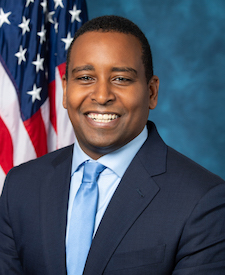
Rep. Joe Neguse
Sponsored bills
This resolution expresses the sense of the House of Representatives that (1) lesbian, gay, bisexual, transgender, queer, intersex, and asexual (LGBTQIA+) rights are human rights and protected by the U.S. Constitution; (2) LGBTQIA+ Pride Month should be celebrated; and (3) all Americans should be treated equally regardless of sexual orientation, sex characteristics, or gender identity.
Maddy summaryThis bill prohibits defendants in federal criminal cases from using a victim's LGBTQ+ identity (sexual orientation, gender identity, or expression) as a legal excuse for violence or to reduce sentences - a practice known as the "LGBTQ+ panic defense." It specifically bans arguments that a "nonviolent sexual advance or perception" of the victim's identity justified the crime, while allowing evidence of the defendant's past trauma under standard evidence rules. The law directly affects federal criminal trials where defendants attempt to justify violence against LGBTQ+ victims using prejudice-based excuses. It also requires the Attorney General to report annually on federal prosecutions involving bias-motivated crimes against LGBTQ+ individuals.
Maddy summaryHR 4400, the Veteran Overmedication and Suicide Prevention Act of 2023, requires the Department of Veterans Affairs (VA) to commission the National Academies of Sciences, Engineering, and Medicine to review all veteran suicides and related deaths from 2018-2023. This review analyzes medication use (including drugs with serious safety warnings or off-label prescriptions), treatment approaches (comparing medication-only vs. non-medication therapies like therapy), staffing levels for mental health providers, and data-sharing practices. It specifically examines veterans who died by suicide, violent death, or accidental death during the five-year period, focusing on medication histories, treatment protocols, and facility-specific patterns. The VA must submit the findings to Congress and the public within 30 days of the review's completion.
Maddy summaryThis bill creates a new pilot program allowing rural law enforcement agencies to apply for federal grants to purchase naloxone (a medication that reverses opioid overdoses) for officers to carry during patrols. It requires that at least 50% of funds under the Comprehensive Opioid Abuse Grant Program be awarded to rural communities, as defined by existing agricultural law. The bill specifically targets opioid overdose response by equipping rural police with life-saving tools during emergency calls. This policy change directly affects rural law enforcement agencies and communities with limited access to overdose reversal resources.
Maddy summaryHR 4422 (Global Respect Act) requires the President to publicly identify foreign officials responsible for violence, torture, or arbitrary detention against LGBTQI individuals and block their entry to the U.S., including revoking visas for them and their immediate families. It mandates annual reporting to Congress on the list of sanctioned individuals, the reasons for additions/removals, and efforts to coordinate with other countries on similar sanctions. The bill also updates U.S. human rights reporting requirements to explicitly include data on violence and discrimination against LGBTQI people worldwide. These measures aim to increase accountability for human rights violations against LGBTQI individuals without advocating for specific policy outcomes.
Maddy summaryHR 4340, the Therapeutic Fraud Prevention Act of 2023, prohibits paid providers from offering conversion therapy - defined as any commercial service attempting to change a person's sexual orientation or gender identity - and bans advertising that claims such therapy is effective or harmless. It directly affects therapists, counselors, or organizations offering paid conversion therapy services, including those advertising such services. Key provisions make it unlawful to provide, advertise, or facilitate paid conversion therapy, with enforcement led by the Federal Trade Commission (FTC) under consumer protection laws and allowing states to pursue civil actions. The bill explicitly excludes supportive care for gender transition or identity exploration from its definition of prohibited therapy.
National Nursing Shortage Task Force Act of 2023 This bill establishes a National Nursing Shortage Task Force to recommend policies for addressing the nursing shortage in the United States, particularly in designated health professional shortage areas. The task force terminates 90 days after it submits its recommendations.
Maddy summaryThe Project Safe Neighborhoods Reauthorization Act of 2023 extends federal funding for the Project Safe Neighborhoods (PSN) program through fiscal years 2024-2028, replacing its previous authorization period. The bill directly affects state, local, tribal, and federal law enforcement agencies, prosecutors, and community groups that receive PSN grants to reduce violent crime. Key provisions allow grantees to use funds for hiring crime analysts, covering overtime for officers and assistants, purchasing technology for crime reduction, and supporting multi-jurisdictional task forces. It also requires annual reports from the Attorney General detailing fund usage, community outreach, and violent crime statistics (including murder, robbery, and assault) in each program area. The program operates across all 94 U.S. federal judicial districts and territories.
Maddy summaryThe Military Families Mental Health Services Act (HR 4383) would eliminate cost-sharing (like copays or deductibles) for the first three mental health outpatient visits each year for active-duty military family members (including spouses and children) enrolled in TRICARE Select or TRICARE Prime. This applies specifically to beneficiaries in the active-duty family member category and certain other military dependents covered under a defined TRICARE provision (section 1110b). The waiver removes financial barriers for these initial visits without altering other TRICARE benefits or coverage. It directly affects military families seeking mental health care through these specific TRICARE plans.