

Safe Workplaces Act This bill requires the Occupational Safety and Health Administration (OSHA) to promulgate an occupational safety and health standard on reducing the threat of workplace violence, including firearm violence. Additionally, the National Institute for Occupational Safety and Health must study and make recommendations about ways to reduce workplace violence. OSHA must consider those recommendations when promulgating the workplace safety and health standard.
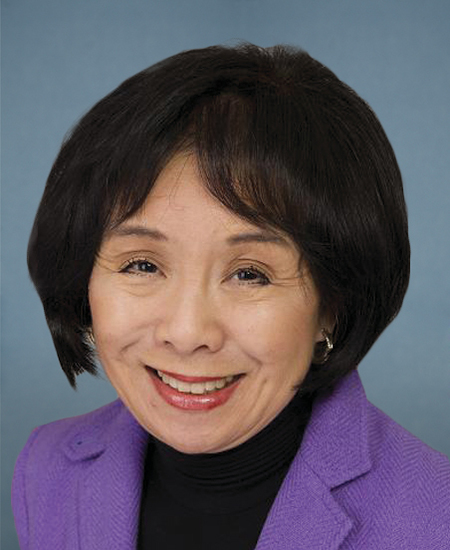
Rep. Doris O. Matsui
Sponsored bills
This resolution condemns the rape and assault of women by Russian forces in the occupied area of Bucha, Ukraine. The resolution condemns the deliberate disruption of the free flow of humanitarian aid that is harming innocent civilians, particularly women. The resolution also highlights the critical importance of ensuring women meaningfully participate in the planning and execution of humanitarian actions and the negotiation of peace agreements to meet their unique needs and to protect their human rights. Finally, the resolution calls on Vladimir Putin to condemn sexual and gender-based violence against women and girls in this conflict; hold all perpetrators who commit acts of sexual and gender-based violence accountable; cease all hostilities, protect human rights, and allow unencumbered humanitarian access; and remove all Russian Armed Forces, and other armed groups, from Ukraine.
Targeting Resources for Equitable Access to Treatment for Long COVID Act or the TREAT Long COVID Act This bill requires the Department of Health and Human Services to award competitive grants to create or expand the capacity of clinics that treat patients with persistent, long-term symptoms following recovery from acute COVID-19 (i.e., Long COVID). Eligible recipients include federally qualified health centers, rural health clinics, urban Indian health centers, and state and local health departments.
Ending Importation of Russian Oil Act This bill prohibits the importation of energy products from Russia. Specifically, the bill prohibits the importation of Russian products that are classified under chapter 27 of the Harmonized Tariff Schedule (which includes mineral fuels, mineral oils and products of their distillation, bituminous substances, and mineral waxes). The President may terminate this prohibition, subject to congressional disapproval, if the President certifies that Russia (1) has reached an agreement to withdraw Russian forces and cease military hostilities in Ukraine, (2) poses no immediate military threat of aggression to any North Atlantic Treaty Organization member, and (3) recognizes the right of the Ukrainian people to independently and freely choose their own government.
Maddy summaryHRES 1049 is a resolution recognizing California rice lands as critical habitat for wildlife, particularly waterfowl along the Pacific Flyway. It highlights rice growers' conservation practices, such as winter flooding, which create essential surrogate wetlands supporting hundreds of species in a region that has lost over 90% of its historic wetlands. The resolution acknowledges these efforts as vital to maintaining biodiversity and ecosystem health in California's Central Valley.
This bill prohibits behavioral health providers from receiving Centers for Medicare & Medicaid Services Innovation Center incentive payments for testing certified electronic health record technology unless the provider has acquired health information systems that meet specified information technology standards and rules for interoperability and patient access.
Ensuring Lasting Smiles Act This bill requires private health insurance plans to cover diagnosis and treatment of congenital anomalies and birth defects, such as reconstructive services and items. Coverage must include services and items that functionally improve, repair, or restore any body part that is medically necessary for normal bodily functions or appearance, as determined by the treating physician. Coverage limits and cost-sharing requirements for such services and items may not be more restrictive than those applicable to all medical and surgical benefits under the plan.
This bill excludes from the gross income of a taxpayer up to $10,200 in unemployment compensation issued to the taxpayer for calendar year 2020, but not received until 2021. This exclusion applies to taxable years beginning after December 31, 2020.
This bill allows a deduction from gross income (above the line deduction) for attorney fees and court costs awarded with respect to a qualifying wildfire disaster (i.e., any forest or range fire that is a federally declared disaster, occurs in a disaster area, and occurs in 2015 or later). The bill excludes from the gross income of a taxpayer, for income tax purposes, amounts paid to compensate victims for losses or damages in connection with a qualifying wildfire disaster.
9-8-8 and Parity Assistance Act of 2022 This bill modifies provisions to increase access to behavioral health services, with a focus on crisis services and the 9-8-8 telecommunication system. (The 9-8-8 system provides callers with mental health or suicide crisis support and resources through the existing National Suicide Prevention Lifeline and is scheduled to take effect by July 16, 2022.) The Substance Abuse and Mental Health Services Administration (SAMHSA) must award grants to crisis call centers for hiring and training staff and otherwise improving operations. Further, SAMHSA must establish standards for a behavioral health crisis continuum of care that health care providers and communities may use in responding to individuals experiencing a behavioral health crisis. The continuum must include emergency treatment, stabilization, and related services. Additionally, the bill (1) sets up an office within SAMHSA to coordinate behavioral health activities, (2) requires a national suicide prevention media campaign, and (3) establishes various grants. The grants include a pilot program for mobile crisis care teams that respond to behavioral health crises rather than law enforcement, a capital improvement program for certain behavioral health facilities, and a program for supporting the implementation of federal mental health parity provisions that require health insurance issuers to provide equivalent coverage for mental health services as they provide for medical and surgical services. The bill also expands certain behavioral health education and training programs to encompass education and training related to crisis management.