

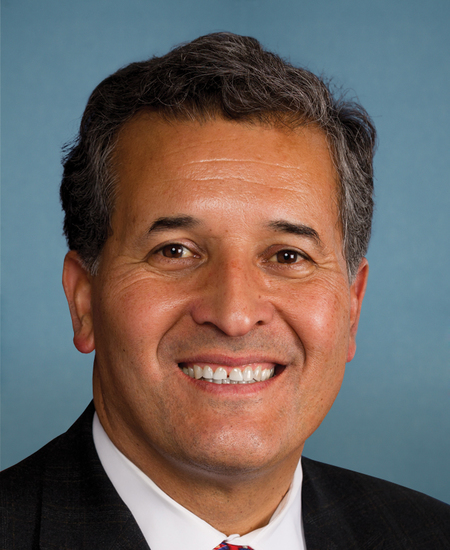
Photo of Juan Vargas
D United States House · District 52 · California On the 2026 ballot

Rep. Juan Vargas

Compare
Total votes
2,837
all sessions
Attendance
98%
48 missed
Near the chamber average
With party
97%
of cast votes
Near the chamber average
Bipartisan score
1%
crosses aisle rarely
Near the chamber average
Sponsored
1,533
bills & resolutions
Near the chamber average
Committees
4
assignments
1,533 bills and resolutions

Sponsored bills

Total
1,533
Primary
34
Co-sponsor
1,499
This page
1,533
matching current filters
Co-sponsor HRES 259
In committee · United States House · Co-sponsor
Of inquiry requesting the President to provide certain documents in the President's possession to the House of Representatives relating to the access provided to the staff and advisers of, including any individual working for or in conjunction with, the Department of Government Efficiency to the systems, applications, and accounts, and any information contained therein, of the Bureau of Consumer Financial Protection.

Maddy summaryHRES 259 is a House resolution requesting the President to provide documents about access to the Bureau of Consumer Financial Protection (CFPB) systems. It specifically asks for details on individuals from the "Department of Government Efficiency" (DOGE), including named staff like Elon Musk, who were granted access to CFPB systems, accounts, or information. The resolution demands records on the type of access granted, clearance levels, any sensitive data viewed, and documentation like access requests and training records. It also seeks employee headcount data for the CFPB as of specific dates. This is a procedural request for transparency, not a law changing policy.

In committee Apr 2, 2025 1 co-sponsor
Co-sponsor HR 2598
In committee · United States House · Co-sponsor
IDEA Full Funding Act

Maddy summaryThe IDEA Full Funding Act (HR 2598) mandates specific annual federal funding levels for the Individuals with Disabilities Education Act (IDEA), directly affecting schools and students with disabilities nationwide. It requires the federal government to appropriate either a fixed dollar amount or a specified percentage (increasing annually from 4.5% to 40%) of a calculated total - based on the number of eligible students and average per-pupil costs - starting in fiscal year 2026 through 2035. The bill sets clear, escalating funding targets, with the higher of two calculated amounts (dollar figure or percentage) becoming available for obligation each fiscal year. This establishes a binding financial commitment to address long-standing underfunding of special education services under IDEA.

In committee Apr 2, 2025 1 co-sponsor
Co-sponsor HR 2595
In committee · United States House · Co-sponsor
Building Child Care for a Better Future Act

Maddy summaryThe Building Child Care for a Better Future Act (HR 2595) increases federal child care funding to $20 billion for fiscal year 2026 with annual inflation-based increases, plus an additional $5 billion annually for targeted improvements in child care access and quality. It allocates specific portions of funds to Indian tribes (5%) and territories (4%), requiring states and tribes to identify areas with particular child care needs and develop plans to improve workforce, supply, quality, and access through activities like provider training, facility upgrades, and higher wages. The bill mandates regular reporting and evaluations to track how funds improve child care services for low-income families, children with disabilities, dual language learners, and those in rural or high-poverty areas. This legislation directly affects child care providers, low-income families seeking care, and tribal organizations by providing concrete funding mechanisms to address specific child care shortages.

In committee Apr 2, 2025 1 co-sponsor
Co-sponsor HR 2601
In committee · United States House · Co-sponsor
Delete DOGE Act

Maddy summaryHR 2601, the "Delete DOGE Act," prohibits federal funding for the U.S. DOGE Service (Department of Government Efficiency) and related entities established under specific executive orders. It blocks all federal funds from implementing, administering, or enforcing the covered executive orders (Executive Orders 14158, 14210, and 14222) or supporting any new projects initiated by the DOGE department after January 20, 2025. The bill restricts U.S. Digital Service funding to only maintaining existing digital services as of January 19, 2025, and bans federal funds from being used by individuals associated with the DOGE entities or their directives. This directly affects the DOGE department, its employees, contractors, and any new initiatives tied to its executive orders.

In committee Apr 2, 2025 1 co-sponsor
Co-sponsor HR 2531
In committee · United States House · Co-sponsor
Workplace Violence Prevention for Health Care and Social Service Workers Act

Workplace Violence Prevention for Health Care and Social Service Workers Act This bill requires the Department of Labor to address workplace violence in health care, social service, and similar sectors. Specifically, Labor must issue an occupational safety and health standard that requires certain employers to take actions to protect workers and other personnel from workplace violence. The standard applies to employers in the health care sector, in the social service sector, and in sectors that conduct activities similar to those in the health care and social service sectors. Among other elements, the standard must require each employer to (1) develop a workplace violence prevention plan, (2) promptly investigate incidents of workplace violence, and (3) provide relevant training and education to employees.  The bill requires certain hospitals and skilled nursing facilities to comply with this standard as a condition of Medicare participation.

In committee Apr 1, 2025 1 co-sponsor
Co-sponsor HR 2495
In committee · United States House · Co-sponsor
Nutrition CARE Act of 2025

Maddy summaryThe Nutrition CARE Act of 2025 requires Medicare to cover medical nutrition therapy services for beneficiaries with eating disorders starting January 1, 2026. It directly affects Medicare beneficiaries with eating disorders, including an estimated 1.6 million people on Medicare Part B, with specific focus on underserved groups like 420,500-560,700 Black, Indigenous, and People of Color beneficiaries. The bill mandates coverage through registered dietitians or nutrition professionals, requiring at least 13 hours of services in the first year (including initial assessment) and 4 hours annually thereafter, with referrals from physicians or psychologists. This addresses a current gap where Medicare does not cover medical nutrition therapy for eating disorders at any treatment level. The policy change aims to improve access to a critical treatment pillar for a condition with high mortality rates and significant healthcare costs.

In committee Mar 31, 2025 1 co-sponsor
Co-sponsor HR 1661
In committee · United States House · Co-sponsor
SAFE Act of 2025

Save America's Forgotten Equines Act of 2025 or the SAFE Act of 2025 This bill permanently prohibits the slaughter of equines (e.g., horses and mules) for human consumption. (Current law prohibits the slaughter of dogs and cats for human consumption. This bill extends the prohibition to equines.) Specifically, this bill prohibits a person from knowingly (1) slaughtering an equine for human consumption; or (2) shipping, transporting, possessing, purchasing, selling, or donating an equine to be slaughtered for human consumption or equine parts for human consumption. The bill subjects a violator to a fine. The bill applies to conduct in or affecting interstate or foreign commerce or within the special maritime and territorial jurisdiction of the United States. However, it does not apply to an activity carried out by an Indian for a religious ceremony. As background, in recent years, the appropriations acts have prohibited the Department of Agriculture (USDA) from using federal funds to inspect horses before they are slaughtered for human consumption. Therefore, there are currently no USDA-inspected horse slaughter facilities in the United States.

In committee Mar 28, 2025 1 co-sponsor
Co-sponsor HRES 261
In committee · United States House · Co-sponsor
Recognizing the heritage, culture, and contributions of Latinas in the United States.

Maddy summaryHRES 261 is a symbolic resolution recognizing the heritage, culture, and contributions of Latinas in the United States. It celebrates Latinas' historical and ongoing roles in fields like business, military service, science, arts, and public office, while acknowledging persistent challenges like wage gaps and systemic barriers. The resolution specifically highlights that Latinas make up approximately 1 in 6 U.S. women (31 million people) and emphasizes their economic impact (contributing $1.3 billion to GDP in 2021) and cultural achievements. It does not create new policies or allocate funds but formally honors these contributions and calls for continued efforts to address inequities. This resolution directly affects Latinas as a recognized demographic group within U.S. society.

In committee Mar 27, 2025 1 co-sponsor
Co-sponsor HR 2439
In committee · United States House · Co-sponsor
Support UNFPA Funding Act

Maddy summaryHR 2439 authorizes $50 million for fiscal year 2026 and $55 million for 2027 to fund the United Nations Population Fund (UNFPA), directly supporting its global programs. The bill specifies that these funds will help end preventable maternal deaths, address unmet contraceptive needs, combat gender-based violence, and end harmful practices like child marriage and female genital mutilation. UNFPA operates in over 150 countries, primarily aiding women and girls in developing nations and crisis zones, including those affected by conflict or natural disasters. The bill emphasizes UNFPA’s compliance with U.S. restrictions (not funding abortion) and its role in advancing U.S. strategic interests through voluntary family planning and reproductive health services.

In committee Mar 27, 2025 1 co-sponsor
Co-sponsor HR 2467
In committee · United States House · Co-sponsor
America's Red Rock Wilderness Act

Maddy summaryHR 2467, America's Red Rock Wilderness Act, would designate approximately 1.3 million acres of public land across Utah as wilderness areas, protecting them from development and managing them for conservation. The bill specifically designates 77 wilderness areas in the Great Basin and Colorado Plateau regions, including lands within existing national monuments like Grand Staircase-Escalante and Bears Ears. It includes provisions for water rights protection, allows continued livestock grazing under certain conditions, and withdraws the designated lands from mining and mineral leasing. The bill also ensures Tribal rights are protected and requires the Secretary of the Interior to administer these areas according to wilderness management standards.

In committee Mar 27, 2025 1 co-sponsor
Showing 311 to 320 of 1,533 bills
Previous 1 … 31 32 33 … 154 Next