

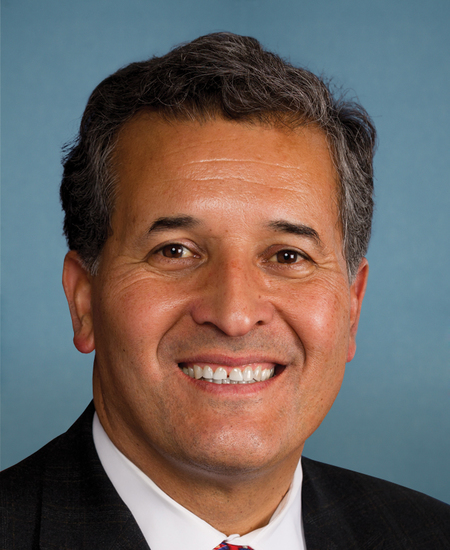
Photo of Juan Vargas
D United States House · District 52 · California On the 2026 ballot

Rep. Juan Vargas

Compare
Total votes
2,837
all sessions
Attendance
98%
48 missed
Near the chamber average
With party
97%
of cast votes
Near the chamber average
Bipartisan score
1%
crosses aisle rarely
Near the chamber average
Sponsored
1,533
bills & resolutions
Near the chamber average
Committees
4
assignments
1,533 bills and resolutions

Sponsored bills

Total
1,533
Primary
34
Co-sponsor
1,499
This page
1,533
matching current filters
Co-sponsor HR 4966
In committee · United States House · Co-sponsor
Stop Price Gouging in Grocery Stores Act of 2025

Maddy summaryHR 4966 prohibits grocery stores from selling items at "grossly excessive prices," defined as 120% or more above the average market price over the previous six months (with exceptions for unavoidable cost increases like supply chain issues). It bans using facial recognition or personal data to set different prices for individual customers (e.g., adjusting prices based on shopping history) and requires clear signage if facial recognition is used. Stores over 10,000 square feet must replace electronic shelf labels with physical price tags. The Federal Trade Commission enforces these rules, allowing consumers to seek $3,000 per violation or actual damages, with penalties for willful violations.

In committee Aug 12, 2025 1 co-sponsor
Co-sponsor HR 4903
In committee · United States House · Co-sponsor
Plastic Health Research Act

Maddy summaryHR 4903, the Plastic Health Research Act, directs federal agencies to fund and coordinate research on the health effects of plastic exposure, including microplastics and nanoplastics. It authorizes $10 million annually (2026-2030) for grants to academic institutions and nonprofits to develop standardized testing methods, improve research comparability, and fill gaps in understanding plastic-related health impacts. The bill also creates "Centers of Excellence" to advance this research, requiring annual public reports on findings and coordination with agencies like the EPA and FDA. This legislation directly affects researchers, federal health agencies, and public health policy by prioritizing scientific rigor in studying plastic exposure sources (e.g., food packaging, waste disposal) and health outcomes.

In committee Aug 5, 2025 1 co-sponsor
Co-sponsor HRES 629
In committee · United States House · Co-sponsor
Honoring the life of Dr. Paul Farmer by recognizing the duty of the Federal Government to adopt a 21st-century global health solidarity strategy and take actions to address past and ongoing harms that undermine the health and well-being of people around the world.

Maddy summaryHRES 629 is a non-binding House resolution honoring Dr. Paul Farmer and calling for U.S. policy changes to address global health inequities. It directly affects low- and middle-income countries by urging the federal government to adopt a "21st-century global health solidarity strategy," including increasing U.S. global health funding to $125 billion annually (to meet the UN 0.7% GNI target) and supporting national health systems through Dr. Farmer’s "Five S’s" framework (staff, space, stuff, systems, social support). The resolution also mandates addressing systemic economic harms like debt, tax evasion, and colonial legacies through debt cancellation, tax reform, and reparations for historical injustices. It emphasizes concrete policy shifts rather than funding alone, requiring coordinated multilateral action to close health financing gaps and reform global governance institutions.

In committee Aug 1, 2025 1 co-sponsor
Co-sponsor HR 4797
In committee · United States House · Co-sponsor
EATS Act of 2025

Maddy summaryThis bill removes a barrier preventing most low-income students from accessing SNAP benefits. It amends the Food and Nutrition Act to explicitly allow students enrolled at least half-time in recognized higher education programs to qualify for SNAP, reversing a prior exclusion. The key change eliminates the previous requirement that students meet specific exceptions (now deleted) and adds a new eligibility category under Section 3(m)(5). This directly affects low-income undergraduate and graduate students at colleges and training programs who were previously ineligible. The changes take effect January 2, 2026.

In committee Jul 29, 2025 1 co-sponsor
Co-sponsor HR 4821
In committee · United States House · Co-sponsor
Gun Violence Prevention Research Act of 2025

Maddy summaryThis bill authorizes $50 million annually for the Centers for Disease Control and Prevention (CDC) to conduct research on firearms safety and gun violence prevention, beginning in fiscal year 2026 through 2031. The funding is in addition to existing CDC appropriations and would support studies under the Public Health Service Act. It does not create new regulations or directly affect individuals, but aims to expand research into causes and prevention strategies for gun violence. The bill focuses solely on enabling CDC research, without proposing policy changes or restrictions.

In committee Jul 29, 2025 1 co-sponsor
Co-sponsor HR 4796
In committee · United States House · Co-sponsor
Restoring Essential Healthcare Act

Maddy summaryHR 4796, the Restoring Essential Healthcare Act, repeals a provision that blocked Medicaid payments to certain healthcare providers during a specific period. It directly affects Medicaid beneficiaries who received care from these providers between the enactment of the prior law (Public Law 119-21) and this bill's enactment. The key provision retroactively restores Medicaid payments for services already provided during that blocked period, treating the payment restriction as if it never existed. This change ensures eligible individuals and providers receive reimbursement for covered care delivered during the prohibited timeframe.

In committee Jul 29, 2025 1 co-sponsor
Co-sponsor HR 4768
In committee · United States House · Co-sponsor
Health Care Fairness for Military Families Act of 2025

Maddy summaryThis bill updates the TRICARE Young Adult Program to make healthcare coverage more accessible for military dependents. It directly affects young adults (ages 21-26) who are children of active-duty service members, by eliminating a separate premium they previously paid for coverage. Key changes include removing an extra cost for young adults and adjusting eligibility rules to simplify enrollment. These amendments aim to reduce out-of-pocket expenses and streamline access to health insurance under the program.

In committee Jul 25, 2025 1 co-sponsor
Co-sponsor HR 4664
In committee · United States House · Co-sponsor
Stop Shackling and Detaining Pregnant Women Act

Maddy summaryThis bill would prohibit the detention of pregnant women, lactating women, and postpartum mothers (within one year of childbirth) in immigration custody, requiring their immediate release except in rare circumstances involving public safety threats. It bans the use of physical restraints on these individuals during pregnancy, labor, delivery, and postpartum recovery, with only extremely limited exceptions. The bill mandates that facilities provide comprehensive reproductive health care including prenatal care, labor and delivery services, postpartum care, and access to abortion services. It requires facilities to maintain medical records, obtain informed consent for medical procedures, and conduct weekly reviews of any detained individuals under exceptional circumstances. The bill also establishes reporting requirements for facilities and creates transparency through public reporting of detention practices.

In committee Jul 23, 2025 1 co-sponsor
Co-sponsor HR 4696
In committee · United States House · Co-sponsor
Renewing Immigration Provisions of the Immigration Act of 1929

Maddy summaryHR 4696 amends Section 249 of the Immigration and Nationality Act to update eligibility for a registry program that provides a pathway to legal status for long-term residents. It changes the requirement from entering the U.S. before January 1, 1972, to entering at least 7 years before the application date. This adjustment bases eligibility on a rolling 7-year window instead of a fixed historical cutoff, allowing more recent long-term residents to qualify. The bill directly affects individuals who entered the U.S. after 1972 but maintained continuous residence for at least seven years prior to applying.

In committee Jul 23, 2025 1 co-sponsor
Co-sponsor HR 4688
In committee · United States House · Co-sponsor
COOL OFF Act

Maddy summaryThis bill requires a 3-business-day waiting period before someone can receive a handgun from another person who isn't a licensed gun seller. It applies to most private handgun transfers but includes exceptions for law enforcement, family loans (like between spouses or parents and children), temporary transfers to prevent imminent harm, and transfers for shooting or hunting under specific conditions. The waiting period begins when the recipient first offers to take possession of the gun. The law would take effect 90 days after enactment.

In committee Jul 23, 2025 1 co-sponsor
Showing 191 to 200 of 1,533 bills
Previous 1 … 19 20 21 … 154 Next