

Maddy summaryThis bill, HR 1097 (Everett Alvarez, Jr. Congressional Gold Medal Act of 2023), authorizes the award of a Congressional Gold Medal to Everett Alvarez, Jr., in recognition of his service as a U.S. Navy pilot and Vietnam War prisoner of war. It directly honors Alvarez, who was the first U.S. pilot shot down in the Vietnam War, spent over 8.5 years in captivity, and later served in the Peace Corps and Veterans Administration. The bill’s key mechanism is directing the U.S. Mint to strike a gold medal bearing his name and image, with bronze duplicates available for sale to cover costs. It does not create new policies or affect any group beyond the honoree.
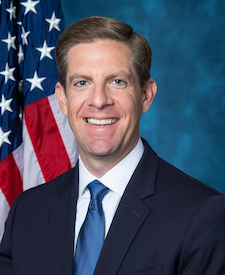
Rep. Mike Levin
Sponsored bills
Maddy summaryThe Co-Location Energy Act allows renewable energy projects (solar and wind) to be developed on existing federal energy leases for oil, gas, coal, and geothermal resources. It requires leaseholders' consent before the Secretary of the Interior can authorize evaluations or issue permits for these projects. The bill streamlines environmental reviews for such developments by directing the Secretary to determine if they qualify for categorical exclusions under the National Environmental Policy Act. This primarily affects current leaseholders of federal energy lands and renewable developers seeking to co-locate projects on those sites.
Maddy summaryThe INNOVATE Act establishes a new "fifth mission" for the Veterans Health Administration (VHA) to foster innovation in healthcare, directly affecting veterans, VHA operations, and private sector partners. It creates an Office of Innovation with authority to partner with private entities - especially early-stage businesses - through streamlined hiring (bypassing civil service rules for up to 250 staff), an Innovation Acceleration Fund, and agreements granting access to VHA data, facilities, and expertise (with fee discounts for veteran-owned businesses). Key provisions include advance market commitments guaranteeing purchases of vet-specific healthcare technologies (e.g., for PTSD, toxic exposure, or prosthetics) and new "other transactional" agreements for research without standard procurement rules. The bill aims to accelerate development of healthcare solutions benefiting veterans while modeling innovation for broader U.S. healthcare systems.
Maddy summaryHR 7070, the Wildfire Response Improvement Act, updates federal wildfire response and recovery policies. It requires FEMA to make fire management assistance available for emergency stabilization regardless of the declared incident period (Section 2), and to add wildfire-specific recovery guidance to its Public Assistance Guide covering debris removal, water toxicity, and emergency measures (Section 3). The bill also mandates FEMA to review and update cost-effectiveness criteria for wildfire mitigation projects (like defensible space, nature-based infrastructure, and smoke impact reduction) under the Stafford Act, prioritizing projects based on these revised standards (Section 4). These changes directly affect communities recovering from wildfires and FEMA's process for funding recovery and mitigation efforts.
Maddy summaryHR 1720, the Ocean Pollution Reduction Act II, directly affects the City of San Diego's Point Loma Wastewater Treatment Plant by imposing stricter discharge limits under federal water pollution rules. It requires the plant to maintain a deep ocean outfall (300+ feet deep, 4+ miles from shore) and sets decreasing annual limits on total suspended solids pollution, starting at 12,000 metric tons in 2024 and reducing to 9,942 metric tons by 2029. The bill also mandates 80% removal of suspended solids monthly, 58% removal of biochemical oxygen demand annually, and requires 10 years of ocean monitoring data before new permits. Additionally, it sets a target for producing 83 million gallons per day of water suitable for potable reuse by 2037.
Maddy summaryHR 3396, the Fire Department Repayment Act of 2023, requires the Secretaries of Agriculture, Interior, Homeland Security, and Defense to establish standard procedures for federal fire suppression cost share agreements within one year. It mandates reviewing existing agreements to align them with local cooperative fire protection agreements and conducting second-level reviews after wildfires, involving state and local fire organizations. The bill directly affects fire departments and agencies participating in these cost-sharing arrangements under the Reciprocal Fire Protection Act. Key changes include standardized procedures for agreement management and post-wildfire reviews to ensure cost-sharing compliance.
Maddy summaryHR 3269, the Law Enforcement Innovate to De-Escalate Act, exempts specific less-than-lethal projectile devices from federal firearm taxes and National Firearms Act restrictions. The bill defines these devices as those firing projectiles at under 500 feet per second and designed not to cause death or serious injury. This directly affects law enforcement agencies using such devices and manufacturers producing them, by removing tax burdens and registration requirements. The key change is creating a clear legal exemption for these devices under federal law, streamlining their use for de-escalation purposes.
Maddy summaryThis bill creates a new Medicare payment model for emergency medical services (EMS) that allows coverage when ambulance providers deliver critical care on-site without transporting patients to a hospital. It directly affects Medicare beneficiaries receiving such on-site emergency care and ambulance providers who would previously not be reimbursed for non-transport services. The key provision requires Medicare to pay for these services at rates matching what would have been paid for transport, based on state protocols and emergency call responses, for a 5-year trial period. A report due 4 years after implementation will evaluate impacts on patient outcomes, system efficiency, and regional access.
Maddy summaryHR 8796, the "Stop Comstock Act," removes outdated restrictions from federal law that previously banned the distribution of materials related to contraception and abortion as "obscene" or "indecent." The bill amends Title 18 and the Tariff Act by deleting references to "indecent," "immoral," "unlawful abortion," and "procuring abortion" from provisions governing obscene materials. It clarifies that the law only prohibits "obscene materials" in commerce, eliminating broad restrictions on reproductive health information. This directly affects internet platforms, healthcare providers, and individuals sharing reproductive health resources by removing legal barriers to their distribution.
Maddy summaryThis bill requires Medicare Advantage plans to implement electronic prior authorization systems by 2027 and publish detailed data on their approval and denial rates for medical services by 2026. It directly affects Medicare Advantage plans (private insurers offering Medicare coverage) and their enrollees (seniors 65+), mandating transparency about prior authorization decisions, processing times, and appeal outcomes. Key provisions include requiring plans to report annual statistics on request approvals/denials, average processing times, and use of technology, with this data published publicly by the Centers for Medicare & Medicaid Services. The bill also sets timelines for plan responses to prior authorization requests and mandates reports to Congress on implementation and impacts.