

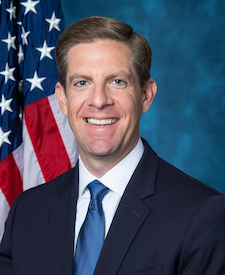
Photo of Mike Levin
D United States House · District 49 · California On the 2026 ballot

Rep. Mike Levin

Compare
Total votes
2,837
all sessions
Attendance
100%
5 missed
Higher than 82% of chamber peers
With party
97%
of cast votes
Near the chamber average
Bipartisan score
2%
crosses aisle rarely
Near the chamber average
Sponsored
1,562
bills & resolutions
Higher than 76% of chamber peers
Committees
3
assignments
1,562 bills and resolutions

Sponsored bills

Total
1,562
Primary
91
Co-sponsor
1,471
This page
1,562
matching current filters
Co-sponsor HR 2736
In committee · United States House · Co-sponsor
Public Service Freedom to Negotiate Act of 2025

Maddy summaryThis bill establishes federal minimum standards for collective bargaining rights for public employees and supervisors. The Federal Labor Relations Authority would determine if state laws provide these rights, and if not, would establish them for affected employees. The bill guarantees public employees the right to form unions, bargain collectively, and engage in concerted activities, while requiring public employers to recognize unions and put agreements in writing. It also prohibits strikes or lockouts that would disrupt emergency services. This would apply to public employees in states that don't meet the federal standards for collective bargaining rights.

In committee Apr 8, 2025 1 co-sponsor
Co-sponsor HR 2703
In committee · United States House · Co-sponsor
Advancing GETs Act of 2025

Maddy summaryHR 2703, the Advancing GETs Act of 2025, creates a shared savings program for developers who install grid-enhancing technologies (GETs) on existing or new transmission infrastructure. Developers can receive 10-25% of the savings from these technologies over three years, provided the savings exceed four times the installation cost. The bill also requires transmission operators to report annual congestion costs and creates a public map of grid constraints, while directing the Energy Secretary to establish an annual guide for utilities on implementing GETs. This directly affects utilities, developers, and grid operators by incentivizing infrastructure upgrades that boost grid efficiency, reliability, and capacity.

In committee Apr 8, 2025 1 co-sponsor
Co-sponsor HR 2725
In committee · United States House · Co-sponsor
Affordable Housing Credit Improvement Act of 2025

Maddy summaryThe Affordable Housing Credit Improvement Act of 2025 would reform the Low-Income Housing Credit program, which provides tax credits to developers of affordable housing. It would increase state allocations based on population with annual cost-of-living adjustments, modify tenant eligibility rules to allow higher income limits for some residents, and add protections for domestic violence victims in housing. The bill would simplify rules for rural and Native American housing projects, clarify credit eligibility requirements, and require greater transparency in program administration. These changes would directly affect developers, property owners, and low-income tenants in housing projects that receive LIHC tax credits.

In committee Apr 8, 2025 1 co-sponsor
Co-sponsor HR 2711
In committee · United States House · Co-sponsor
Invest to Protect Act of 2025

Maddy summaryThe Invest to Protect Act of 2025 establishes a $50 million annual grant program (2027-2031) for local governments employing fewer than 175 law enforcement officers, including counties, municipalities, and Tribal governments. Grants fund de-escalation training, victim-centered domestic violence response training, evidence-based safety training for scenarios like mental health crises or active shooters, recruitment/retention bonuses (capped at 20% of salary), and mental health resources for officers. Recipients must report on program use, disclose bonus amounts publicly, and comply with audits to prevent misuse of funds. The bill aims to improve officer safety and community relations through targeted support for smaller law enforcement agencies.

In committee Apr 8, 2025 1 co-sponsor
Co-sponsor HR 2253
In committee · United States House · Co-sponsor
Puppy Protection Act of 2025

Maddy summaryThis bill, HR 2253 (Puppy Protection Act of 2025), sets new federal standards for commercial dog dealers who sell puppies to the public. It requires specific housing sizes based on dog size (e.g., 12-30 square feet per dog), daily exercise in safe outdoor areas, clean water and nutritious food twice daily, and annual veterinary exams including dental checks. The bill also limits breeding frequency (max 2 litters in 25 months), sets age minimums for breeding (18 months for small dogs, 2 years for large dogs), and mandates health screenings to prevent genetic diseases. These requirements apply directly to commercial dealers, with final regulations to be issued within 18 months of enactment.

In committee Apr 4, 2025 1 co-sponsor
Co-sponsor HR 2102
In committee · United States House · Co-sponsor
Major Richard Star Act

Maddy summaryThis bill, HR 2102 (Major Richard Star Act), allows veterans with combat-related disabilities to receive both full military retired pay and veterans' disability compensation simultaneously, without the previous offset that reduced retired pay. It directly affects veterans already eligible for both benefits due to combat-related injuries, removing the requirement that their retired pay be reduced by the disability compensation amount. The key provision amends Title 10 and Title 38 to eliminate the offset rule (sections 5304 and 5305 of Title 38) for these veterans. The change applies to payments starting after the bill’s enactment date, effective for all qualifying veterans. This is a policy change to increase financial support for affected veterans, not a new benefit.

In committee Apr 4, 2025 1 co-sponsor
Co-sponsor HR 2598
In committee · United States House · Co-sponsor
IDEA Full Funding Act

Maddy summaryThe IDEA Full Funding Act (HR 2598) mandates specific annual federal funding levels for the Individuals with Disabilities Education Act (IDEA), directly affecting schools and students with disabilities nationwide. It requires the federal government to appropriate either a fixed dollar amount or a specified percentage (increasing annually from 4.5% to 40%) of a calculated total - based on the number of eligible students and average per-pupil costs - starting in fiscal year 2026 through 2035. The bill sets clear, escalating funding targets, with the higher of two calculated amounts (dollar figure or percentage) becoming available for obligation each fiscal year. This establishes a binding financial commitment to address long-standing underfunding of special education services under IDEA.

In committee Apr 2, 2025 1 co-sponsor
Co-sponsor HR 2531
In committee · United States House · Co-sponsor
Workplace Violence Prevention for Health Care and Social Service Workers Act

Workplace Violence Prevention for Health Care and Social Service Workers Act This bill requires the Department of Labor to address workplace violence in health care, social service, and similar sectors. Specifically, Labor must issue an occupational safety and health standard that requires certain employers to take actions to protect workers and other personnel from workplace violence. The standard applies to employers in the health care sector, in the social service sector, and in sectors that conduct activities similar to those in the health care and social service sectors. Among other elements, the standard must require each employer to (1) develop a workplace violence prevention plan, (2) promptly investigate incidents of workplace violence, and (3) provide relevant training and education to employees.  The bill requires certain hospitals and skilled nursing facilities to comply with this standard as a condition of Medicare participation.

In committee Apr 1, 2025 1 co-sponsor
Co-sponsor HR 2539
In committee · United States House · Co-sponsor
FISCAL Act

Freedom in School Cafeterias and Lunches Act or the FISCAL Act This bill revises requirements for milk provided by the National School Lunch Program of the Department of Agriculture (USDA) to require that schools offer plant-based milk. Under current law, schools must provide a substitute for fluid milk for students whose disability restricts their diet (on receipt of a written statement from a licensed physician). Schools may also substitute a nondairy beverage for fluid milk for students who have an identified medical or other special dietary need (on receipt of a written statement from a medical authority or a student's parent or legal guardian). The bill eliminates the exceptions and documentation requirements. Instead, schools participating in the school lunch program must offer all students a plant-based milk option that is consistent with (1) the most recent U.S. Dietary Guidelines, or (2) USDA-established nutritional standards if the milk is not included under those guidelines.

In committee Apr 1, 2025 1 co-sponsor
Co-sponsor HR 2585
In committee · United States House · Co-sponsor
Armenian Genocide Education Act

Maddy summaryHR 2585, the Armenian Genocide Education Act, establishes a federal program through the Library of Congress to develop educational resources about the 1915-1923 Armenian Genocide for K-12 schools. It requires the Librarian to create and distribute accurate teaching materials, provide teacher training workshops, and maintain an online resource hub focused on the genocide's history, lessons, and prevention of hate. The program directly supports local educational agencies, independent schools, and educators by offering professional development and curriculum resources. It defines key terms like "denial" and "distortion" to guide the educational content, aiming to improve understanding of this historical event and its relevance to preventing modern-day hate crimes.

In committee Apr 1, 2025 1 co-sponsor
Showing 331 to 340 of 1,562 bills
Previous 1 … 33 34 35 … 157 Next