

Securing Universal Communications Connectivity to Ensure Students Succeed Act or the SUCCESS Act This bill provides additional funding for the Emergency Connectivity Fund, which supports remote learning during the COVID-19 emergency period by covering reasonable costs of laptop and tablet computers, Wi-Fi hotspots, modems, routers, and broadband connectivity purchases for off-campus use by students, school staff, and library patrons.
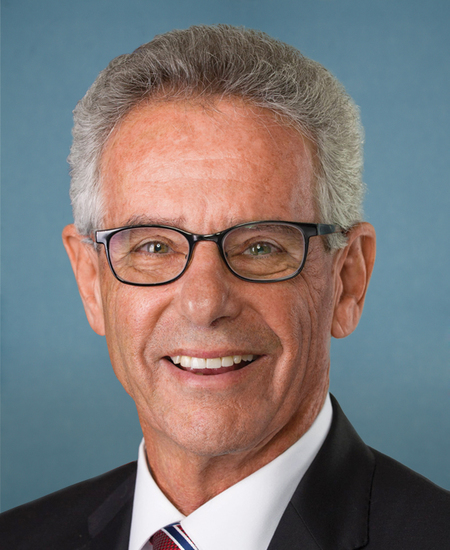
Rep. Alan S. Lowenthal
Sponsored bills
Water Conservation Rebate Tax Parity Act This bill expands the tax exclusions for energy conservation subsidies to include subsidies provided (directly or indirectly) (1) by a public utility for the purchase or installation of any water conservation or efficiency measure; (2) by a storm water management provider for the purchase or installation of any storm water management measure; or (3) by a state or local government to a resident of such state or locality for the purchase or installation of any wastewater management measure, but only if such measure concerns the taxpayer's principal residence.
Wastewater Infrastructure Pollution Prevention and Environmental Safety Act or the WIPPES Act This bill requires the Federal Trade Commission to issue regulations requiring entities responsible for the labeling or retail packaging of certain premoistened, nonwoven wipes (e.g., baby wipes, cleaning wipes, or personal care wipes) to label such products clearly and conspicuously with the phrase Do Not Flush and accompanying symbol as depicted under specified industry guidelines. The commission is authorized to enforce this requirement.
Universal School Meals Program Act of 2021 This bill revises requirements under the food and nutrition programs of the Department of Agriculture, such as the school lunch and breakfast programs. For example, the bill permanently provides free meals to all school children regardless of income. The bill increases the reimbursement rate for school food authorities participating in the food and nutrition programs. The bill also prohibits school food authorities from (1) physically segregating or otherwise discriminating against any child participating in the free breakfast program, or (2) overtly identifying a child participating in the program with a special token or announcement. Additionally, the bill expands the summer food service program by making all children eligible for participation in the program. Further, the bill revises eligibility determinations for measuring poverty to include runaway or homeless youth, foster children, migratory children, and children participating in specified programs (e.g., Head Start).
Supporting Medicaid in the U.S. Territories Act of 2021 This bill extends, increases, and otherwise modifies Medicaid funding for U.S. territories. Specifically, the bill extends (1) the temporarily increased Federal Medical Assistance Percentage (i.e., federal matching rate), and (2) a higher cap on Medicaid funding. Such provisions apply to Puerto Rico through FY2026 and to other territories through FY2029. The bill also requires Puerto Rico to implement an asset verification program and to report on its ability to comply with certain reporting requirements, procurement standards, and other Medicaid program integrity measures.
Consumer Protection and Recovery Act This bill authorizes the Federal Trade Commission (FTC) to seek monetary relief in federal court from businesses that engage in unlawful commercial practices such as false advertising, consumer fraud, and anticompetitive conduct. Specifically, the FTC may seek restitution in these cases for losses, rescission or reformation of contracts, refund of money, return of property, or disgorgement of unjust enrichment. On April 22, 2021, the Supreme Court held in AMG Capital Management, LLC v. Federal Trade Commission that the Federal Trade Commission Act does not authorize the FTC to seek, or a court to award, such relief.
Strengthening the Vaccines for Children Program Act of 2021 This bill modifies vaccination programs and coverage for children under Medicaid and the Children's Health Insurance Program (CHIP). Specifically, the bill expands and otherwise modifies the Vaccines for Children Program, which provides free vaccinations to individuals 18 years of age or younger who are uninsured or underinsured (i.e., with limited or no insurance for vaccines), are eligible for Medicaid, or are American Indians or Alaskan Natives. The bill expands the program to include children enrolled in CHIP and temporarily provides for additional payments to incentivize provider participation. The Government Accountability Office must report on the related effects of the bill's changes. The bill also expands coverage under Medicaid and CHIP to include vaccine counseling and educational services for children and temporarily requires payments to be made at a rate that is no less than the rate under Medicare for equivalent services. It also temporarily increases the Federal Medical Assistance Percentage (i.e., federal matching rate) for states that conduct culturally appropriate outreach regarding the benefits of vaccinations for children.
Refugee Sanitation Facility Safety Act of 2021 This bill directs the Department of State, when providing overseas assistance for refugees, to ensure the provision of safe and secure access to sanitation facilities, with a special emphasis on women, girls, and vulnerable populations.
This resolution calls on the United States and North Korea to begin the process of reuniting Korean Americans with their immediate relatives in North Korea. (Many families were divided after the signing of the Korean War Armistice Agreement, which divided the Korean Peninsula into North and South Korea.)
Generating Resilient, Environmentally Exceptional National Streets Act or the GREEN Streets Act This bill establishes national goals to reduce carbon dioxide and other greenhouse gas emissions and improve the resilience of the transportation system. Specifically, the bill directs the Department of Transportation (DOT) to establish minimum standards for states to decrease greenhouse gas emissions and per capita vehicle miles traveled (VMTs) on the National Highway System; DOT to establish measures for states to assess and reduce carbon dioxide; states and metropolitan planning organizations (MPOs) to consider projects and strategies that reduce carbon dioxide and other greenhouse gas emissions and decrease per capita VMT's; states and MPOs to publish an analysis of the impact on per capita VMTs and mobile source greenhouse gas emissions for each project that adds new lanes or otherwise increases traffic capacity and costs more than $25 million; states that are out of compliance with the per capita VMT standards or carbon dioxide or greenhouse gas emission measures to dedicate federal highway funding to achieve compliance; and DOT to establish national transit access standards and performance measures for transit accessibility, transit stop distance, and transit mode share.