This act designates the facility of the United States Postal Service located at 2016 East 1st Street in Los Angeles, California, as the Marine Corps Reserve PVT Jacob Cruz Post Office.
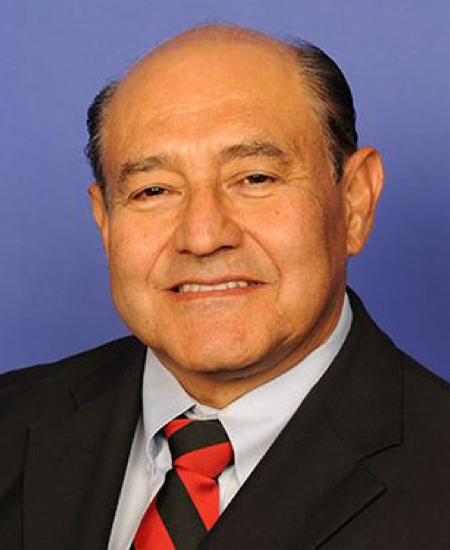
Rep. J. Luis Correa
Sponsored bills
This act designates the facility of the United States Postal Service located at 1961 North C Street in Oxnard, California, as the John R. Hatcher III Post Office Building.
This act designates the facility of the United States Postal Service located at 101 South Willowbrook Avenue in Compton, California, as the PFC James Anderson, Jr., Post Office Building.
Expanding the Voluntary Opportunities for Translations in Elections Act or the Expanding the VOTE Act This bill expands access to voting materials for individuals with limited proficiency in the English language, including by establishing incentive grants for states and political subdivisions to provide translated voting materials. Additionally, the bill directs the Government Accountability Office to study the impact of (1) reducing the threshold requirement under Section 203 of the Voting Rights Act of 1965, and (2) expanding the definition of language minorities to include native speakers of additional languages.
This act directs the Speaker of the House of Representatives and the President pro tempore of the Senate to arrange for the posthumous award of a Congressional Gold Medal to commemorate Glen Doherty, Tyrone Woods, J. Christopher Stevens, and Sean Smith, four Americans killed in the September 11, 2012, attack on the U.S. consulate in Benghazi, Libya. (Stevens was the U.S. Ambassador to Libya at the time, Smith was an officer in the Foreign Service, and Doherty and Woods were both government contractors and former Navy SEALs.) After the medal has been awarded, it shall be given to the Central Intelligence Agency Museum.
This act designates the community-based outpatient clinic of the Department of Veterans Affairs in Palm Desert, California, as the Sy Kaplan VA Clinic.
Real Courts, Rule of Law Act of 2022 This bill establishes the U.S. Immigration Courts, a system of courts to be independent of the executive branch. The bill also transfers all functions of the Executive Office for Immigration Review (EOIR) to the Immigration Courts, with some exceptions. (Currently, the EOIR, located in the Department of Justice, has authority to adjudicate immigration cases.) The trial division of the Immigration Courts shall have jurisdiction over various immigration-related matters, including (1) removal proceedings, (2) reviews of rescissions of lawful permanent resident status, and (3) reviews of credible fear determinations in applications for refugee status. The appellate division shall have jurisdiction over appeals of decisions by the trial division and certain Department of Homeland Security determinations. The bill establishes various requirements and authorities relating to the Immigration Courts, including qualifications, length of term in office, and mandatory retirement age for judges. Each appellate division judge must be appointed by the President with the advice and consent of the Senate, and the appellate division shall appoint the trial division judges.
Big Cat Public Safety Act This act revises requirements governing the trade of big cats (i.e., species of lion, tiger, leopard, cheetah, jaguar, or cougar or any hybrid of such species) under the Lacey Act to limit the possession, breeding, and exhibition of big cats. The Lacey Act prohibits any person from importing, exporting, buying, selling, transporting, receiving, or acquiring big cats across state lines or the U.S. border. However, some exemptions are provided for certain entities, such as universities and wildlife sanctuaries. (Sec. 3) The act expands the Lacey Act prohibitions to include a prohibition on possessing or breeding big cats. Breeding means facilitating propagation or reproduction (whether intentionally or negligently), or failing to prevent propagation or reproduction. Owners of big cats that were born before this act's enactment may keep their big cats, but the owners must register them with the U.S. Fish and Wildlife Service. The act modifies the list of entities that are exempt from prohibitions to export, buy, sell, transport, receive, acquire, possess, or breed big cats. The modified list includes exemptions for entities or facilities exhibiting animals to the public if they (1) hold a Class C license in good standing under the Animal Welfare Act, and (2) do not allow individuals to come into direct physical contact with big cats. However, direct contact is allowed if the individual is a trained professional, a veterinarian, or directly supporting conservation programs that do not involve commercial activities and meet other specified restrictions. (Sec. 4) A person who knowingly violates the act must be fined not more than $20,000, or imprisoned for no more than five years, or both. The act considers each violation to be a separate offense. The offense must be deemed to have been committed not only in the district where the violation first occurred, but also in any district in which the defendant may have taken or been in possession of the prohibited wildlife species. (Sec. 5) The act extends forfeiture provisions to fish, wildlife, or plants that are bred or possessed; thus, big cats bred or possessed in violation of the act are subject to forfeiture. (Sec. 6) The Department of the Interior must issue regulations to implement this act.

This act designates the facility of the United States Postal Service located at 2141 Ferry Street in Anderson, California, as the Norma Comnick Post Office Building.
Accessible Care by Curbing Excessive lawSuitS Act of 2022 or the ACCESS Act of 2022 This bill establishes rules for health care lawsuits where some amount of coverage or care was provided or paid for by a federal program, regardless of the number of other parties to the claim. The bill sets a three-year maximum statute of limitations from the date of the injury, subject to specific exceptions. Further, noneconomic damages (e.g., damages for pain and suffering) are limited to a maximum of $250,000. The bill permits courts to supervise and limit contingent fees paid to attorneys and sets a maximum contingent fee percentage based on a downward sliding scale as a damages increase. The bill permits either party to introduce evidence of collateral source benefits (e.g., workers’ compensation programs, accident insurance coverage, or other future benefit). Statements by a health care provider expressing fault, sympathy, or apology are, however, inadmissible as evidence of liability. Additionally, a plaintiff must give 90 days’ notice to the health care provider before filing a lawsuit. When filing a health care lawsuit, plaintiffs also must simultaneously submit an affidavit in support of the claim from a health care professional who meets the standards for an expert witness that are provided in the bill. This bill generally does not preempt state laws that impose additional limits on health care liability claims.