

Credit Access and Inclusion Act of 2022 This bill allows for the reporting of certain positive consumer-credit information to consumer reporting agencies. Specifically, a person or the Department of Housing and Urban Development may report information related to a consumer's performance in making payments either under a lease agreement for a dwelling or pursuant to a contract for a utility or telecommunications service. However, information about a consumer's usage of any utility or telecommunications service may be reported only to the extent that the information relates to payment by the consumer for such service or other terms of the provision of that service. Furthermore, an energy-utility firm may not report a consumer's outstanding balance as late if the firm and the consumer have entered into a payment plan and the consumer is meeting the obligations of that plan. Specified provisions that establish civil liability with respect to furnishers of information to consumer reporting agencies shall not apply to any violation of the bill. The Government Accountability Office must report on the consumer impact of such reporting.
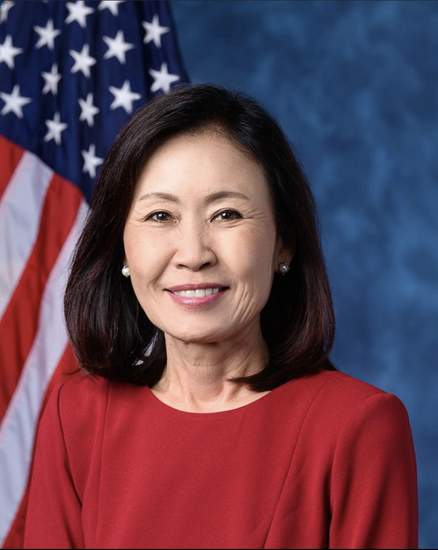
Rep. Michelle Steel
Sponsored bills
Maddy summaryHRES 1386 is a non-binding resolution designating the week of September 26-30, 2022, as "National Clean Energy Week." It expresses the House’s support for this designation and encourages individuals, organizations, and governments to promote clean energy solutions. The resolution highlights clean energy’s economic benefits (like supporting 7.8 million jobs in 2021) and urges investment in affordable, low-emission energy technologies. It does not create new laws, funding, or obligations - it is purely symbolic recognition of the clean energy sector’s role in the U.S. economy.
Social Security Fairness Act of 2021 This bill repeals provisions that reduce Social Security benefits for individuals who receive other benefits, such as a pension from a state or local government. The bill eliminates the government pension offset , which in various instances reduces Social Security benefits for spouses, widows, and widowers who also receive government pensions of their own. The bill also eliminates the windfall elimination provision , which in some instances reduces Social Security benefits for individuals who also receive a pension or disability benefit from an employer that did not withhold Social Security taxes. These changes are effective for benefits payable after December 2021.
TCJA Permanency Act This bill makes permanent provisions affecting individual and business taxpayers that were enacted in 2017 by the Tax Cuts and Jobs Act and are scheduled to expire at the end of 2025. The bill makes permanent reductions in individual and capital gain tax rates. The bill increases the standard tax deduction for individual taxpayers. It also increases and modifies the child tax credit and raises the contribution base for the tax deduction for charitable contributions. The bill allows additional contributions to ABLE accounts (tax-exempt accounts designed to enable individuals with disabilities to save and pay for disability-related expenses). It exempts from taxation combat zone benefits of members of the Armed Forces serving in the Sinai Peninsula of Egypt and limits the deduction for moving expenses to active duty members of the Armed Forces. Additionally, the bill expands the types of elementary and secondary school expenses eligible for payment from qualified tuition programs (529 programs); lowers to $750,000 the amount of mortgage debt eligible for an interest expense tax deduction; reinstates after 2023 the exclusion of income from the gross income of student loan borrowers for loan debt discharged due to death or total and permanent disability; makes permanent the limitation on the tax deduction for state and local taxes and denies a deduction for foreign real property taxes; makes permanent the tax deduction of the income of certain pass-through business entities; repeals the tax deduction for personal tax exemptions and the exclusion of employer-provided bicycle commuter fringe benefits; terminates certain miscellaneous itemized tax deductions; doubles the estate and gift tax exemption amount; and makes permanent the increase of the alternative minimum tax exemption amount for individual taxpayers.
Maddy summaryHR 8868, the Solidify Iran Sanctions Act of 2022, repeals the sunset provision in the 1996 Iran Sanctions Act, making existing sanctions against Iran permanent. It removes the expiration date from the sanctions regime, ensuring they remain in effect without needing periodic renewal. This bill directly affects the enforcement of current U.S. sanctions targeting Iran’s weapons programs, ballistic missile development, and support for terrorism, as defined under the 1996 Act. The key change is procedural, maintaining the status quo of existing sanctions without introducing new penalties or altering the scope of prohibited activities.
Improving Seniors' Timely Access to Care Act of 2022 This bill establishes several requirements and standards relating to prior authorization processes under Medicare Advantage (MA) plans. Specifically, MA plans must (1) establish an electronic prior authorization program that meets specified standards, including the ability to provide real-time decisions in response to requests for items and services that are routinely approved; (2) annually publish specified prior authorization information, including the percentage of requests approved and the average response time; and (3) meet other standards, as set by the Centers for Medicare & Medicaid Services, relating to the quality and timeliness of prior authorization determinations.
This resolution condemns Azerbaijan's September 2022 military attack on Armenia and Nagorno-Karabakh and calls for an end to all U.S. assistance to Azerbaijan.
This joint resolution nullifies a Department of Education rule published on July 6, 2022, concerning final priorities, requirements, definitions, and selection criteria for the Charter Schools Program.
DHS Restrictions on Confucius Institutes and Chinese Entities of Concern Act This bill restricts funding to an institution of higher education (IHE) that has a relationship with a Confucius Institute (a cultural institute directly or indirectly funded by the Chinese government). It also requires certain disclosures related to Chinese entities of concern (generally, universities or colleges involved in China's military, police, or intelligence activities). Specifically, the Department of Homeland Security (DHS) must ensure that an IHE that has awarded a contract to, entered into an agreement with, or received an in-kind donation or gift from a Confucius Institute is ineligible to receive specified funds from DHS, unless the IHE terminates the relationship. The IHE may regain eligibility for these funds upon termination of the relationship. DHS may waive this funding restriction, on a case-by-case basis and for a period of not more than one year, if it is in the national security interests of the United States. Additionally, an IHE that has a relationship with a Chinese entity of concern and is seeking to receive or receives specified DHS funds must notify DHS about the relationship. DHS must provide outreach and, upon request, technical assistance to IHEs related to compliance with this bill.
Responsible Education Assistance through Loan Reforms Act This bill makes various changes to the federal student loan system, including by (1) limiting the authority of the Department of Education to issue regulations, (2) establishing a new income-based repayment plan, (3) repealing the Public Service Loan Forgiveness program for new borrowers, and (4) allowing certain workforce development programs to be eligible for Pell Grants.