

Maddy summaryHR 1060 designates the United States Postal Service facility at 1663 East Date Place in San Bernardino, California, as the "Dr. Margaret B. Hill Post Office Building." The bill updates all federal references - such as in laws, maps, regulations, and official documents - to use this new name for the building. This is a procedural designation with no policy changes or direct impact on residents or services. The bill was passed by Congress and signed into law on November 25, 2024.
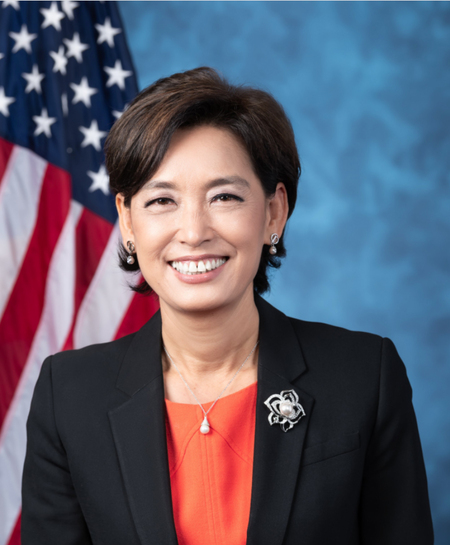
Rep. Young Kim
Sponsored bills
Maddy summaryThe Working Dog Commemorative Coin Act (HR 807) directs the U.S. Treasury to mint three types of commemorative coins honoring working dogs' service: $5 gold coins, $1 silver coins, and half-dollar coins with specific weight and composition requirements. Each coin will carry a surcharge ($35 for $5 coins, $10 for $1 coins, $5 for half-dollars) that will be paid directly to America's VetDogs to support their programs providing service dogs for veterans, the disabled, and others. The coins will be issued in 2027 with designs reflecting working dogs' roles in military, detection, therapy, and assistance work. The legislation specifies that all surcharge revenue must fund America's VetDogs' operations without creating new government programs. This is a commemorative measure focused on honoring working dogs' contributions through coin sales, with all surcharge funds going to a specific nonprofit organization.
Maddy summaryThis bill redesignates a United States Postal Service facility at 3500 West 6th Street, Suite 103 in Los Angeles, California, as the "Dosan Ahn Chang Ho Post Office." It directly affects the postal service location by changing its official name to honor Dosan Ahn Chang Ho, a Korean independence activist and community leader. The bill amends prior legislation to update references to the facility’s address and name in all federal records and documents. This is a ceremonial naming resolution with no policy changes to postal services or operations.
Maddy summaryThe CLEAR Act of 2024 provides $200 million annually (2024-2029) in federal grants to states, territories, and tribes to establish or maintain local resilience offices. These offices must develop 5-year plans addressing environmental, economic, infrastructure, health, and housing risks from disasters, implement community-focused resilience programs, and improve coordination between agencies. Priority is given to projects benefiting disadvantaged communities and adhering to prevailing wage rules, with 10% of funds reserved for tribes. The bill directly affects local governments and tribal entities by requiring structured planning and resource allocation to strengthen community resilience against climate and disaster impacts.
Maddy summaryHR 10196, the "Strengthening Exports Against China Act," amends the Export-Import Bank Act to prevent certain financing from counting toward the Bank's rate calculations. Specifically, it excludes financing that helps replace or compete with products from entities on U.S. sanctions lists (like the Bureau of Industry and Security's Entity List or Treasury's Specially Designated Nationals list). The bill targets financing provided to entities competing with sanctioned Chinese companies, excluding such transactions from the Bank's rate calculations under section 8(g)(1). This change directly affects the Export-Import Bank's financing oversight and entities seeking U.S. export financing tied to competition with sanctioned Chinese businesses.
Maddy summaryHR 3012 reauthorizes U.S. programs under the North Korean Human Rights Act of 2004 through 2028, extending funding and reporting requirements for existing initiatives. It directs the U.S. Agency for Global Media to continue broadcasting independent news into North Korea, supports transparent humanitarian aid delivery, and urges China to halt forcible repatriation of North Korean refugees. The bill directly affects North Korean citizens by promoting information access and refugee protection, and North Korean refugees in China by advocating for UNHCR access and refugee rights. Key provisions include extending program deadlines, reinforcing U.S. diplomatic efforts on human rights, and calling for swift confirmation of the Special Envoy on North Korean Human Rights Issues.
Maddy summaryHRES 1328 is a congressional resolution recognizing the actions of Sudan's Rapid Support Forces (RSF) and allied militias against non-Arab ethnic communities in Darfur - including the Masalit people - as genocide under international law. It cites evidence of mass killings, sexual violence, forced displacement, and targeted attacks on leaders, meeting the Genocide Convention's definition of acts intended to destroy a group. The resolution calls on the U.S. government to support humanitarian access, document atrocities, fund local aid, and review Sudan's genocide determination every six months. As a symbolic resolution (not a law), it does not impose new legal requirements but formally condemns the RSF's actions and urges U.S. diplomatic and humanitarian measures. It directly affects Masalit and other non-Arab communities in Darfur facing systemic violence.
Maddy summaryHR 10175, the "Global Alzheimer’s Initiative Now Act," authorizes U.S. government participation and funding in the Davos Alzheimer’s Collaborative (DAC) to advance global efforts against Alzheimer’s disease and dementia. The bill requires U.S. contributions to be matched by non-U.S. funding, with U.S. spending capped at 33% of total DAC funds, and mandates annual reports to Congress detailing U.S. financial commitments and governance involvement. It directly affects U.S. agencies (State Department, USAID, HHS) and international health systems, particularly in low- and middle-income countries where over 70% of global cases occur. The legislation focuses on leveraging existing U.S. global health funding to support DAC’s work in developing diagnostics, treatments, and care strategies worldwide.
Maddy summaryHR 10169, the Advancing Digital Freedom Act of 2024, establishes a Coordinator for Digital Freedom within the State Department's Bureau of Cyberspace and Digital Policy. This position is tasked with leading U.S. efforts to promote digital freedom globally, including coordinating with allies against digital authoritarianism, supporting information integrity, and advancing democratic governance of AI. The bill mandates an annual report to Congress analyzing global threats to digital freedom - such as censorship, disinformation, and risks to AI governance - and providing recommendations. The Coordinator’s duties focus on integrating digital freedom into U.S. foreign policy priorities and diplomatic engagements.
Maddy summaryThe HEATS Act removes the requirement for federal drilling permits for geothermal exploration and production on non-Federal surface lands where the U.S. owns less than 50% of the underlying geothermal resources. Operators must instead obtain a state permit, after which activities can begin 30 days later and are exempt from major federal environmental reviews under NEPA, the Endangered Species Act, and most historic preservation requirements. The bill does not change existing royalty payments for geothermal electricity production or byproducts, and the Secretary retains authority for onsite inspections to verify production and royalty reporting. This applies only to non-Federal lands not designated as Indian lands under specific tribal trust or ownership rules.