Biliteracy Education Seal and Teaching Act or the BEST Act This bill directs the Department of Education to award renewable two-year grants to states to establish or improve, and carry out, Seal of Biliteracy programs to recognize student proficiency in speaking, reading, and writing in both English and a second language. Further, these programs must allow speakers of any official Native American language to use equivalent proficiency in speaking, reading, and writing in such language in lieu of proficiency in English.
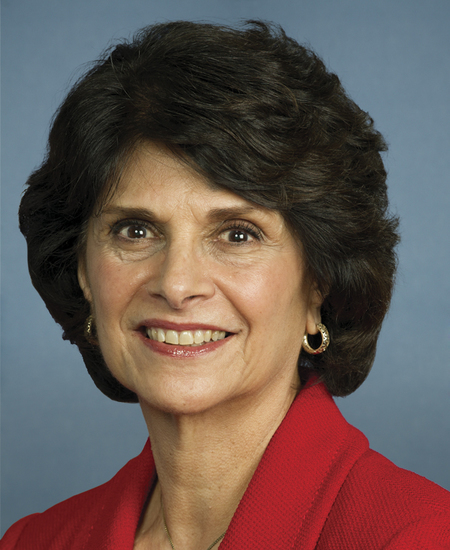
Rep. Lucille Roybal-Allard
Sponsored bills
Air Carrier Access Amendments Act of 2021 This bill expands provisions prohibiting discrimination against disabled individuals by an air carrier. Specifically, it enumerates certain actions that an air carrier must take or may not take with respect to a disabled individual. It also requires the Department of Transportation (DOT) to ensure that disabled individuals traveling in air transportation are able to file complaints with DOT in response to disability-related discrimination and receive assistance from DOT through a hotline or comparable electronic means. The bill authorizes an aggrieved individual and the Department of Justice to bring a civil action for discrimination. The Architectural and Transportation Barriers Compliance Board shall prescribe regulations setting forth minimum standards for aircraft with new or existing type certificates to ensure the accessibility of individuals with disabilities, including those who use wheelchairs. The standards shall address, among other things, boarding and deplaning equipment, seating accommodations, lavatories, visually accessible announcements, and proper stowage of assistive devices in the cargo hold to prevent damage.
George Floyd Justice in Policing Act of 2021 This bill addresses a wide range of policies and issues regarding policing practices and law enforcement accountability. It increases accountability for law enforcement misconduct, restricts the use of certain policing practices, enhances transparency and data collection, and establishes best practices and training requirements. The bill enhances existing enforcement mechanisms to remedy violations by law enforcement. Among other things, it does the following: lowers the criminal intent standard—from willful to knowing or reckless—to convict a law enforcement officer for misconduct in a federal prosecution, limits qualified immunity as a defense to liability in a private civil action against a law enforcement officer, and grants administrative subpoena power to the Department of Justice (DOJ) in pattern-or-practice investigations. It establishes a framework to prevent and remedy racial profiling by law enforcement at the federal, state, and local levels. It also limits the unnecessary use of force and restricts the use of no-knock warrants, chokeholds, and carotid holds. The bill creates a national registry—the National Police Misconduct Registry—to compile data on complaints and records of police misconduct. It also establishes new reporting requirements, including on the use of force, officer misconduct, and routine policing practices (e.g., stops and searches). Finally, it directs DOJ to create uniform accreditation standards for law enforcement agencies and requires law enforcement officers to complete training on racial profiling, implicit bias, and the duty to intervene when another officer uses excessive force.

Capitol Remembrance Act This bill requires the Architect of the Capitol (AOC) to design and install in a prominent location in the U.S. Capitol a permanent exhibit that depicts the January 6, 2021, attack on the Capitol. To the extent possible, the AOC must preserve property that was damaged during the attack and include it in the exhibit. The AOC must also include (1) existing photographic records relating to the attack; and (2) a plaque to honor the U.S. Capitol Police and other law enforcement agencies that protected the Capitol, the individuals who died or sustained injuries to protect the Capitol, and the staff who helped restore the Capitol complex after the attack.
Girls' Leadership, Engagement, Agency, and Development Act of 2021 or the Girls LEAD Act This bill directs the Department of State and the U.S. Agency for International Development (USAID) to jointly report to Congress a strategy to strengthen the participation of adolescents, particularly girls, in democracy, human rights, and governance. The State Department and the USAID shall (1) implement activities to achieve this goal, including activities to increase adolescent girls' civic and political knowledge and skills and address barriers to political participation; and (2) prioritize foreign assistance funding for democracy, human rights, and governance programs toward achieving the goals in this bill.
Give Our Athletes Level Salaries Act or the GOALS Act This bill prohibits the use of funds for the 2026 World Cup until the U.S. Soccer Federation agrees to provide equitable pay to the members of the U.S. Women's National Team and the U.S. Men's National Team.
National Women's Hall of Fame Commemorative Coin Act of 2021 This bill directs the Department of the Treasury to mint and issue $5 gold coins, $1 silver coins, half-dollar clad coins, and proof silver $1 coins in recognition and celebration of the National Women's Hall of Fame in Seneca Falls, New York. All minted coins shall include a specified surcharge, which shall be paid to the National Women's Hall of Fame Foundation to establish an endowment fund to provide for the long-term financing of the hall's operations.
This resolution thanks and honors the journalists and news staff who risked themselves to chronicle the insurrection at the U.S. Capitol on January 6, 2021, and it condemns the harassment and violent attacks on the media during the insurrection.
Jakelin Caal Death in Custody Reporting Act of 2021 This bill requires an investigation and reports for each death of an alien in Department of Homeland Security or Department of Health and Human Services custody. Within 24 hours of such a death, the relevant department shall provide to Congress a publicly available report containing (1) the name, gender, race, ethnicity, and age of the deceased; (2) the date, time, and location of the death; and (3) the circumstances surrounding the death. The relevant department shall conduct an investigation within 30 days of the death of an alien in its custody, including an analysis of (1) the root cause of the death, and (2) any policy or systemic changes that could reduce the possibility of such a death in the future. The results of such an investigation shall be reported to Congress and made publicly available on the internet.
Correcting Hurtful and Alienating Names in Government Expression (CHANGE) Act This bill prohibits any executive agency from using the term alien to refer to an individual who is not a U.S. citizen or national, or i llegal alien to refer to such an individual who is unlawfully present in the United States or lacks lawful immigration status. This prohibition does not apply when quoting certain texts. The bill (1) establishes a uniform definition for the term foreign national when used in acts of Congress and agencies; (2) replaces alien with foreign national in federal government documents, including statutes and regulations; and (3) replaces illegal alien with undocumented foreign national in such documents. Under the bill, a foreign national is any individual other than an individual (1) who is a citizen of the United States; or (2) though not a citizen of the United States, who owes permanent allegiance to the United States.