

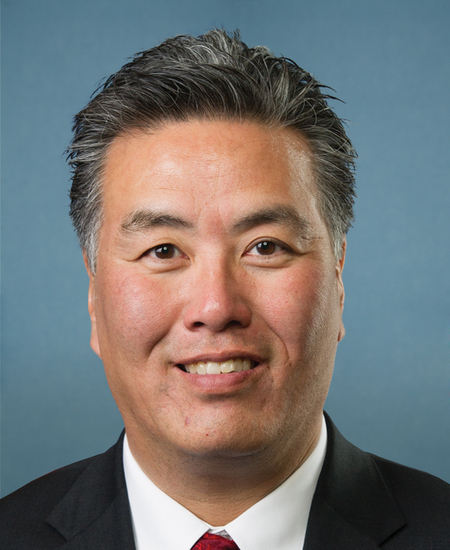
Photo of Mark Takano
D United States House · District 39 · California On the 2026 ballot

Rep. Mark Takano

Compare
Total votes
2,837
all sessions
Attendance
99%
27 missed
Higher than 78% of chamber peers
With party
97%
of cast votes
Higher than 76% of chamber peers
Bipartisan score
1%
crosses aisle rarely
Lower than 77% of chamber peers
Sponsored
1,625
bills & resolutions
Near the chamber average
Committees
5
assignments
1,625 bills and resolutions

Sponsored bills

Total
1,625
Primary
96
Co-sponsor
1,529
This page
1,625
matching current filters
Co-sponsor HRES 413
In committee May 17, 2023 1 co-sponsor
Co-sponsor HR 3409
In committee · United States House · Co-sponsor
Healthy Families Act

Maddy summaryHR 3409, the Healthy Families Act, requires most employers to provide employees with paid sick leave. Employees earn 1 hour of paid sick time for every 30 hours worked, up to a maximum of 56 hours per year, which can be used for their own illness, caring for family members, or addressing domestic violence, sexual assault, or stalking situations. Smaller employers with fewer than 15 employees can provide unpaid sick leave instead of paid leave. The bill includes protections against retaliation for using sick leave and requires employers to inform employees about their rights under this law.

In committee May 17, 2023 1 co-sponsor
Co-sponsor HR 3434
In committee · United States House · Co-sponsor
Teaching Asian American, Native Hawaiian, and Pacific Islander History Act

Maddy summaryThis bill requires public schools (K-12) to integrate Asian American, Native Hawaiian, and Pacific Islander (AANHPI) history into their American history and civics curricula. It amends the Elementary and Secondary Education Act to mandate that all required history content "shall include" AANHPI history, updating existing standards for teachers, textbooks, and national assessments. The law directs the Smithsonian Institution’s Asian Pacific American Center to provide educational resources for schools implementing this change. It directly affects school districts, educators, and curriculum developers by requiring concrete revisions to history instruction. The bill does not fund new programs but modifies existing federal education law to ensure AANHPI contributions and experiences are included in required teaching.

In committee May 17, 2023 1 co-sponsor
Co-sponsor HR 3422
In committee · United States House · Co-sponsor
Judiciary Act of 2023

Maddy summaryHR 3422, the Judiciary Act of 2023, would amend the structure of the U.S. Supreme Court by increasing the number of associate justices from eight to twelve. It would also raise the required quorum for court proceedings from six to eight justices. This bill directly affects the Supreme Court's operational structure and composition. The change is purely procedural, altering the Court's size and voting requirements without impacting other legal processes or specific groups of people.

In committee May 17, 2023 1 co-sponsor
Co-sponsor HR 3444
In committee · United States House · Co-sponsor
Strength in Diversity Act of 2023

Maddy summaryThe Strength in Diversity Act of 2023 creates a federal grant program to help school districts address racial and socioeconomic isolation in public schools (K-12). Eligible school districts, states, or consortia with significant segregation gaps can apply for planning or implementation grants to develop strategies like equitable school assignments, transportation plans, or teacher recruitment programs. Grants require community engagement, data tracking on academic outcomes and diversity metrics, and plans to sustain efforts after funding ends. The program aims to increase student diversity and improve outcomes for students of color and low-income students in segregated schools.

In committee May 17, 2023 1 co-sponsor
Co-sponsor HRES 319
In committee · United States House · Co-sponsor
Recognizing the duty of the Federal Government to create a Green New Deal.

Maddy summaryHRES 319 is a symbolic resolution passed by the U.S. House of Representatives on April 24, 2023, recognizing the federal government's duty to develop a Green New Deal. It states the House believes the government should create a comprehensive plan to address climate change and economic inequality through a 10-year national mobilization. The resolution outlines goals like achieving net-zero emissions by 2050, creating high-wage union jobs, upgrading infrastructure, and prioritizing frontline communities, but it does not establish binding policy or funding mechanisms. As a non-binding resolution, it serves as a statement of legislative intent rather than a law.

In committee May 15, 2023 1 co-sponsor
Co-sponsor HR 3332
In committee · United States House · Co-sponsor
Extending WIC for New Moms Act

Maddy summaryThis bill extends eligibility for the WIC nutrition program to new mothers for 24 months after childbirth (up from six months) and extends breastfeeding support periods to 24 months (up from one year). It directly affects new mothers and infants who rely on WIC for nutrition assistance, breastfeeding support, and health services. Key provisions include amending the Child Nutrition Act to lengthen these benefit periods and requiring a report within two years evaluating health outcomes, breastfeeding rates, and family experiences. The report must assess impacts on maternal/infant health, racial disparities, and program effectiveness. This is a substantive policy change focused on improving access to critical postpartum support.

In committee May 15, 2023 1 co-sponsor
Co-sponsor HR 3344
In committee · United States House · Co-sponsor
Justice for Incarcerated Moms Act

Justice for Incarcerated Moms Act This bill establishes new requirements related to grants, programs, and reports to improve the treatment and care of pregnant and postpartum women who are incarcerated. Specifically, the bill requires the following: states must restrict the use of restraints on pregnant women in prison in order to receive full funding under the Edward Byrne Memorial Justice Assistance Grant program; the Bureau of Prisons must establish programs to optimize maternal health outcomes for pregnant and postpartum women in federal prisons; the Bureau of Justice Assistance must award state grants for programs to support pregnant and postpartum women in state and local prisons and jails; and the Government Accountability Office must report on adverse maternal and infant health outcomes among incarcerated individuals and infants born to such individuals, with a particular focus on racial and ethnic disparities.

In committee May 15, 2023 1 co-sponsor
Co-sponsor HR 2783
In committee · United States House · Co-sponsor
AANAPISI Opportunity Act

AANAPISI Opportunity Act This bill requires the Department of Agriculture (USDA) to establish a scholarship grant program for covered Asian American and Native American Pacific Islander-serving institutions (AANAPISIs) to provide scholarships in agriculture-related fields. Covered institutions include community colleges, colleges, or universities that (1) have a student body consisting of at least 10% Asian American or Native American Pacific Islander students; and (2) offer associate, bachelors, or other accredited degree programs in agriculture-related fields. USDA may only award the grants to AANAPISIs that have established a competitive scholarship awards process for individuals who intend to pursue a career in agriculture, including in the agricultural disciplines of business, engineering, technology, food science, forestry, home economics, nutrition, soil conservation, non-medical biological sciences, and computer science. This bill also allows USDA to provide competitive grants for up to five years for integrated agricultural research, education, and extension projects at covered AANAPISIs to address U.S. agriculture priorities. The project grants include a 50% matching funds requirement that USDA may waive if certain requirements are met.

In committee May 15, 2023 1 co-sponsor
Co-sponsor HR 2786
In committee · United States House · Co-sponsor
Climate Change Relief for Urban Areas Act of 2023

Maddy summaryThis bill directs the U.S. Department of Agriculture to prioritize urban forestry assistance for communities with the lowest tree equity scores - measured by how tree canopy coverage aligns with community factors like income, race, health, and employment. It also creates a $30 million pilot program for public elementary and secondary schools to establish rooftop gardens, requiring at least 20% native plants, organic methods, and curriculum integration on urban agriculture or pollinator habitats. Schools in areas with high population density, respiratory illness rates, or low existing garden access receive priority for funding. The program mandates annual inspections of funded gardens and defines "tree equity score" using tools like American Forests' methodology.

In committee May 15, 2023 1 co-sponsor
Showing 781 to 790 of 1,625 bills
Previous 1 … 78 79 80 … 163 Next