

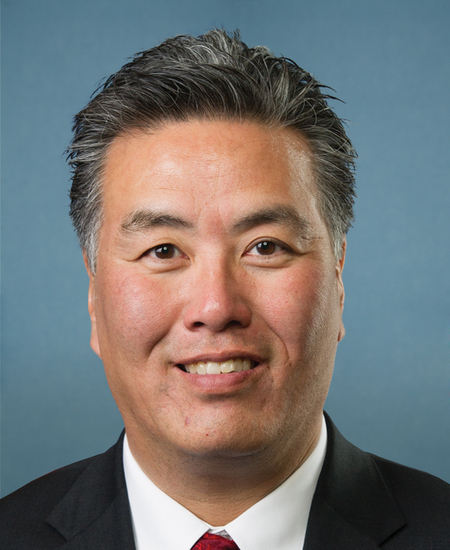
Photo of Mark Takano
D United States House · District 39 · California On the 2026 ballot

Rep. Mark Takano

Compare
Total votes
2,837
all sessions
Attendance
99%
27 missed
Higher than 78% of chamber peers
With party
97%
of cast votes
Higher than 76% of chamber peers
Bipartisan score
1%
crosses aisle rarely
Lower than 77% of chamber peers
Sponsored
1,619
bills & resolutions
Near the chamber average
Committees
5
assignments
1,619 bills and resolutions

Sponsored bills

Total
1,619
Primary
96
Co-sponsor
1,523
This page
1,619
matching current filters
Co-sponsor HR 4285
In committee · United States House · Co-sponsor
COMMUNITIES Act

Creation of Opportunities for Medical Manpower in Underserved Neighborhoods by Indemnifying Tuition and Incentivizing Exceptional Service Act or the COMMUNITIES Act This bill increases the amount of student loan repayment available to eligible health care providers who agree to complete a five-year period of obligated service in a health professional shortage area. Specifically, for each year of service, the Department of Health and Human Services shall pay one-fifth of the total amount owed on a participating provider's qualifying student loans. Current law caps the maximum amount of student loan repayment that a provider may receive in exchange for such service.

In committee Jul 1, 2021 1 co-sponsor
Co-sponsor HR 3277
In committee · United States House · Co-sponsor
Animal Welfare Enforcement Improvement Act

Animal Welfare Enforcement Improvement Act This bill revises the licensing process of the Department of Agriculture (USDA) for animal dealers and exhibitors to expand USDA's oversight and enforcement of animal welfare requirements. The bill also authorizes citizen suits to enforce the Animal Welfare Act. Dealers and exhibitors must apply to USDA for licenses or renewal licenses each year. In order to obtain the licenses or renewals, dealers and exhibitors must meet certain standards for the humane treatment of animals and pass inspections as specified by this bill. USDA may not issue or renew such licenses if the dealers or exhibitors have violated laws relating to animals or if the issuance of the licenses would facilitate the circumvention of state or local laws that prohibit the private ownership of certain animals. Further, USDA must suspend the licenses of dealers or exhibitors whose violations present a risk to animal welfare. USDA must revoke the licenses if the violations persist or if the licensees commit multiple violations. Dealers and exhibitors with suspended or revoked licenses may not be (1) granted another license, (2) granted another license through another person or entity, or (3) employed by another licensee to work with animals during the period of the suspension or revocation.

In committee Jul 1, 2021 1 co-sponsor
Co-sponsor HR 4249
In committee · United States House · Co-sponsor
Screening With Dignity Act

Screening With Dignity Act This bill directs the Transportation Security Administration (TSA) to develop procedures to appropriately and respectfully screen self-identified transgender air passengers and passengers traveling with religious headwear or other articles of faith and begin training of all TSA Officers on such procedures. The TSA must implement protections for such passengers, including (1) prohibiting human viewing of passenger images and conducting pat downs by an officer of the gender requested by the passenger; and (2) ensuring secondary screening measures are no more intrusive than necessary to resolve an alarm or other concern raised by primary screening, including consideration of the sensitivity of the groin, chest, and other body areas and the sensitivity of religious articles of faith such as religious headwear. The TSA shall separately study and report on (1) the cost and feasibility of retrofitting advanced image technology screening equipment to distinguish between foreign objects and human body parts (including hair) in a manner that is gender neutral; and (2) the impact of imaging technology on transgender passengers, passengers whose religious faith requires them to travel with articles of faith, and passengers traveling with assistive devices. Additionally, the TSA must identify any policy, procedure, or training changes and complete any testing, certification, and assessment for qualifying additional technology to ensure that any advanced imaging utilized for passenger screening meets certain requirements, including not generating alarms based only on passengers' body parts (including hair), undergarments, or religious headwear.

In committee Jun 30, 2021 1 co-sponsor
Co-sponsor HR 4188
In committee · United States House · Co-sponsor
Respect for Peace Corps Volunteers Act

Respect for Peace Corps Volunteers Act This bill allows the official seal or emblem of the Peace Corps and the name Peace Corps to be used on any death announcement, plaque, grave stone, or other grave marker of a former volunteer, officer, or employee of the Peace Corps.

In committee Jun 25, 2021 1 co-sponsor
Co-sponsor HR 4173
In committee · United States House · Co-sponsor
Tax-Free Pell Grant Act

Tax-Free Pell Grant Act This bill excludes from gross income, for income tax purposes, any amount received as a federal Pell Grant. It also expands the definition of qualified tuition and related expenses under the American Opportunity and Lifetime Learning tax credit to include computer or peripheral equipment (up to a maximum of $1,000), child and dependent care expenses, and course materials.

In committee Jun 25, 2021 1 co-sponsor
Co-sponsor HR 4151
In committee · United States House · Co-sponsor
FASD Respect Act

Advancing FASD Research, Services, and Prevention Act or the FASD Respect Act This bill expands and establishes programs for fetal alcohol spectrum disorders (FASD). Specifically, it directs the Department of Health and Human Services, the National Institutes of Health, the National Center on Birth Defects and Developmental Disabilities, and the Health Resources and Services Administration to carry out and coordinate research, surveillance, and related activities to diagnose, prevent, and treat FASD. Furthermore, the bill establishes various grant programs to support FASD coalitions and develop systems of care; provide services for individuals affected by FASD and other conditions related to prenatal substance exposure; identify and implement best practices for educating children with FASD; and establish centers for excellence to build relevant capacity for preventing, treating, and responding to the needs of individuals with FASD. The bill also directs the Department of Education and the Department of Justice to develop and disseminate trainings and best practices related to FASD in schools and correctional facilities, respectively.

In committee Jun 25, 2021 1 co-sponsor
Co-sponsor HR 4146
In committee · United States House · Co-sponsor
Therapeutic Fraud Prevention Act of 2021

Therapeutic Fraud Prevention Act of 20 21 This bill prohibits commercial conversion therapy, which is a practice or treatment designed to change a person's sexual orientation or gender identity or otherwise change behaviors, thoughts, or expressions related to gender or sexual attraction. This prohibition does not apply to treatment that assists an individual undergoing a gender transition or facilitates identity exploration and development.

In committee Jun 25, 2021 1 co-sponsor
Co-sponsor HR 4158
In committee · United States House · Co-sponsor
Insulin Access for All Act of 2021

Insulin Access for All Act of 2021 This bill prohibits cost-sharing (e.g., copayments) under Medicaid and the Medicare prescription drug benefit for insulin and associated medical supplies.

In committee Jun 25, 2021 1 co-sponsor
Co-sponsor HR 2062
Passed · United States House · Co-sponsor
Protecting Older Workers Against Discrimination Act of 2021

Protecting Older Workers Against Discrimination Act of 2021 This bill revises the evidentiary standard for age discrimination by establishing an unlawful employment practice when the complaining party demonstrates that age or participation in an investigation, proceeding, or litigation related to an age discrimination claim was a motivating factor for an adverse practice, even though other factors also motivated the practice (thereby allowing what are commonly known as mixed motive claims). The bill (1) permits the complaining party to rely on any type or form of admissible evidence, which need only be sufficient for a reasonable trier of fact to find that an unlawful practice occurred; and (2) declares that the complaining party shall not be required to demonstrate that age or retaliation was the sole cause of the employment practice (thereby rejecting the Supreme Court's decision in Gross v. FBL Financial Services, Inc. , which requires the complainant to prove that age was the but-for cause for the employer's decision). The bill applies this evidentiary standard to other employment discrimination and retaliation claims, including claims under the Civil Rights Act of 1964, the Americans With Disabilities Act of 1990, and the Rehabilitation Act of 1973. In a claim in which age discrimination is shown, but where the employer demonstrates that it would have taken the same action absent the motivating factor of age, the bill authorizes courts to grant declaratory and injunctive relief, but prohibits the court from awarding damages or issuing an order requiring any admission, reinstatement, hiring, promotion, or payment. This limitation also applies to claims of discrimination based on disability. The bill also includes reporting requirements for the Equal Employment Opportunity Commission and the Department of Labor.

Passed Jun 24, 2021 1 co-sponsor
Showing 1,351 to 1,360 of 1,619 bills