

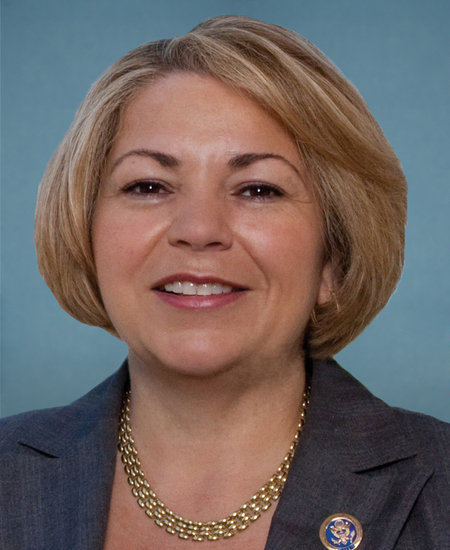
Photo of Linda T. Sánchez
D United States House · District 38 · California On the 2026 ballot

Rep. Linda T. Sánchez

Compare
Total votes
2,837
all sessions
Attendance
98%
44 missed
Near the chamber average
With party
98%
of cast votes
Higher than 89% of chamber peers
Bipartisan score
1%
crosses aisle rarely
Lower than 90% of chamber peers
Sponsored
1,400
bills & resolutions
Near the chamber average
Committees
3
assignments
1,400 bills and resolutions

Sponsored bills

Total
1,400
Primary
74
Co-sponsor
1,326
This page
1,400
matching current filters
Co-sponsor HR 761
In committee · United States House · Co-sponsor
HITS Act

Maddy summaryThis bill allows independent music producers to deduct production costs immediately as business expenses (rather than spreading them over time) for U.S.-recorded sound recordings. It specifically covers independent artists and small labels producing music in the U.S., with a $150,000 annual limit on deductible costs per project. The bill also extends bonus depreciation for equipment used in qualifying recording projects. These changes apply to productions starting after the bill's enactment.

In committee Jan 28, 2025 1 co-sponsor
Co-sponsor HR 777
In committee · United States House · Co-sponsor
Closing the College Hunger Gap Act

Maddy summaryThis bill requires the U.S. Department of Education to proactively notify eligible college students about potential access to SNAP (food stamp) benefits. It targets students with a negative or zero student aid index (SAI) who file the Free Application for Federal Student Aid (FAFSA). The Department must send annual written and electronic notices explaining SNAP eligibility and providing state contact information for applying. The bill also mandates consultation between the Education and Agriculture Departments to design these notifications. This is a policy change focused on improving access to nutrition assistance for low-income students already enrolled in college.

In committee Jan 28, 2025 1 co-sponsor
Co-sponsor HRES 66
In committee · United States House · Co-sponsor
Affirming the role of the United States in improving access to quality, inclusive public education and improving learning outcomes for children and adolescents, particularly for girls, around the world.

Maddy summaryHRES 66 is a non-binding resolution affirming the U.S. government's leadership in global education. It calls on the State Department and USAID to prioritize quality, inclusive public education for girls, children with disabilities, and children in crisis settings, while integrating education into humanitarian responses. The resolution urges these agencies to meet existing commitments to international education programs and advance learning outcomes for marginalized youth worldwide. It does not create new laws or funding but emphasizes coordination across U.S. government agencies to support global education efforts.

In committee Jan 24, 2025 1 co-sponsor
Co-sponsor HR 728
In committee · United States House · Co-sponsor
Expanding Head Start Eligibility Act of 2025

Maddy summaryHR 728, the Expanding Head Start Eligibility Act of 2025, would amend the Head Start Act to broaden eligibility criteria. It adds a new definition of "public assistance" to include benefits from programs like SNAP (food stamps), housing assistance under Section 8, and state-funded food programs with similar income standards. This change directly affects low-income families seeking Head Start enrollment, as children in households receiving these benefits would now qualify under the expanded definition. The bill modifies the Head Start Act’s eligibility rules to count these additional benefits, making it easier for more children to access early childhood education programs.

In committee Jan 24, 2025 1 co-sponsor
Co-sponsor HR 721
In committee · United States House · Co-sponsor
Performing Artist Tax Parity Act of 2025

Maddy summaryThis bill creates a new above-the-line tax deduction for performing artists (like musicians, actors, and dancers) to deduct work-related expenses directly from their gross income, rather than itemizing deductions. It sets a $100,000 income threshold (adjusted annually for inflation), phasing out the deduction by 10% for every $2,000 earned above this amount. The bill also explicitly includes commissions paid to an artist’s manager or agent as deductible expenses and raises the $200 "nominal employer" threshold for expense deductions to $500 (with inflation adjustments). These changes apply to tax years beginning after December 31, 2024.

In committee Jan 24, 2025 1 co-sponsor
Co-sponsor HR 609
In committee · United States House · Co-sponsor
Assuring Medicare’s Promise Act of 2025

Maddy summaryHR 609, the Assuring Medicare's Promise Act of 2025, directs revenue from the net investment income tax (currently applied to investment income) into the Medicare Hospital Insurance Trust Fund. It expands the tax base to include certain business income for high-income individuals with modified adjusted gross income exceeding $400,000 ($500,000 for joint filers), with a phase-in to limit the tax increase. The bill ensures this tax revenue directly supports Medicare's hospital insurance program, applying to taxable years beginning after December 31, 2025. The changes do not alter the tax rate but broaden the income types subject to the tax for high earners.

In committee Jan 22, 2025 1 co-sponsor
Co-sponsor HR 539
In committee · United States House · Co-sponsor
Chiropractic Medicare Coverage Modernization Act of 2025

Chiropractic Medicare Coverage Modernization Act of 2025 This bill expands Medicare coverage of chiropractic services to include all services provided by chiropractors, rather than only subluxation corrections through manual manipulation of the spine.

In committee Jan 16, 2025 1 co-sponsor
Co-sponsor HR 516
In committee · United States House · Co-sponsor
To amend the Internal Revenue Code of 1986 to modify the railroad track maintenance credit.

This bill increases the annual limit on the tax credit for qualified railroad track maintenance expenses (also referred to as the short line railroad tax credit) and expands eligibility for claiming the credit. Under current law, the tax credit is limited each tax year to $3,500 multiplied by the sum of the number of miles of railroad track owned or leased by the taxpayer (miles owned or leased) and the number of railroad track miles assigned to the taxpayer by a Class II or III railroad (miles assigned). This bill increases the annual limit to $6,100 multiplied by the sum of miles owned or leased and miles assigned. The $6,100 amount used in the calculation of the tax credit limit is adjusted for inflation for tax years beginning after 2025. The bill also expands eligibility for the tax credit to include gross expenses for maintaining railroad tracks owned or leased as of January 1, 2024. Under current law, the tax credit is limited to gross expenses for maintaining railroad tracks owned or leased as of January 1, 2015.

In committee Jan 16, 2025 1 co-sponsor
Co-sponsor HR 515
In committee · United States House · Co-sponsor
Ensuring Military Readiness Not Discrimination Act

Maddy summaryThis bill prohibits discrimination based on gender identity, sexual orientation, or sex characteristics in military service. It requires that eligibility for military service and all personnel policies consider only an individual's ability to meet job-specific military standards, banning the use of race, color, national origin, religion, or gender-related factors. The law directly affects all current and prospective members of the Armed Forces by mandating that military occupational standards apply equally to everyone. It amends Title 10 of the U.S. Code to establish these protections as a formal requirement for all military personnel policies.

In committee Jan 16, 2025 1 co-sponsor
Co-sponsor HR 507
In committee · United States House · Co-sponsor
Veterans Member Business Loan Act

Maddy summaryHR 507, the Veterans Member Business Loan Act, amends the Federal Credit Union Act to explicitly include loans made to veterans as qualifying "member business loans" under credit unions. This change directly affects veterans seeking business financing through federal credit unions, allowing them to access these loans under the same framework as other small business borrowers. The key mechanism is adding a new definition category ("made to a veteran") to the existing eligibility criteria for business loans, using the standard military definition of "veteran" from Title 38, U.S. Code. The bill does not create new funding or programs but expands existing credit union lending options to include veterans. This definition change takes effect six months after the bill's enactment.

In committee Jan 16, 2025 1 co-sponsor
Showing 341 to 350 of 1,400 bills
Previous 1 … 34 35 36 … 140 Next