

Law Enforcement De-Escalation Training Act of 2022 This bill directs the Department of Justice (DOJ) to develop scenario-based training curricula (or identify existing curricula) that includes topics such as alternatives to the use of force, de-escalation tactics, and safely responding to an individual experiencing a mental, behavioral health, or suicidal crisis. The bill also directs DOJ to make grants to states for costs associated with providing the training to law enforcement officers or mental health professionals.
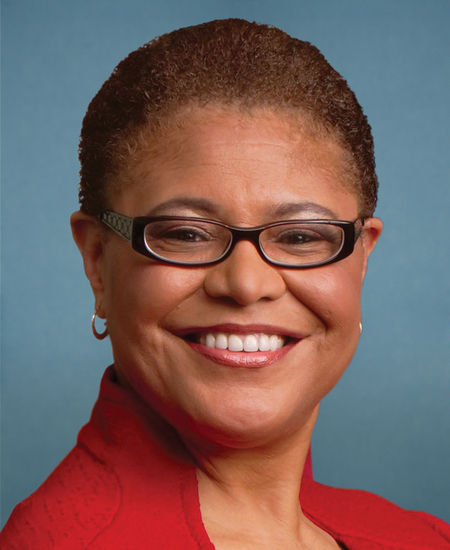
Rep. Karen Bass
Sponsored bills
Maddy summaryThe Supreme Court Tenure Establishment and Retirement Modernization Act of 2022 would require the President to nominate one Supreme Court justice every other year (during the first and third years after a Presidential election), with Senate confirmation. New justices would serve an 18-year term before automatically retiring, while current justices would be deemed retired in order of their service duration (starting with the longest-serving) as new appointments occur. If the Court's membership falls below the required number due to vacancies, the most recently retired justice under this system would serve as an associate justice until the full complement is restored. This bill directly affects the appointment process, term lengths, and retirement mechanics for all Supreme Court justices.
Renewing Immigration Provisions of the Immigration Act of 1929 This bill expands eligibility for a program that authorizes the Department of Homeland Security to, at its discretion, provide lawful permanent resident status to certain long-term residents of the United States, including individuals who are unlawfully present. Currently, this program, sometimes referred to as the Registry program, is only available to eligible non-U.S. nationals ( aliens under federal law) who entered the United States before January 1, 1972. The bill removes this entry cutoff date and opens up the program to eligible individuals who have resided in the United States for at least seven years. Existing requirements (e.g., the individual must not be inadmissible or deportable due to certain grounds related to crime or terrorism) continue to apply.
Children's Safe Welcome Act of 2022 This bill imposes requirements related to the treatment of noncitizen children detained in immigration custody. For example, the bill (1) prohibits an accompanied noncitizen child from being separated from a parent or legal guardian while in immigration custody, except in certain situations; (2) requires each child in immigration custody to receive a legal orientation presentation and have access to legal counsel and child advocates; and (3) requires each unaccompanied noncitizen child in Department of Health and Human Services custody to be placed in the least restrictive setting that most approximates a family and in which any special needs may be met.
PREA Rights Enforcement Act of 2022 This bill allows a person to file a civil action against the United States for violations in a federal prison of established national standards for the detection, prevention, reduction, and punishment of prison rape.
Right to Trial Act This bill addresses the constitutional right to a jury trial, including by (1) outlining additional factors that a court shall consider when imposing a sentence, and (2) authorizing a court to impose a sentence below the mandatory minimum.
Eliminating Limits to Justice for Child Sex Abuse Victims Act of 2022 This bill eliminates the statute of limitations for a minor victim of a human trafficking offense or federal sex offense to file a civil action to recover damages.
Stealthing Act of 2022 This bill establishes a civil action for the nonconsensual removal of a sexual protection barrier (e.g., a condom). A person may recover compensatory and punitive damages, injunctive and declaratory relief, and such other relief as a court may deem appropriate.
Consent is Key Act This bill directs the Department of Justice to increase a state's allocation of funds under the Sexual Assault Services Program if the state has in effect a law that authorizes civil damages and equitable relief against a person who engages in the nonconsensual removal of a sexual protection barrier (e.g., a condom).
Women in Criminal Justice Reform Act This bill establishes programs and requirements to address the health and wellness of women in the criminal justice system. For example, the bill requires the Bureau of Prisons to (1) ensure that all incarcerated women have access to basic standards of health care specific to their needs, and (2) develop and implement gender-responsive training for its officers and employees.