This resolution acknowledges racial disparities in the impact of colorectal cancer, particularly in the Black community, and encourages actions to address those disparities.
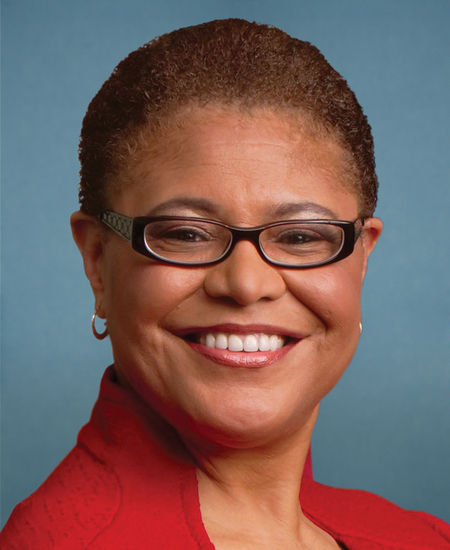
Rep. Karen Bass
Sponsored bills
Improving Access to Indian Health Services Act This bill permanently extends certain Medicaid flexibilities relating to Indian health care providers. Specifically, the bill permanently expands coverage to include clinical services that are furnished outside of a clinic by an Indian Health Service (IHS) facility, a tribe or tribal organization, or an Urban Indian Organization (UIO). Current guidance from the Centers for Medicare & Medicaid Services allows IHS and tribal facilities to receive payment for clinical services provided outside of clinics through October 31, 2021; facilities are expected to work with their state Medicaid programs to transition to other, more permanent payment options for these services. The bill also permanently establishes a 100% federal matching rate, also known as the Federal Medical Assistance Percentage (FMAP), for UIO services. Current law provides a 100% FMAP for UIO services during the eight fiscal quarters after March 11, 2021.
This resolution supports the designation of Eddie Bernice Johnson Black Women in Science and Technology Month.
Expanded Coverage for Former Foster Youth Act This bill modifies certain changes that are scheduled to take effect under the Substance Use-Disorder Prevention that Promotes Opioid Recovery and Treatment (SUPPORT) for Patients and Communities Act relating to the coverage of former foster youth under Medicaid. Under current law, a state Medicaid program must cover former foster youth until the age of 26 if the youth were in the state's foster care system at the age of 18 and were enrolled in the state's Medicaid program while in foster care; a state may choose to also cover former foster youth from other states. The SUPPORT for Patients and Communities Act altered these provisions to require a state Medicaid program to cover former foster youth from other states until the age of 26; such changes apply to former foster youth who reach the age of 18 on or after January 1, 2023. The bill requires state Medicaid programs to also cover former foster youth who were placed in a legal guardianship with a kinship caregiver or were emancipated from foster care before the age of 18. The bill also repeals the provision that requires former foster youth to have been enrolled in a state Medicaid program while in foster care in order to qualify for Medicaid coverage until the age of 26. States must also establish Medicaid outreach and enrollment programs for former foster youth.
Foster Youth Dental Act of 2021 This bill expands Medicaid coverage of current and former foster youth, particularly with respect to dental services. Specifically, the bill requires state Medicaid programs to cover early and periodic screening, diagnostic, and treatment services, including dental services, for current and former foster youth under the age of 26. States must set a special payment rate, based on rates in the private sector, for dental services provided to such individuals; the bill provides an enhanced Federal Medical Assistance Percentage (i.e., federal matching rate) for excess expenses that result from such payments. The bill's requirements take effect 80 days after the date of enactment of the bill. The bill also accelerates the application of certain provisions that require a state Medicaid program to cover former foster youth from other states until the age of 26; such provisions currently apply to former foster youth who reach the age of 18 on or after January 1, 2023. The bill instead applies these provisions to former foster youth who reach the age of 18 on or after the date of enactment of the bill.
Immediate Coverage for Former Foster Youth Act This bill accelerates the application of certain changes that are scheduled to take effect under the Substance Use-Disorder Prevention that Promotes Opioid Recovery and Treatment (SUPPORT) for Patients and Communities Act relating to the coverage of former foster youth under Medicaid. Under current law, a state Medicaid program must cover former foster youth until the age of 26 if the youth were in the state's foster care system at the age of 18 and were enrolled in the state's Medicaid program while in foster care; a state may choose to also cover former foster youth from other states. The SUPPORT for Patients and Communities Act altered these provisions to require a state Medicaid program to cover former foster youth from other states until the age of 26; such changes apply to former foster youth who reach the age of 18 on or after January 1, 2023. The bill instead applies these changes to former foster youth who reach the age of 18 on or after the date of enactment of this bill. States must also establish Medicaid outreach and enrollment programs for former foster youth.
This bill designates the portion of U.S. Route 80 from Selma, Alabama, to Montgomery, Alabama, as the John R. Lewis Voting Rights Highway.
COVID Community Care Act This bill provides FY2021 supplemental appropriations for the Department of Health and Human Services (HHS) to prevent, prepare for, and respond to COVID-19 (i.e., coronavirus disease 2019). Specifically, the bill provides appropriations to the HHS Public Health and Social Services Emergency Fund and the Indian Health Service for implementing programs to prevent, prepare for, and respond to COVID-19 in medically underserved communities and among tribal populations, respectively. The bill designates the funding as emergency spending, which is exempt from discretionary spending limits.
No Tax Breaks for Outsourcing Act This bill modifies the tax treatment of the foreign source income of domestic corporations. The bill includes provisions that modify calculations of the gross income of U.S. shareholders to include net CFC tested income in the current taxable year, apply limitations on the foreign tax credit on a country-by-country basis, limit the tax deduction for the interest expense of a U.S. corporation that is a member of a financial reporting group (i.e., a group that prepares consolidated financial statements according to generally accepted accounting principles or international financial reporting standards), modify the rules for the taxation of inverted corporations (i.e., U.S. corporations that acquire foreign companies to reincorporate in a foreign jurisdiction with income tax rates lower than the United States), and treat certain foreign corporations managed and controlled primarily in the United States as domestic corporations for tax purposes.
Protecting the Right to Organize Act of 20 21 This bill expands various labor protections related to employees' rights to organize and collectively bargain in the workplace. Among other things, it (1) revises the definitions of employee , supervisor , and employer to broaden the scope of individuals covered by the fair labor standards; (2) permits labor organizations to encourage participation of union members in strikes initiated by employees represented by a different labor organization (i.e., secondary strikes); and (3) prohibits employers from bringing claims against unions that conduct such secondary strikes. The bill also allows collective bargaining agreements to require all employees represented by the bargaining unit to contribute fees to the labor organization for the cost of such representation, notwithstanding a state law to the contrary; and expands unfair labor practices to include prohibitions against replacement of, or discrimination against, workers who participate in strikes. The bill makes it an unfair labor practice to require or coerce employees to attend employer meetings designed to discourage union membership and prohibits employers from entering into agreements with employees under which employees waive the right to pursue or a join collective or class-action litigation. The bill further prohibits employers from taking adverse actions against an employee, including employees with management responsibilities, in response to that employee participating in protected activities related to the enforcement of the prohibitions against unfair labor practices (i.e., whistleblower protections). Such protected activities include providing information about a potential violation to an enforcement agency, participating in an enforcement proceeding, initiating a proceeding concerning an alleged violation or assisting in such a proceeding, or refusing to participate in an activity the employee reasonably believes is a violation of labor laws. Finally, the bill addresses the procedures for union representation elections, provides employees with the ability to vote in such elections remotely by telephone or the internet, modifies the protections against unfair labor practices that result in serious economic harm, and establishes penalties and permits injunctive relief against entities that fail to comply with National Labor Relations Board orders.