This concurrent resolution recognizes the service and sacrifice of those who served and perished in California at Port Chicago Naval Magazine during World War II. The concurrent resolution also exonerates the 50 Port Chicago sailors convicted of the charge of mutiny against the United States and all other charges brought against them after the July 17, 1944, explosion that killed 320. It upgrades the general and summary discharges of the Port Chicago sailors to honorable discharges.
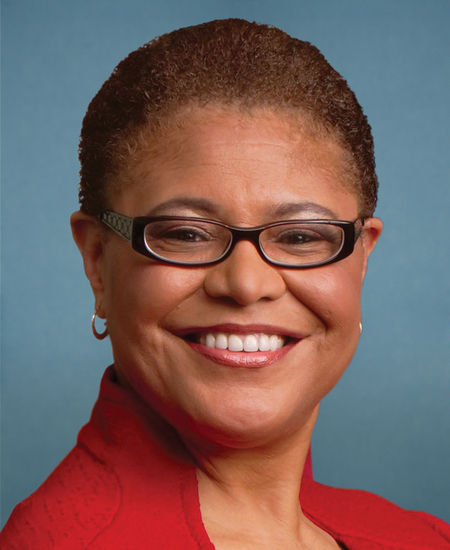
Rep. Karen Bass
Sponsored bills
Pathways to Health Careers Act This bill provides funding for, reauthorizes through FY2026, and makes a variety of changes to certain grants administered by the Department of Health and Human Services that provide education and training to low-income individuals for health care occupations, including by establishing a new competitive grant for projects designed to train low-income individuals in allied health professions.
Data to Save Moms Act This bill expands data collection and research on maternal morbidity and mortality among minority populations. Specifically, the bill adds requirements to a program within the Centers for Disease Control and Prevention (CDC) that supports maternal mortality review committees. To the extent practicable, the committees must use the most up-to-date indicators of severe maternal morbidity; review deaths caused by suicide, overdose, or other behavioral health conditions attributed to or aggravated by pregnancy or childbirth; and consult with representatives of communities about nonclinical factors that may contribute to adverse maternal outcomes. The CDC may also award grants to committees to increase their engagement with local communities, such as by bringing on community representatives as committee members. Additionally, the Centers for Medicare & Medicaid Services and the Agency for Healthcare Research and Quality must consult with diverse stakeholders to review maternal health data collection processes and quality measures and make recommendations to improve them. The Indian Health Service and the Department of Health and Human Services must also arrange for studies on adverse maternal health outcomes among tribal and minority populations, respectively.
Veterans Preventive Health Coverage Fairness Act This bill eliminates veterans' copayments for medication, hospital care, and medical services related to preventive health services provided by the Department of Veterans Affairs. The bill expands the definition of preventive health services to include (1) evidence-based items or services that have an A or B rating in the recommendations of the United States Preventive Services Task Force; (2) immunizations that have a recommendation from the Advisory Committee on Immunization Practices of the Centers for Disease Control and Prevention with respect to the individual involved; and (3) with respect to women, the preventive care and screenings provided for in the Health Resources and Services Administration Preventive Services Guidelines in effect as of January 1, 2017.
This resolution expresses support for the designation of Journeyman Lineworkers Recognition Day. (A journeyman lineworker is a person who builds and maintains electrical power systems.)
This bill repeals the joint resolution of March 9, 1957, that provided for the use of certain funds to promote peace and stability in the Middle East.
This bill repeals the January 14, 1991, resolution authorizing the use of military force against Iraq.
Global Learning Loss Assessment Act of 2021 This bill requires the U.S. Agency for International Development (USAID) to report on the impact of the COVID-19 pandemic on the agency's basic education programs. This report shall include (1) an assessment of the global learning loss that will result from protracted school closures; (2) evaluations of the effectiveness, cost, accessibility, and reach of the most commonly used forms of distance learning in low- and middle-income countries; and (3) a description of the resources needed for the USAID to support continued distance learning, safe school reopenings, remedial and accelerated learning, and reenrollment campaigns.
Global Health Security Act of 2021 This bill directs the United States to implement a strategy to strengthen global health security, including by requiring the President to create the Global Health Security Agenda Interagency Review Council to implement the Global Health Security Agenda. The agenda is an initiative launched by nearly 30 nations to address global infectious disease threats. The council's responsibilities include (1) providing policy recommendations on agenda-related goals, objectives, implementation, and other international efforts to strengthen pandemic preparedness and response; (2) helping federal agencies with implementation; and (3) reviewing the progress and challenges in achieving U.S. commitments, including assistance to help other countries meet agenda targets. The bill also directs the federal agencies involved with the agenda to prioritize its implementation and to take certain steps to achieve that goal. The President shall coordinate a strategy for responding to global health security emergencies and submit a report on the implementation of this strategy. Additionally, the Department of State should seek to enter into negotiations with donors, relevant United Nations agencies, and other multilateral stakeholders to establish a Fund for Global Health Security and Pandemic Preparedness that (1) closes gaps in global health security and pandemic preparedness; and (2) builds capacity in eligible partner countries related to global health security, infectious disease control, and pandemic preparedness. The fund should provide grants, technical assistance, and innovative funding mechanisms to achieve its purposes.

Opening Doors for Youth Act of 2021 This bill requires the Department of Labor to provide funding to states for the development or expansion of summer and year-round youth employment programs that (1) match youth participants with appropriate employers for high-quality employment opportunities; and (2) provide work-readiness training and educational programs, coaching and mentoring, career and postsecondary education planning services, financial literacy education, and supportive services.