All Participating in Process Reaching Informed Solutions for Everyone Act or the APPRISE Act This bill requires the Federal Aviation Administration to ensure that an aviation roundtable technical representative or consultant is allowed to participate in the Next Generation Air Transportation System (NextGen) performance-based navigation implementation process for new or modified flight procedures affecting their communities. NextGen performance-based navigation is an advanced, satellite-enabled form of air navigation that creates 3-D flight paths.
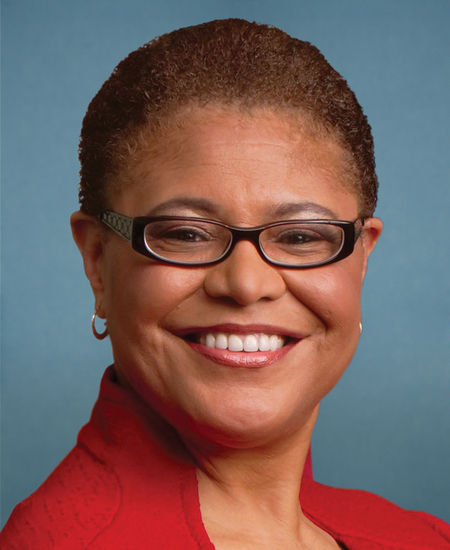
Rep. Karen Bass
Sponsored bills
Fairness in Airspace Includes Residents Act or the F-AIR Act This bill revises the priorities of the Federal Aviation Administration (FAA) in developing plans and policy for the use of navigable airspace. Specifically, the FAA must ensure (1) the safety of aircraft as a primary priority in developing such plans and policy; and (2) the minimization of the impact of aviation noise, and other health impacts, on residents and communities, and other impacts of the use of airspace on the environment as a secondary priority on an equal basis with the efficient use of airspace.
Notify Officials To Inform Fully and Impel Educated Decisions Act or the NOTIFIED Act This bill requires the Federal Aviation Administration to notify the public of any proposed new Performance Based Navigation flight procedure or flight procedure change affecting airspace at altitudes below 18,000 feet.
Responsive Employees Support Productive Educated Congressional Talk Act or the RESPECT Act This bill requires the Federal Aviation Administration (FAA) to respond in writing within 90 days to requests for data and information from Congress. Specifically, the FAA must respond if the data is within the control of the FAA; and the data would be otherwise appropriate to provide if requested by an airline, an airport, a flight procedure proponent, an Aviation Roundtable, or anyone not employed by the FAA, via a Freedom of Information request from any individual or any entity. The FAA must also provide staff at a private or public meeting with a Member of Congress if certain conditions are met.
Restore Everyone's Sleep Tonight Act of 2021 or the REST Act of 20 21 This bill authorizes an airport to impose an access restriction between the hours of 10 p.m. and 7 a.m. for aircrafts. An airport may impose a noise deterrence penalty on an air carrier or aircraft operator for a violation of the access restriction. The restriction does not apply to the operation of military, law enforcement, and U.S. Coast Guard flights.
This concurrent resolution recognizes the disparity in wages paid to Black women and its impact on women, families, and the nation, and reaffirms Congress' support for ensuring equal pay and closing the gender wage gap.
Equal Pay for Equal Work Act This bill establishes the National Equal Pay Enforcement Task Force to improve enforcement of equal pay laws.
Quiet Communities Act of 2021 This bill requires the Environmental Protection Agency to reestablish an Office of Noise Abatement and Control to promote the development of local noise control programs, carry out research, and develop and disseminate educational materials, among other duties.
Medical Device Nonvisual Accessibility Act of 2021 This bill requires certain medical devices with a digital interface to meet nonvisual accessibility standards established by the Food and Drug Administration (FDA). Specifically, the FDA must establish regulations to require a Class II or Class III medical device with a digital interface to provide a blind or low-vision user access to the same services and information, and generally the same ease of use, as provided to a user who is not low-vision or blind. (The FDA classifies medical devices in three classes. Class I devices are low-risk, Class II devices are moderate-risk, and Class III devices are high-risk.) A Class II or Class III medical device that does not meet the nonvisual accessibility standards established under this bill may not be sold.
Domestic Workers Bill of Rights Act This bill provides rights and protections for domestic workers (e.g., housekeepers, nannies, caretakers, personal assistants, and chauffeurs), including pay and leave rights, and health and safety protections. Specifically, the bill repeals the exemption of domestic live-in employees from certain minimum wage and maximum hour requirements. Employers must provide written notice of termination and provide at least 30 days of lodging and two weeks of severance pay to terminated live-in employees. Live-in employees also must be provided with reasonable access to telephone and internet service during their employment. The bill requires employers to provide domestic workers with a written agreement covering wages, sick leave, benefits, and other matters. Further, domestic workers may request and be granted changes to work schedules due to personal events. The bill also provides domestic workers with certain privacy rights, extends to domestic workers protections against discrimination in employment, and increases the federal medical assistance percentage (FMAP) for certain Medicaid-funded medical services provided by domestic workers. The Department of Labor must (1) award grants for a domestic worker national hotline for reporting emergencies, training on hazards facing domestic workers, and workforce investment activities for domestic workers; and (2) establish a Domestic Worker Wage and Standards Board to investigate standards in the domestic workers industry. Labor must publish online a document that describes the rights and protections for domestic workers under this bill.