

Help Extract Animals from Red Tape Act of 2021 or the HEART Act of 2021 This bill modifies notice requirements in a civil forfeiture proceeding that involves the seizure of an animal involved in animal fighting. Specifically, the government must notify interested parties of an animal's seizure within 30 days (currently, 60 days). The notice period may be extended only if a delay is warranted after considering certain factors, including the cost to the government of providing shelter for the animal, the health of the animal and the effect of a delay on its rehabilitation, any increased risk that a delay could necessitate the euthanasia of the animal, and any psychological harm incurred by the animal's owner due to the delay in disposition. Additionally, the bill authorizes amounts in the Department of Justice Assets Forfeiture Fund to be used to pay for costs associated with a seized animal, including transportation, shelter, care, veterinary services, and humane euthanasia.
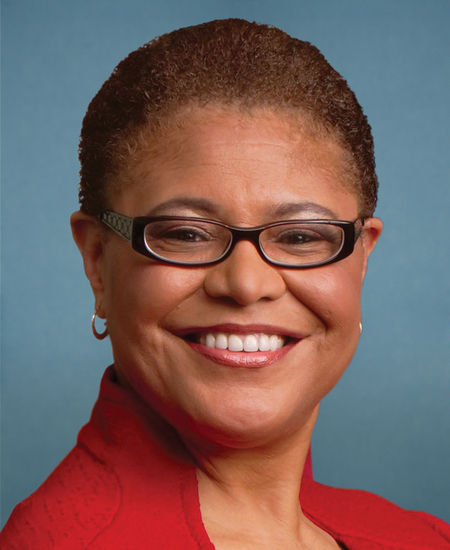
Rep. Karen Bass
Sponsored bills
PrEP Assistance Program Act This bill establishes a grant program to provide pre-exposure prophylaxis (PrEP) and related services to individuals at no cost. PrEP is medication given to individuals at risk of HIV to reduce their likelihood of contracting the virus. The Department of Health and Human Services must award the grants to state, tribal, and local governments; certain health clinics; and community-based organizations.
Outdoors for All Act This bill directs the Department of the Interior to establish an outdoor recreation legacy partnership grant program under which Interior may award grants to states, certain political subdivisions of a state, special purpose districts, Indian tribes, or Alaska Native or Native Hawaiian communities or organizations. Funds must be used for projects to (1) acquire land and water for parks and other outdoor recreation purposes in qualifying areas, and (2) develop new or renovate existing outdoor recreation facilities that provide outdoor recreation opportunities to the public in qualifying areas. A qualifying area is an area that has a population of 30,000 or more in the most recent census, or that is administered by an Indian tribe or an Alaska Native or Native Hawaiian community organization. Interior shall give priority to projects that create or significantly enhance access to park and recreational opportunities in an urban neighborhood or community, engage and empower underserved communities and youth, provide opportunities for employment or job training for youth or underserved communities, establish or expand public-private partnerships, and take advantage of coordination among various levels of government.
Cybersecurity Opportunity Act This bill requires the Department of Homeland Security to establish a grant program to promote cybersecurity training and education at institutions of higher education with an enrollment of needy students, historically Black colleges and universities, and minority-serving institutions.
Reconciliation in Place Names Act This bill directs the Department of the Interior to establish the Advisory Committee on Reconciliation in Place Names to advise the Board on Geographic Names with regard to renaming geographic features with offensive place names. The board shall rename a geographic feature with an offensive name in accordance with a recommendation of the committee unless the board determines that (1) there is a compelling reason and substantial public interest in rejecting the recommendation, or (2) approving the recommendation would violate federal law. The board shall accept or reject a recommendation within three years of receiving the recommendation.
This resolution expresses support for the designation of National Vitiligo Awareness Day. (Vitiligo is a chronic condition that results in the loss of pigment in patches on the skin, hair, eyes, and inside of the mouth; the condition may lead to discomfort, itching, and pain.)
Finding Orphan-disease Remedies With Antifungal Research and Development Act of 2021 or the FORWARD Act of 2021 This bill establishes programs to support research on endemic fungal diseases and the development of antifungal drugs, with a particular focus on Valley Fever. Endemic fungal diseases are fungal infections that tend to occur in specific geographic areas and affect older adults and other at-risk populations. Specifically, the bill establishes the Endemic Fungal Disease Working Group to review, coordinate, and make recommendations about the Department of Health and Human Services' efforts to address endemic fungal diseases. The working group is comprised of experts from both relevant federal agencies and the private sector. In addition, the National Institutes of Health must continue its support for research on endemic fungal diseases. Furthermore, the Food and Drug Administration must issue guidance for entities seeking approval for therapies, diagnostics, and vaccines to prevent and treat Valley Fever. Additionally, the bill provides for the use of priority reviews and other fast-track procedures to incentivize and expedite development and approval of these medical products. The bill also requires the Biomedical Advanced Research and Development Authority to implement the Combating Antimicrobial Resistance Biopharmaceutical Accelerator Program to reduce and prevent antimicrobial resistance.
This concurrent resolution objects to the slowdown in mail delivery instituted by the Postmaster General and urges that the decisions to slow down mail and increase postage rates be halted immediately pending further investigation and full substantiation by the Postmaster General to Congress.
Improving Mental Health and Wellness in Schools Act This bill requires local educational agencies (LEAs) participating in the school lunch or breakfast programs to include in their local school wellness policies (1) goals for mental health promotion and education, and (2) nutrition guidelines for reducing childhood eating disorders. Such LEAs must also include registered dietitians and school-based mental health services providers in the development, implementation, and periodic review of such policies. The bill also requires the Department of Agriculture to provide information and technical assistance to school health professionals (including school-based mental health services providers) for use in establishing healthy school environments. Such technical assistance must promote mental health, encourage mental health assessments, and establish resilient school environments.
Animal Freedom from Testing, Experiments, and Research Act of 2021 or the AFTER Act of 2021 This bill requires federal research facilities to facilitate the adoption or nonlaboratory placement of certain warm-blooded animals (e.g., dogs, cats, monkeys, guinea pigs, hamsters, and rabbits) with animal rescue organizations, animal sanctuaries, animal shelters, or individuals. In order to be adopted or placed, the animals must (1) no longer be needed for research; (2) be suitable for release; (3) not be birds, rats, or mice.