

Behavioral Health Crisis Services Expansion Act This bill establishes requirements, expands health insurance coverage, and directs other activities to support the provision of behavioral health crisis services along a continuum of care. Specifically, the Department of Health and Human Services (HHS) must establish standards for a behavioral health crisis continuum of care that health care providers and communities may use in responding to individuals experiencing a behavioral health crisis. This continuum of care must include 24-7 crisis hotlines, emergency treatment, stabilization services, and other specified components. In addition, the bill expands health insurance coverage for behavioral health crisis services. It also expands the Community Mental Health Services Block Grant to assist states and territories with developing the infrastructure to provide crisis response services. Furthermore, HHS, in consultation with the Department of Justice, must convene an expert panel to make recommendations concerning training for emergency services dispatchers and crisis call center personnel to respond appropriately to individuals experiencing a behavioral health crisis.
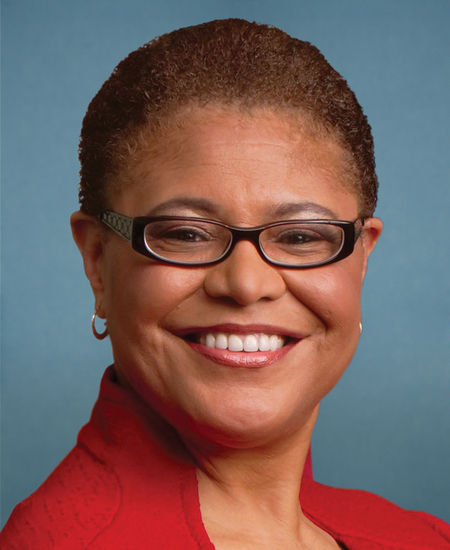
Rep. Karen Bass
Sponsored bills
This resolution expresses that the House of Representatives applauds the Biden administration for reaffirming the U.S. commitment to the Paris Agreement on climate change and to our collective responsibility to globally combat climate change; encourages the Biden administration to implement measures to ensure global climate change remains a top priority for this and future administrations and to cement the United States as a global leader in the fight to mitigate its most severe consequences; voices strong commitment as legislators toward achieving the climate goals of the Paris Agreement, fulfilling the forthcoming pledges from the COP26 in Glasgow, Scotland, and advancing other international efforts to keep global warming to no more than 1.5 degrees Celsius and realize global net-zero carbon emissions by 2050 using a whole-of-government approach; and recognizes the critical responsibility of the United States and other developed nations to ensure all societies have the capabilities to transition to a clean energy economy, the resources to protect against climate-induced disasters, and the necessary assistance to endure climate-related challenges to food security, regional migration, and public health.
Cady Housh and Gemesha Thomas Student Suicide Prevention Act of 2021 This bill reauthorizes through FY2028, and otherwise revises, grants administered by the Substance Abuse and Mental Health Services Administration (SAMHSA) to support youth suicide early-intervention and prevention strategies. Specifically, the bill requires SAMHSA to award a portion of such grants for statewide training programs on emotional well-being, mental health, and suicide awareness and prevention for elementary and secondary school students and staff.
Continued State Flexibility To Assist Older Foster Youth Act This bill temporarily extends certain flexibilities for states to assist older youth in foster care during the COVID-19 pandemic. This includes expanding through FY2022 eligibility for services until a child reaches age 27 and suspending until December 31, 2021, certain education and training requirements.
Young African Leaders Initiative Act of 2021 or the YALI Act of 2021 This bill provides statutory authority for the Young African Leaders Initiative (YALI), which seeks to build the capacity of young African leaders in sub-Saharan Africa in the areas of business, civic engagement, or public administration. The YALI program must support the participation of fellows from Africa in the Mandela Washington Fellowships for Young African Leaders and offer training through regional leadership centers in sub-Saharan Africa to individuals who have demonstrated strong capabilities in entrepreneurship, innovation, public service and leadership, and peace building and conflict resolution. The Department of State must oversee all U.S.-based activities carried out under the program, and the United States should continue to support program initiatives in sub-Saharan Africa. The State Department must also submit a plan for implementing the program and annual reports on program progress and recommendations for improvements or changes to the program.
Social Security 2100: A Sacred Trust This bill makes changes to Social Security benefits, taxes, and other aspects of the program, including by raising the primary insurance amount, increasing the maximum taxable earnings that are subject to Social Security payroll taxes, and requiring Social Security account statements to be mailed unless the individual recipient opts for electronic delivery.
Equitable Health Care for All Act This bill prohibits discrimination in health care based on race, religion, and other characteristics. It also revises reporting requirements, adds equity-related measures to certain Medicare programs, and makes other changes to reduce health disparities. To enforce the prohibition, the Department of Health and Human Services (HHS) must establish an administrative process to resolve complaints about inequitable health care. HHS must investigate these complaints and mediate agreements to resolve issues. In the event of noncompliance with a mediated agreement, an aggrieved individual may bring a civil action. Health care providers must also report data in formats that allow disaggregation by demographic factors. HHS must issue proposed regulations to carry out this requirement within 90 days. Additionally, the Centers for Medicare & Medicaid Services (CMS) must include measures related to equitable health care in the Medicare value-based purchasing program for hospitals. This program provides incentive payments based on quality of care. The CMS may also exclude providers that furnish inequitable health care from its programs. In addition, the bill establishes the Federal Health Equity Commission to monitor implementation of the bill and establishes a grant program for hospitals to promote equitable health care.
Original National Domestic Violence Awareness Month Resolution of 2021 This resolution supports the goals and ideals of National Domestic Violence Awareness Month. Further, it expresses the sense of the House of Representatives that Congress should continue to raise awareness of and support programs to end domestic violence.
Public Service Freedom to Negotiate Act of 20 21 This bill provides minimum collective bargaining rights and procedures for public employees and prohibits strikes by certain public safety workers. The Federal Labor Relations Authority (FLRA) shall determine for each state whether the laws of such state substantially provide for each of the minimum standard collective bargaining rights and procedures specified by this bill, including the right of public employees and supervisory employees to self-organize, form or join a labor organization, or collectively bargain. The FLRA must issue rules and take actions to establish and administer bargaining rights and procedures for those states that do not substantially provide for them. No employers, emergency services employees, or law enforcement officers may engage in a lockout, strike, or any other organized job action that is likely to result in a measurable disruption of the delivery of emergency or public safety services. Furthermore, no labor organization may be the cause of a violation of such prohibition.
Samier Amer Foster Care Improvement Act of 2021 This bill revises notification requirements that are triggered when states decide to remove a child from the custody of the child's parent(s) and to place the child in another home. Specifically, states must provide notice of the decision to each relative who expressed an interest in caring for the child, the guardian of the child, the guardian ad litem for the child, the attorney for the child, the attorney for each parent of the child, the child (if the child is able to express an opinion regarding placement), and the prosecutor involved. The notice must be provided within 90 days after the state makes a placement decision. States must establish procedures to (1) allow an individual who receives such a notice to request documentation of the reasons for the decision involved, (2) allow the attorney for the child to petition the court involved to review the decision, and (3) require the court to commence a review after receiving a petition.