

Maddy summaryHR 1060 designates the United States Postal Service facility at 1663 East Date Place in San Bernardino, California, as the "Dr. Margaret B. Hill Post Office Building." The bill updates all federal references - such as in laws, maps, regulations, and official documents - to use this new name for the building. This is a procedural designation with no policy changes or direct impact on residents or services. The bill was passed by Congress and signed into law on November 25, 2024.
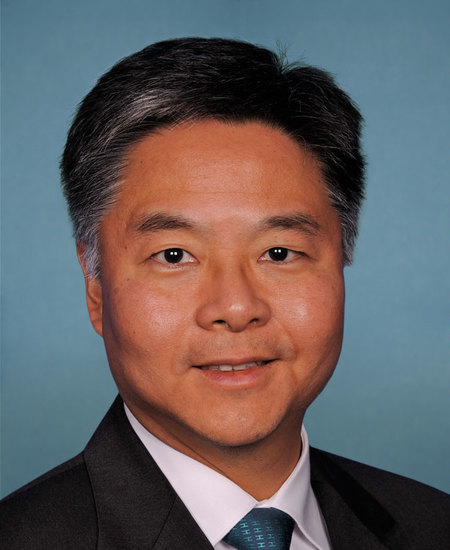
Rep. Ted Lieu
Sponsored bills
Maddy summaryThe Working Dog Commemorative Coin Act (HR 807) directs the U.S. Treasury to mint three types of commemorative coins honoring working dogs' service: $5 gold coins, $1 silver coins, and half-dollar coins with specific weight and composition requirements. Each coin will carry a surcharge ($35 for $5 coins, $10 for $1 coins, $5 for half-dollars) that will be paid directly to America's VetDogs to support their programs providing service dogs for veterans, the disabled, and others. The coins will be issued in 2027 with designs reflecting working dogs' roles in military, detection, therapy, and assistance work. The legislation specifies that all surcharge revenue must fund America's VetDogs' operations without creating new government programs. This is a commemorative measure focused on honoring working dogs' contributions through coin sales, with all surcharge funds going to a specific nonprofit organization.
Maddy summaryThis bill redesignates a United States Postal Service facility at 3500 West 6th Street, Suite 103 in Los Angeles, California, as the "Dosan Ahn Chang Ho Post Office." It directly affects the postal service location by changing its official name to honor Dosan Ahn Chang Ho, a Korean independence activist and community leader. The bill amends prior legislation to update references to the facility’s address and name in all federal records and documents. This is a ceremonial naming resolution with no policy changes to postal services or operations.
Maddy summaryThe Our Homes, Our Votes Act requires landlords and public housing agencies managing federally assisted housing (including public housing, Section 8, and supportive housing programs) to include voter registration forms in lease agreements. When tenants sign their lease, it automatically serves as a voter registration application for federal elections, unless they opt out. Landlords must ensure forms include basic eligibility information, provide language access for limited-English speakers, and submit completed forms to election officials within 10 days. This applies to all tenants in covered housing units, streamlining registration without requiring separate action.
Maddy summaryHRES 1588 is a House resolution supporting Transgender Day of Remembrance (TDoR) by recognizing the epidemic of violence against transgender people and memorializing those killed between October 1, 2023, and September 30, 2024. It specifically honors 38 transgender or gender-nonconforming individuals whose lives were lost to violence during that period, highlighting that transgender women of color face disproportionate risks. The resolution acknowledges systemic issues like underreporting, barriers to healthcare, and higher rates of homelessness and suicide within the community. It calls for the U.S. government to prioritize solutions to this violence while affirming transgender people's right to dignity and safety. As a symbolic resolution, it does not create new laws or policies but formally recognizes these issues for congressional record.
Maddy summaryHR 10165, the Security Clearance Review Act, requires the FBI Director to approve security clearances and access to classified information for political appointees working in the Executive Office of the President. It prohibits such appointees from holding clearances or accessing classified information without the FBI Director’s explicit authorization. If the FBI denies clearance, the Director must immediately notify the President and Congress. If the President overrides this denial, they must provide a written explanation to Congress within 30 days. The bill directly affects political appointees in the White House and establishes new oversight steps for security clearance decisions.
Maddy summaryThis bill prohibits Medicaid from covering conversion therapy for any enrollee. It amends federal law to block Medicaid payments for any therapy aimed at changing a person's sexual orientation or gender identity (defined as "conversion therapy" in the bill), starting in the first full quarter after the law takes effect. The prohibition applies to all Medicaid providers who offer such therapy for compensation, but explicitly excludes support for gender transition, acceptance-based care, and interventions focused on safety or unlawful conduct. It directly affects Medicaid recipients seeking therapy and providers who previously billed for conversion therapy services.
Maddy summaryThis bill increases the cap on project-based housing assistance units from 20% to 30% of a public housing agency's inventory under the Housing Act of 1937. It specifically allows agencies to use these units for homeless individuals and families, requiring Secretary approval for additional units beyond the standard limit. The Secretary of Housing and Urban Development must issue implementing rules within 90 days of enactment, with the changes taking effect in the first fiscal year after the bill passes. The legislation directly affects public housing agencies managing federally assisted housing, expanding their capacity to serve homeless populations through modified funding rules.
Maddy summaryThe AI Fraud Deterrence Act increases penalties for financial fraud committed using artificial intelligence. It amends key laws (mail fraud, wire fraud, bank fraud, and money laundering) to add specific fines of up to $1 million or 20-30 years in prison when AI assists in these crimes. The bill defines "artificial intelligence" using the existing 2020 National AI Initiative Act definition. This directly affects individuals or entities committing financial fraud with AI tools, raising legal consequences for such actions.
Maddy summaryThe PROVIDE Act creates a new priority processing category for veterans whose disability claims are impacted by major disasters (like fires or floods) where the President has declared a federal emergency. It requires the VA to establish regulations that automatically include veterans living in declared disaster zones among those eligible for expedited claim handling, alongside existing categories like homelessness or terminal illness. The bill also mandates flexible evidence requirements and extended filing deadlines for veterans unable to meet standard documentation due to the disaster. This policy change directly affects veterans in disaster-affected areas by streamlining access to disability benefits during recovery. The VA must post these eligibility details on its website within 60 days of the bill's enactment.