This resolution condemns the actions taken by the governments of China and Hong Kong to put in place national security legislation that violates the freedoms and rights guaranteed to the people of Hong Kong. (Hong Kong is a part of China but, by agreement, has operated a legal and economic system largely separate from China's.)
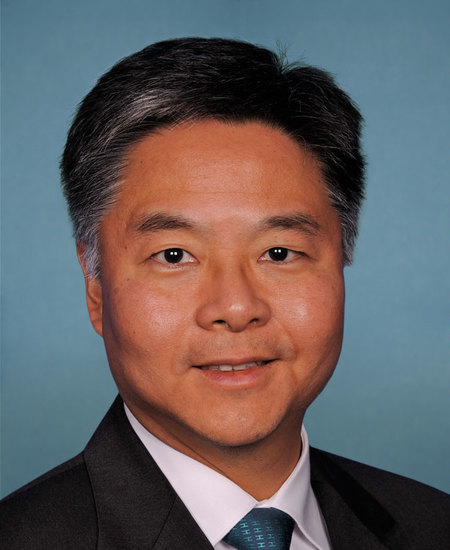
Rep. Ted Lieu
Sponsored bills
Green New Deal for Public Housing Act This bill addresses energy efficiency and workforce development in the context of public housing. Specifically, the Department of Housing and Urban Development (HUD) must award grants to public housing agencies (PHAs) and other eligible entities under a variety of new programs, including programs for facilitating workforce development and high-income employment transition; conducting physical needs assessments and subsequent energy efficiency retrofits; and making upgrades, replacements, and improvements for energy efficiency, building electrification, and water quality upgrades. Recipients of these grants must provide relocation assistance for residents who are displaced during construction and must ensure that they can return to their homes once retrofitting is completed. A certain percentage of the employment positions generated by these grant programs and other specified federal grant programs must be filled by low-income individuals, and a specified percentage of certain contracts associated with these programs must be awarded to businesses owned by residents of public housing. The bill also repeals a provision that prohibits a PHA from using HUD funds to construct or operate new public housing units if doing so would result in the PHA owning or operating more units than it did on October 1, 1999.
Increasing Behavioral Health Treatment Act This bill repeals restrictions that generally prohibit federal payment under Medicaid for services provided in institutions for mental diseases (IMDs) for individuals under the age of 65. (Currently, states may receive payment for such services through certain mechanisms, such as through a Medicaid demonstration waiver.) The bill also requires state Medicaid programs that cover IMD services to improve patient access to outpatient and community-based behavioral health care, expand crisis stabilization services, facilitate care coordination between providers and first responders, and report specified information relating to IMD utilization and costs.
Workplace Violence Prevention for Health Care and Social Service Workers Act This bill requires the Department of Labor to address workplace violence in health care, social service, and other sectors. Specifically, Labor must issue an interim occupational safety and health standard that requires certain employers to take actions to protect workers and other personnel from workplace violence. The standard applies to employers in the health care sector, in the social service sector, and in sectors that conduct activities similar to those in the health care and social service sectors. In addition, Labor must promulgate a final standard within a specified time line.
FDA Modernization Act of 2021 This bill allows an applicant for market approval for a new drug to use methods other than animal testing to establish the drug's safety and effectiveness. Under this bill, these alternative methods may include cell-based assays, organ chips and microphysiological systems, sophisticated computer modeling, and other human biology-based test methods.
This bill establishes that it is U.S. policy to not use nuclear weapons first.
Fire Fighters and EMS Employer-Employee Cooperation Act This bill requires the Federal Labor Relations Authority to determine whether a state substantially provides fire and emergency medical services (EMS) personnel the right to form and join a labor organization; recognition by fire and EMS employers of the employees' labor organization, agreement to bargain with the organization, and reduction of any agreements to writing in a contract or memorandum of understanding; the right to bargain over hours, wages, and terms and conditions of employment; and arbitration or other mechanisms to resolve an impasse in collective bargaining negotiations. The bill makes the authority responsible for (1) determining the appropriateness of units for labor representation; (2) supervising elections; (3) conducting hearings and resolving complaints of unfair labor practices; and (4) protecting the right of employees to form, join, or assist any labor organization, or to refrain from doing so. An employer, fire and EMS personnel, or labor organization may not engage in a lockout, sickout, work slowdown, strike, or any other organized job action that will measurably disrupt the delivery of emergency services and is designed to compel an employer, fire and EMS personnel, or labor organization to agree to the terms of a proposed contract.

Tax Fairness for Workers Act This bill allows an above-the-line tax deduction for union dues and expenses. (An above-the-line deduction is subtracted from gross income and is available whether or not a taxpayer itemizes other deductions.) The bill also reinstates the miscellaneous itemized tax deduction for unreimbursed expenses attributable to the performance of services as an employee (Under current law, all miscellaneous itemized deductions are suspended through 2025).
Affordable Housing Credit Improvement Act of 2021 This bill revises provisions of the low-income housing tax credit and renames it as the affordable housing credit . The bill increases the per capita dollar amount of the credit and its minimum ceiling amount beginning in 2021 and extends the inflation adjustment for such amounts. The bill modifies tenant income eligibility requirements and the average income formula for determining such income. It also revises rules for student occupancy of rental units and tenant voucher payments, and prohibits any refusal to rent to victims of domestic abuse. The bill further modifies the credit to increase state allocations of the credit; repeal the qualified census tract population cap; prohibit local approval and contribution requirements; increase the credit for certain projects designated to serve extremely low-income households; increase the credit for certain bond-financed projects designated by state agencies; eliminate the basis reduction for properties that receive certain energy-related tax benefits; and increase the population cap for difficult development areas (i.e., areas with high construction, land, and utility costs relative to area median gross income). The bill also includes Indian and rural areas as difficult development areas and modifies other requirements relating to casualty losses, acquisition credits, and foreclosures.
For the 99.5 Percent Act This bill imposes increased tax rates on decedent estates, gifts, and generation-skipping transfers. Estates with a value of over $1 billion are taxed at a 65% tax rate. The basic exclusion amount is reduced to $3.5 million. The bill increases (1) to $3 million the reduction in valuations of farmland for estate tax purposes and adjusts such increased amount for inflation, and (2) to $2 million the maximum estate tax exclusion for contributions of conservation easements. It also increases to 60% the applicable percentage for such exclusion. The bill requires (1) consistent basis reporting for property acquired by gift and transfers in trust, and (2) executors of estates and donors of gifts required to file a gift tax return to disclose to the Department of the Treasury, and to recipients of any interest in an estate or a gift, information identifying the value of each interest received. The bill sets forth estate valuation rules for certain transfers of nonbusiness assets and limits estate tax discounts for certain individuals with minority interests in a business acquired from a decedent. The bill expands rules for valuing assets in grantor retained annuity trusts to require that (1) the right to receive fixed amounts from an annuity last for a term of not less than 10 years and not more than the life expectancy of the annuitant plus 10 years, and that such fixed amounts not decrease during the first 10 years of the annuity term, and (2) the remainder interest have a value when transferred that is not less than the the greater of 25% of the fair market value of the trust property or $500,000. The bill also sets forth rules for the application of transfer taxes to a grantor trust (a trust in which the grantor retains control over the trust assets and has the right to receive income from the trust). The bill eliminates the generation-skipping transfer tax exemption for any trust whose termination date is not greater than 50 years after its creation. The bill modifies the tax exclusion for annual gifts to eliminate the present interest requirement for such exclusion and to impose a new, aggregate per donor limit equal to twice the annual exclusion amount in effect for the taxable year.