

Ending Homelessness Act of 2021 This bill expands the housing choice voucher program and provides assistance to homeless individuals and families. Specifically, the bill provides FY2022-2025 funding for the expansion of the housing choice voucher program for certain extremely low income families. Furthermore, beginning in FY2026, the bill creates and funds an entitlement to housing choice vouchers for certain extremely low income families. Eligibility for the entitlement expands annually, extending to low-income families by FY2030. The bill also reduces the geographic area used to calculate an area's fair market rent for purposes of voucher payment standards and prohibits the use of criminal history in determining eligibility for certain housing assistance. Additionally, the bill prohibits housing discrimination on the basis of a renter's source of income or a renter's veteran status. The bill also provides additional FY2022-FY2026 funding for the Department of Housing and Urban Development (HUD) to assist the homeless, including to award emergency relief grants in jurisdictions with the highest need and award grants to provide outreach and coordinate services. Furthermore, the bill provides additional FY2022-FY2026 funding for the Housing Trust Fund, which provides affordable housing for extremely low-income and very low-income families. While this additional funding is available, HUD must ensure that priority for occupancy in assisted units is given to individuals and families who are homeless. Finally, the bill permanently reauthorizes certain homeless assistance grants and makes permanent the U.S. Interagency Council on Homelessness.
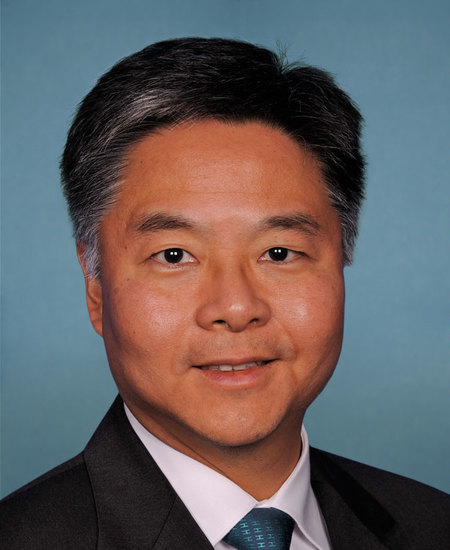
Rep. Ted Lieu
Sponsored bills
Housing is Infrastructure Act of 2021 This bill generally addresses housing affordability and infrastructure. The bill authorizes the Department of Housing and Urban Development (HUD) to provide grants, programs, and other support related to public housing, affordable housing preservation and construction, and mortgage access. The bill also establishes and funds the National Investment Authority (NIA) which must design, finance, and implement a strategy of long-term national economic growth and development. The NIA must select projects that coordinate investment of public and private capital in equitable, inclusive, and sustainable growth of the economy. Furthermore, the bill establishes the National Infrastructure Bank (NIB) to implement the strategy by engaging in credit market activities that support public and private investment in critical public infrastructure projects. The bill gives the NIA bond issuing authority and authorizes the Board of Governors of the Federal Reserve System to purchase these bonds. The Federal Reserve must lend funds on a short-term basis upon the request of the NIB and other subsidiaries. Additionally, the Department of the Treasury must provide for a line of credit not to exceed 100% of the NIA's total assets. Finally, the bill (1) authorizes HUD to provide support for fair housing organizations, and (2) requires consultation with a fair housing enforcement organization as part of an application for certain housing grants or funds.
Federal Bureau of Prisons Voting Assistance Act of 2021 This bill requires the Bureau of Prisons (BOP) to provide information about voting to inmates from jurisdictions that allow inmates to vote while in custody. Specifically, before a federal, state, or local election, the BOP must send inmates voting-related information, such as how to register to vote and how to request an absentee ballot. The BOP must send additional voting-related information to the reentry affairs coordinator at each federal correctional facility. The information must be provided in English and Spanish.
Repatriate Our Patriots Act This bill protects certain veterans of the Armed Forces from removal from the United States and provides such veterans with an expedited procedure for naturalization. The bill applies to special veterans , defined as persons who served in the active Armed Forces who were (1) honorably discharged or released; (2) not convicted of various crimes, including voluntary manslaughter, murder, rape, or terrorism; and (3) not a child abuser or pedophile. Special veterans shall not be removed from the United States, and the Department of Homeland Security (DHS) shall cancel any pending removal proceedings or orders against any such veterans. DHS shall establish a program to permit such veterans who were already removed from the United States to return to as an alien with permanent residence status. Special veterans shall be naturalized upon filing an application, paying the relevant fees, and taking an oath of allegiance. DHS shall take steps to ensure such naturalization applications are pending for no longer than 90 days.
Bankruptcy Venue Reform Act of 2021 This bill limits where a non-individual debtor (e.g., a corporate debtor) may file for bankruptcy. Specifically, these debtors must file in the district court for the district in which the principal place of business or principal assets of the debtor are located. Such a debtor may also file in a district where there is a pending bankruptcy case concerning an affiliate that has a certain level of control or ownership of the debtor (e.g., if the affiliate is a controlling shareholder of the debtor), if that pending case is in a proper venue under this bill. Under current law, these debtors may also file where they are domiciled (i.e., incorporated) or where there is a bankruptcy case pending concerning an affiliate, general partner, or partnership. For certain debtors who are issuers of securities, their principal place of business is defined in the bill as the address of the entity's principal executive office as provided in specified Securities and Exchange Commission filings.
Amend the Code for Marriage Equality Act of 2021 This bill amends the Internal Revenue Code, the Social Security Act (SSAct), and other federal laws to replace (1) references to wife or husband with references to spouse , and (2) references to husband and wife or husband or wife with references to married couple or married person. For purposes of federal laws or regulations, marriage is defined as a legal union between two people as spouses. The bill eliminates a definition of spouse that refers only to a person of the opposite sex who is a husband or a wife. Requirements concerning compensation to a surviving wife after the disability or death of a person employed at a military, air, or naval base outside the United States are revised to make surviving spouses eligible for such compensation. The bill makes similar revisions to the Family and Medical Leave Act of 1993 and the Federal Mine Safety and Health Act of 1977. The bill revises title II (Old Age, Survivors and Disability Insurance) of the SSAct to consolidate separate provisions for a wife's insurance benefits and a husband's insurance benefits into a single standard for a spouse's insurance benefits. Criminal penalties that currently apply to persons who threaten to kill, kidnap, or inflict bodily harm upon a former President's wife or widow are revised to apply to threats made to a former President's spouse or surviving spouse.
Preventing Election Subversion Act of 2021 This bill establishes certain federal criminal offenses related to voting and sets forth additional requirements for federal elections. The bill makes it a crime to (1) intimidate, threaten, coerce, or harass an election worker (i.e., an election official, a poll worker, or an election volunteer) with the intent to interfere with the official duties of, or retaliate against, the worker; or (2) publicly disclose restricted personal information about an election worker or an immediate family member with the intent to threaten or cause harm to the worker or the family member. In addition, the bill restricts the ability of a statewide election administrator to remove a local election administrator. A statewide election administrator may suspend, remove, or relieve the duties of a local election administrator only for inefficiency, neglect of duty, or malfeasance while in office. Further, the bill establishes certain requirements for challenging an individual's eligibility to register to vote or vote in federal elections. The bill also sets a minimum distance for poll observers.
Study To Observe and Prevent (STOP) Human Trafficking Act of 2021 This bill directs the Department of Justice, in coordination with the President's Interagency Task Force to Monitor and Combat Trafficking in Persons, to study and report on the prevalence and instances of human trafficking at adult entertainment clubs in the United States.
Disarm Hate Act The bill expands the categories of persons who are prohibited from receiving or possessing a firearm. Specifically, it prohibits firearm sale or transfer to and receipt, possession, shipment, or transport by a person (1) who has been convicted of a misdemeanor hate crime, or (2) who has received an enhanced hate crime misdemeanor sentence.
Support and Defend Our Military Personnel and Their Families Act This bill provides immigration-related benefits and protections for certain Armed Forces veterans. Any person who has served under honorable conditions as a member of the Armed Forces in support of contingency operations shall be eligible for naturalization as if the person had served during a period of presidentially designated military hostilities. (Contingency operations are operations where Armed Forces members are or may become involved in military actions, operations, or hostilities, or that result in the call to active duty.) The bill also extends the period for filing a naturalization application from six months to one year after completing eligible military service. An alien eligible for a family-sponsored visa and is either the spouse or child of a permanent resident alien serving in the Armed Forces shall be exempt from worldwide visa numerical limitations. The Department of Homeland Security (DHS) may adjust to permanent resident status an alien who is a parent, spouse, adult or minor child, or minor sibling of a person who has served in the Armed Forces under honorable conditions. DHS must give prior approval before a notice to appear in a removal proceeding may be issued against an alien veteran who has served honorably. Before giving such approval, DHS shall consider factors such as the alien's record of service and any hardship to the Armed Forces or the alien or family members if placed in removal proceedings. Such an alien may not be removed based on certain grounds of inadmissibility or a prior order of removal.