

Bringing an End to Harassment by Enhancing Accountability and Rejecting Discrimination in the Workplace Act or the BE HEARD in the Workplace Act This bill expands protections against discrimination and harassment in the workplace and raises the minimum wage for tipped employees. Specifically, the bill (1) makes it an unlawful employment practice to discriminate against an individual in the workplace based on sexual orientation, gender identity, pregnancy, childbirth, a medical condition related to pregnancy or childbirth, or a sex stereotype; and (2) provides a statutory definition for what constitutes workplace harassment. Further, these protections apply to all workplaces, regardless of size, and to all workers, including independent contractors, interns, volunteers, and trainees. The bill prohibits employers from entering into contracts or agreements with workers that contain certain nondisparagement or nondisclosure clauses and prohibits certain predispute arbitration agreements and postdispute agreements. It also establishes grant programs to (1) prevent and respond to workplace discrimination and harassment, (2) provide legal assistance for low-income workers, and (3) establish a system of legal advocacy in states to protect the rights of workers. The bill further provides employees the right to retain their tips and it increases, in specified annual increments, the minimum wage for tipped employees to match the federal minimum wage for nontipped employees. Additionally, the bill requires the Equal Employment Opportunity Commission to provide specified training and resource materials, establish and convene a harassment prevention task force, and establish an Office of Education and Outreach with regard to prohibited discrimination and harassment in employment. The bill also requires specified studies, reports, and research on prohibited workplace harassment.
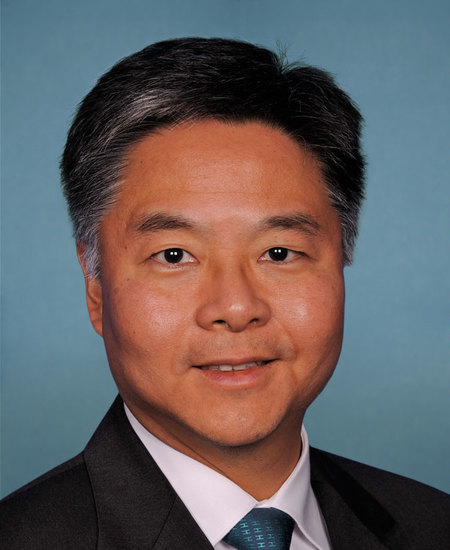
Rep. Ted Lieu
Sponsored bills
Prison Camera Reform Act of 2021 This bill establishes various requirements to ensure that the security camera, radio, and public address systems used by the Bureau of Prisons (BOP) have the capabilities necessary to (1) ensure the health and safety of staff and inmates; and (2) ensure the documentation and accessibility of video evidence pertaining to misconduct, maltreatment, or criminal activity within correctional facilities. Among the requirements, the BOP must evaluate the systems currently in use at its facilities and implement a plan that addresses deficiencies in and makes upgrades to the systems.
Private Prison Information Act of 2021 This bill specifies that a record related to a nonfederal prison, correctional, or detention facility must be considered a federal agency record for purposes of the Freedom of Information Act (FOIA). A nonfederal prison, correctional, or detention facility must disclose information under FOIA unless the information is exempt from disclosure or the disclosure is prohibited by law. The term nonfederal prison, correctional, or detention facility means (1) a private prison, correctional, or detention facility; or (2) a state or local prison, jail, or other correctional or detention facility.
National Response to Exploitation and Sexual abuse of Children in Unaddressed Emergencies Act or the Child RESCUE Act This bill directs the Department of Justice to establish a national working group—the United States Working Group on Children in Imminent Danger—to study policing strategies and resource needs to rescue children who are victims of child sexual abuse material or victims of sexual abuse involving child sexual abuse material. The working group must report to Congress on its findings and conclusions, as well as recommendations for legislation.
End Gun Violence Act of 2021 This bill prohibits the sale or disposition of a firearm or ammunition to a person who has been convicted in any court of a violent misdemeanor within the preceding five years.
Customer Non-Discrimination Act This bill prohibits discrimination based on sex, sexual orientation, and gender identity with respect to public accommodations and facilities. Specifically, the bill defines and includes sex, sexual orientation, and gender identity among the prohibited categories of discrimination or segregation. The bill expands the definition of public accommodations to include places or establishments that provide (1) exhibitions, recreation, exercise, amusement, gatherings, or displays; (2) goods, services, or programs; and (3) transportation services. Protections against discrimination based on race, color, religion, sex, sexual orientation, gender identity, or national origin shall include protections against discrimination based on (1) an association with another person who is a member of such a protected class; or (2) a perception or belief, even if inaccurate, that an individual is a member of such a protected class. The bill prohibits the Religious Freedom Restoration Act of 1993 from providing a claim, defense, or basis for challenging such protections. The bill prohibits an individual from being denied access to a shared facility, including a restroom, a locker room, and a dressing room, that is in accordance with the individual's gender identity. The bill also prohibits the provision of less favorable treatment with respect to pregnancy, childbirth or related medical conditions as compared to other physical conditions.
Preventing Vigilante Stalking that Stops Women's Access to Healthcare and Abortion Rights Act of 2021 This bill increases the maximum prison term for a stalking offense, if the offense is committed with the intent to obtain health care information of an individual or to prevent the health care decisions of an individual.
Firearms Retailer Code of Conduct Act of 2021 This bill establishes requirements for federal firearms licensees (e.g., gun dealers) and their employees regarding certain business practices, training, and certification. It also prohibits licensees from transferring firearms to certain individuals, including straw purchasers, gun traffickers, intoxicated individuals, or individuals at risk of harming themselves or others.
Stop Wall Street Looting Act This bill generally revises provisions related to the regulation of private equity funds. Among other things, the bill increases financial and legal liability for these funds in the event of certain violations of law, gives employee compensation higher priority in bankruptcies, and generally prohibits the payment of dividends for two years from an acquired asset firm to a private equity fund. The bill modifies the tax treatment of carried interest—compensation that is typically received by a partner of a private equity fund and is based on a share of the fund's profits. (Under current law, carried interest is taxed as investment income rather than at ordinary income tax rates.) Among other things, the bill treats as ordinary income the net capital gain with respect to a private equity fund.
Reimagining Asylum Processing Act of 2021 This bill modifies the processing of asylum seekers, including by establishing humanitarian processing centers along the southern border. The Department of Homeland Security must establish at least five humanitarian processing centers to process adult asylum seekers who arrive at the southern border and did not arrive as part of a family unit with minor children. The bill imposes certain requirements on these processing centers, including by (1) requiring a rest period of at least 72 hours from the asylum seeker's arrival before an asylum officer may conduct an interview to determine whether there is a credible fear of persecution, (2) limiting an asylum seeker's detention at a processing center to no longer than 15 days, (3) requiring the processing center to provide legal counsel and interpreters, and (4) requiring that appropriate nongovernmental organizations are authorized to monitor the processing centers for human rights abuses. The bill also changes the processing of asylum seekers generally, including by (1) removing provisions requiring the mandatory detention of an asylum seeker after the credible fear interview; (2) prohibiting the use of information obtained from the interview for immigration enforcement; and (3) requiring an asylum officer conducting the interview to consider whether an asylum seeker is eligible for other forms of relief, such as special immigrant juvenile status.